Rapid Prototype CNC Machining – EDM/Wire Cutting for Tooling
Date:2026-07-14Article editor:Starting Point PrecisionViews:281For product engineers and toolmakers, rapid prototype CNC machining is the gold standard for validating form, fit, and function. Yet, a critical challenge emerges when the prototype involves a complex mold core, a deep cavity, or intricate features in hardened steel. Standard CNC milling, even with advanced multi-axis capability, often cannot produce sharp internal corners, deep narrow ribs, or delicate geometrical details without risking tool breakage or excessive wear. This is where the complementary processes of Electrical Discharge Machining (EDM) and Wire Cutting (Wire EDM) become indispensable, particularly for creating the tooling necessary to manufacture these prototypes.
In the context of rapid prototype CNC machining, EDM and wire cutting are not used to shape the final plastic or metal part directly. Instead, they excel at manufacturing the tooling components—specifically, the electrodes and die details—that enable the primary CNC machining to achieve its highest potential.
◆ EDM (Sinker EDM): This process uses a precisely machined electrode, often crafted from graphite or copper, to erode material from a workpiece via a series of rapid, controlled electrical discharges. Its unique advantage is the ability to produce complex, three-dimensional shapes with exceptional sharp internal corners, deep ribs, and fine surface finishes, which are impossible for standard end mills. For rapid tooling, EDM is the go-to solution for creating intricate mold cavities, core details, and challenging features in hardened tool steels (up to 60 HRC).
◆ Wire EDM (Wire Electrical Discharge Machining): This variant uses a thin, continuously moving brass or coated wire as an electrode to cut through conductive materials. It excels at producing precise 2D and 3D contours, such as extrusion dies, punch-and-die sets, and precise internal splines or gear forms. The wire never contacts the workpiece, eliminating mechanical stress and allowing for the machining of delicate, thin-walled features with minimal distortion.
Achieving success with these processes requires sophisticated equipment and strict parameter control. The necessary precision is a cornerstone of effective rapid prototype CNC machining. Our facility utilizes top-tier Japanese machinery to ensure unparalleled accuracy and surface finish for every prototype tooling project.
| Process & Equipment Type | Model / Specification | Core Capabilities & Parameters | Typical Application in Prototype Tooling |
| Wire EDM (Slow Wire Cut) | Japan Seibu M50B | Max. workpiece thickness: 200mm; Machining accuracy: ±0.003mm; Max. taper angle: ±15° | Precision stamping dies, extrusion dies, complex 2D/3D contours, and internal splines for prototype gears. |
| Wire EDM (Slow Wire Cut) | Japan Sodick ALN400Gs | Linear motor drive system; Surface roughness: Ra ≤ 0.2µm; Max. workpiece size: 600 x 400mm | High-accuracy thin-wall components, micro-gear prototypes, and surgical tool profiles requiring a flawless surface finish. |
| CNC Sinker EDM | Japan MAKINO EDGE3 | Micro-machining capability; Precise spark gap control; Mirror-like surface finish (Ra < 0.1µm) | Intricate injection mold cavities, sharp internal corners, and fine 3D rib details in complex electrode burning operations. |
| CNC Sinker EDM | Japan Sodick AD30Ls | High-response servo control; Standard C-axis rotation; Machining accuracy: ±0.005mm | Large/ deep cavity mold inserts, multi-cavity complex die steel machining, and high-hardness tool steel components. |
For a complete overview of our manufacturing capabilities, please refer to the Precision Equipment List on our official website.
To visualize how EDM and wire cutting integrate into the overall rapid prototype CNC machining workflow, consider the following process diagram:
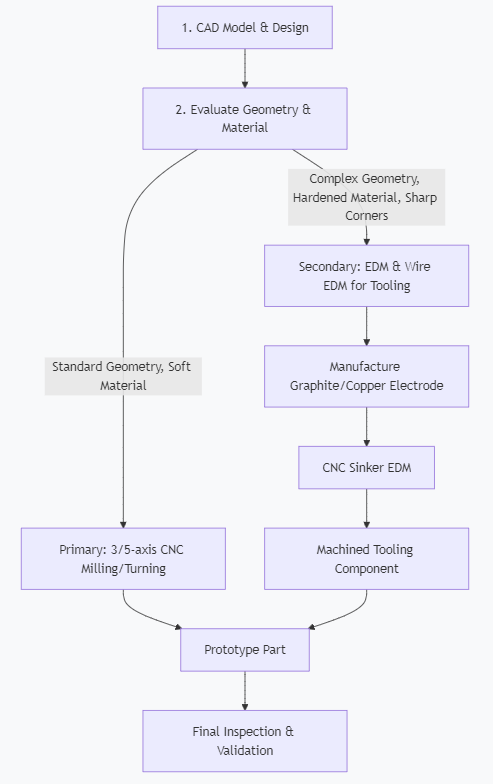
This workflow ensures that geometry dictates the manufacturing strategy, enabling a flexible and responsive approach to rapid prototype CNC machining.
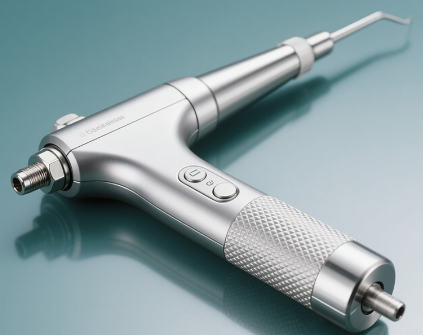
A medical device company needed to validate a new surgical tool handle, designed with an ergonomic, complex curved internal cavity and sharp, non-continuous cooling fins in a pre-hardened stainless steel (17-4 PH). Traditional CNC milling would have required multiple setups, custom-formed tools, and extensive polishing to achieve the required 0.8µm surface finish inside the cavity, a process estimated to take 12 weeks.
By leveraging a combined rapid prototype CNC machining strategy, the project was redesigned:
1. A graphite electrode was milled on a 5-axis CNC, replicating the intricate cavity geometry.
2. The cavity was then "burned" into the hard steel block using the Japan MAKINO EDGE3 Sinker EDM, achieving perfect sharp internal corners and an exceptional mirror-like surface finish in a single operation.
3. Simultaneously, the external cooling fins were created using the Japan Sodick ALN400Gs Wire EDM to precision-cut the narrow, closed slots around the handle's circumference with zero mechanical stress.
The result was a fully functional, high-precision metal prototype delivered in just 4 weeks, meeting all mechanical and aesthetic validation criteria ahead of schedule.
In summary, while CNC milling is the workhorse of rapid prototype CNC machining, EDM and wire cutting are the specialized craftsmen that unlock the door to complex tooling. They provide the unique capability to create the very tools—electrodes, mold inserts, dies—that make prototyping the most difficult geometries possible. Integrating these electrical discharge technologies into your rapid manufacturing strategy ensures that challenging designs are not a roadblock, but an opportunity for precision innovation.
Are you ready to move past the limitations of conventional machining? Upload your 3D CAD drawing now to receive an instant, competitive quote for your complex electrode or tooling prototype.
1. What is the key difference between CNC milling and EDM in prototyping?
CNC milling is a subtractive process that uses mechanical force to cut material, ideal for simple to moderately complex geometries in softer materials. EDM is an electrical erosion process that uses sparks to remove material, which is perfect for hard materials, complex 3D shapes, and achieving sharp internal corners without mechanical stress.
2. Can EDM be used for materials other than steel?
Yes, EDM and Wire EDM can machine any electrically conductive material. This includes hardened steels, titanium, superalloys (like Inconel), aluminum, copper, and graphite, making them highly versatile for rapid prototype CNC machining across aerospace, medical, and automotive sectors.
3. How does the accuracy of Wire EDM compare to standard machining?
Wire EDM is exceptionally accurate, typically achieving tolerances of ±0.003mm to ±0.005mm with specific machines like the Seibu M50B or Sodick ALN400Gs, which often surpasses the capabilities of standard CNC milling, especially on thin walls or when cutting complex internal profiles.
4. Is EDM or Wire EDM a suitable process for one-off prototypes or only for mass production?
Absolutely. EDM and Wire EDM are extremely cost-effective for one-off prototypes and small-batch production of complex tooling because they require no expensive hard tooling themselves. The setup is primarily focused on creating the electrode or programming the wire path, making them ideal for a rapid prototype CNC machining strategy.
Add: Building 3No.277 Zhen'an Middle Road, Chang'an Town,Dongguan,Guangdong, China
Tel:+86-769-82855591
Copyright © 2019 All Rights Reserved Dongguan Start Precision Technology Co., Ltd. Tel: +86-769-82855591
Add: No. 277 Zhen'an Middle Road, Chang'an Town, Dongguan, Guangdong, China



 中文版
中文版 English