Precision Brass Components with High Conductivity
Date:2026-07-18Article editor:Starting Point PrecisionViews:236High-current systems from EV battery packs to industrial switchgear depend on precision brass components with high conductivity to maintain efficiency and prevent thermal runaway. Even a small voltage drop across a terminal can generate enough heat to degrade insulation or accelerate oxidation. This makes material purity, contact interface quality, and physical geometry just as critical as the base alloy itself.
C11000 electrolytic tough pitch copper achieves a minimum of 101% IACS, making it the reference for low-resistance current paths . When designed into precision brass components as a bimetal insert or a solid-contact blade, it virtually eliminates the I²R losses that plague lower-grade brasses. The Copper Development Association notes that even a 2% drop in conductivity can raise the operating temperature of a 300 A connector by over 25°C under continuous load. For that reason, specifying C11000 in the high-current chain is not a luxury — it is a thermal necessity.
A connector may measure single-digit micro-ohms in the lab, yet degrade to milliohms in the field if the surface finish or clamping force is wrong. Contact resistance testing following the four-wire Kelvin method is therefore mandatory. In a typical qualification, a dry-circuit test limits voltage to 20 mV to avoid breaking through oxide films, giving a true picture of the contact interface. For precision brass components with high conductivity, we target values below 0.2 mΩ for bolted joints and under 1 mΩ for spring-loaded terminals, with a tolerance that stays stable across 1,000 thermal cycles.
Burrs are not just a handling hazard; they are a primary cause of micro-arcing, partial discharge, and fretting corrosion in high-voltage connectors. After Swiss-type CNC turning, components pass through an electrochemical deburring stage that removes rolled-over edges without changing critical dimensions. A radius of ≤0.05 mm on the current-carrying edge is maintained, and automated optical inspection captures any protruding filament larger than 30 µm. This level of burr control is essential for busbar stabs and blade terminals that must slide into mating contacts without shaving off conductive plating.
Plating often gets the spotlight, but the current-carrying cross-section, the number of contact points, and the shape of the lead-in chamfer have a much greater effect on ampacity. Finite element analysis shows that a well-designed multi-lam contact can reduce current density at the interface by 40% compared to a simple flat blade — all while staying within the same envelope. When this geometry is paired with C11000 inserts, the resulting precision brass components with high conductivity routinely sustain 400 A continuous with less than a 50°C rise above ambient, as verified by infrared thermography.
A distribution transformer manufacturer was experiencing repeated thermal alarms on the low-voltage bushings of 11 kV/415 V units. The original flat-brass terminals, tin-plated and simply punched, developed contact resistance values as high as 0.8 mΩ after only a few thermal cycles. By replacing them with C11000 copper terminals machined to a radiused contact face and a controlled bolt-landing zone — and by introducing an electrochemical deburring step to eliminate micro-edges — the design team drove the average joint resistance down to 0.15 mΩ. A 100% Kelvin-resistance verification was integrated into the production line, and torque-controlled assembly ensured repeatable clamping force. Over a 14-month field observation, peak bushing temperatures dropped by 28°C, and zero over-temperature incidents were recorded. The upgrade not only resolved the thermal issue but also extended the maintenance interval of the entire transformer assembly.
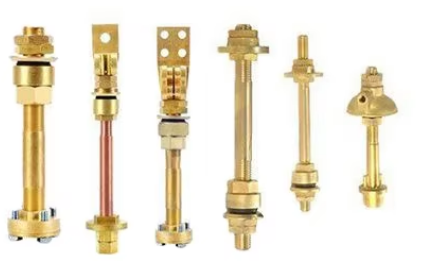
For engineers looking to replicate such results, it is important to partner with a manufacturer that controls every variable from raw material to final inspection. Start Precision combines in-house C11000 sourcing, automated burr control, and full-contact resistance testing to deliver precision brass components with high conductivity that perform reliably under demanding electrical loads.
Contact us to discuss your manufacturing requirements.
Frequently Asked Questions
Q1: What is the typical conductivity of C11000 copper, and how does it compare to brass?
C11000 copper reaches ≥101% IACS, while common brass alloys like C36000 fall to around 26% IACS. This order-of-magnitude difference makes C11000 essential for high-current paths.
Q2: Why is Kelvin (four-wire) testing better than a standard multimeter for contact resistance?
A standard two-wire measurement includes lead and probe contact resistance, easily adding tens of milliohms. The Kelvin method separates current and voltage paths, measuring only the resistance of the contact interface itself.
Q3: How do small burrs affect electrical performance in brass terminals?
Burrs create high-current-density micro-points that can initiate arcing, increase local temperature, and accelerate oxidation. Over time, this raises contact resistance and can cause connector failure.
Q4: Can a high-current connector design reduce the need for silver plating?
Yes. Optimizing contact geometry, clamping force, and using C11000 can sometimes eliminate the cost and complexity of silver plating while still meeting thermal and resistance targets.
Add: Building 3No.277 Zhen'an Middle Road, Chang'an Town,Dongguan,Guangdong, China
Tel:+86-769-82855591
Copyright © 2019 All Rights Reserved Dongguan Start Precision Technology Co., Ltd. Tel: +86-769-82855591
Add: No. 277 Zhen'an Middle Road, Chang'an Town, Dongguan, Guangdong, China



 中文版
中文版 English