Stainless Steel Turning Parts for 304 vs 316L Selection
Date:2026-07-16Article editor:Starting Point PrecisionViews:301Selecting the right grade for stainless steel turning parts is a critical decision that directly impacts product longevity, safety, and overall project economics. While 304 and 316L are the two most common austenitic grades, their distinct differences in chemistry, corrosion resistance, and cost often lead to confusion. This article provides a data-driven comparison to help engineers and procurement specialists make an informed choice for their specific applications.
The performance gap between 304 and 316L originates from their alloying elements. The table below summarizes key compositional differences (weight %) per ASTM A240:
| Element (wt%) | 304 Stainless Steel | 316L Stainless Steel |
| Chromium (Cr) | 18.0 – 20.0 | 16.0 – 18.0 |
| Nickel (Ni) | 8.0 – 10.5 | 10.0 – 14.0 |
| Molybdenum (Mo) | – | 2.0 – 3.0 |
| Carbon (C) | ≤0.08 | ≤0.03 (L grade) |
| Iron (Fe) | Balance | Balance |
The critical differentiator is molybdenum – 316L contains 2‑3% Mo, which significantly enhances pitting and crevice corrosion resistance, especially in chloride-rich environments. The lower carbon content in 316L also minimizes sensitization during welding, a key advantage for thick-section turning parts.
Chloride ions are the arch‑enemy of austenitic stainless steels. In marine atmospheres, de‑icing salts, or brackish water, 304 is prone to pitting and stress corrosion cracking (SCC) above 50°C. 316L offers a higher Pitting Resistance Equivalent Number (PREN) – typically 24‑26 vs. 18‑20 for 304 – making it the preferred choice for:
◆ Offshore equipment and shipboard components
◆ Chemical storage tanks and piping flanges
◆ Heat exchangers exposed to cooling water
For turning parts such as shafts, valve stems, and pump impellers, if the operating environment exceeds 1000 ppm chlorides or involves intermittent wetting, 316L is virtually mandatory. In contrast, 304 remains suitable for indoor, dry, or low‑chloride settings (e.g., HVAC components, decorative trim).
Food Processing: 304 has long been the workhorse for dairy, brewing, and general food equipment due to its good corrosion resistance and ease of cleaning. However, for acidic foods (tomato sauces, citrus) or high‑salt brines, 316L’s molybdenum prevents pitting, extending service life and reducing metallic contamination risks. Regulatory bodies like the FDA and 3‑A Sanitary Standards accept both, but 316L is often specified for high‑end hygienic turning parts like mixer shafts and filling nozzles.
Chemical Industry: Here, the choice hinges on specific chemicals. 304 withstands nitric acid up to moderate concentrations but fails in sulfuric or hydrochloric acid. 316L resists sulfuric acid up to 5% at room temperature and performs better in organic acids. For turning parts used in pumps, valves, and reactor internals handling aggressive media, 316L’s superior resistance reduces unplanned downtime. Always consult a chemical compatibility chart – we at Start Precision often recommend 316L for chloride‑containing process streams.
The raw material cost of 316L is roughly 30‑50% higher than 304 due to nickel and molybdenum content. However, a complete cost analysis must include:
◆ Machinability: 304 is slightly easier to machine (machinability rating ~70% vs. 316L at ~60% for B1112 steel). Turning 316L requires slower speeds, more rigid tooling, and frequent insert changes – adding 15‑25% to machining cycle time.
◆ Corrosion Allowance: In aggressive environments, 304 may require thicker sections or frequent replacement, negating its initial savings.
◆ Maintenance and Downtime: A single failure in a critical part can cost 10× the material premium.
Rule of thumb: For non‑critical, indoor applications with minimal chloride exposure, 304 offers the best value. For marine, chemical, or high‑temperature (>60°C) chloride service, 316L’s lifecycle cost is usually lower.
A recent project involved manufacturing precision coupling joints for a high‑pressure hydraulic system used in offshore drilling equipment. The mating parts – a threaded male nipple and a flanged female socket – required extremely tight tolerances (≤ ±0.01 mm on sealing diameters) and a surface finish of Ra 0.4 µm to ensure leak‑free operation at 500 bar working pressure. The fluid contained seawater‑contaminated hydraulic oil with chloride levels around 2000 ppm, and the operating temperature reached 80°C.
Our engineering team initially evaluated 304 for its better machinability and lower cost. However, rapid prototyping revealed that 304 samples suffered from pitting and stress corrosion cracking on the thread roots after just 200 hours of cyclic pressure testing. Switching to 316L eliminated corrosion issues entirely, and the parts passed a 2000‑hour endurance test with no measurable degradation. Despite the 35% higher material cost and 20% longer cycle time (due to reduced speeds and more frequent tool changes), the customer reported that the upgrade prevented potential catastrophic failures and saved over $50,000 in offshore repair costs per year. This case reaffirms that for high‑pressure fluid applications with chloride exposure, 316L is the only viable choice.
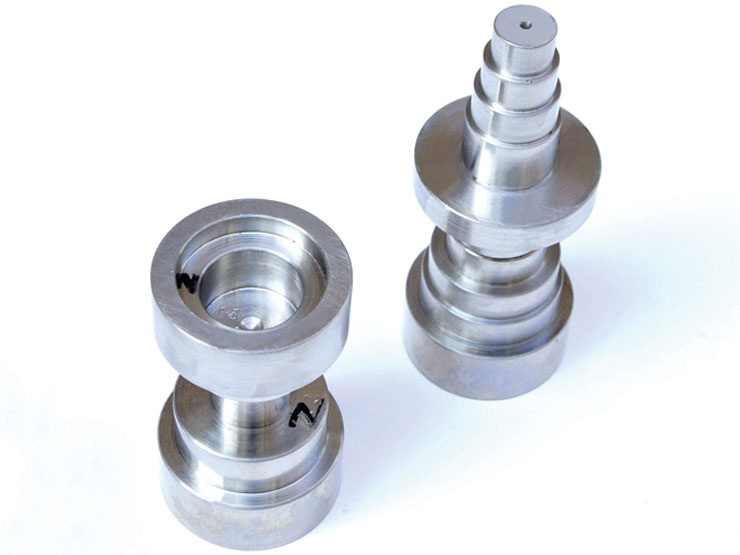
A finished 316L high‑pressure coupling
For detailed equipment capabilities, including max turning length, tolerance classes, and secondary operations, please refer to our Precision Equipment List.
Choosing between 304 and 316L for stainless steel turning parts boils down to:
◆ Chemical environment: Chlorides, acids, and temperature.
◆ Regulatory requirements: Food or medical applications may mandate specific grades.
◆ Total cost of ownership: Include machining, maintenance, and failure risks.
For most general industrial uses, 304 is cost‑effective. For demanding chemical, marine, or high‑chloride services, 316L’s superior corrosion resistance pays for itself. Always validate with field testing or consult with experienced machining partners.
Contact us to discuss your manufacturing needs. Our team of process engineers is ready to review your drawings and recommend the optimal material and turning strategy for your specific application. Reach out today for a no‑obligation feasibility study.
Q1: Can 304 be used in seawater applications?
A: No – 304 suffers rapid pitting and crevice corrosion in seawater. 316L is marginally better but for permanent seawater immersion, duplex or super‑austenitic grades are preferred.
Q2: Is 316L always better for food contact?
A: Not always – 304 is sufficient for most dry and non‑acidic foods. But for acidic or salty products (e.g., pickles, cheese brine), 316L adds a safety margin.
Q3: Does the "L" in 316L affect machinability?
A: The lower carbon improves weldability but has minimal direct effect on turning. The added molybdenum increases toughness, requiring lower speeds and more robust tooling.
Q4: How do I decide which grade to specify for a new project?
A: Evaluate operating temperature, chloride concentration, pH, and abrasion. If uncertain, run a coupon test in the actual fluid – or request a consultation from our engineering team.
Add: Building 3No.277 Zhen'an Middle Road, Chang'an Town,Dongguan,Guangdong, China
Tel:+86-769-82855591
Copyright © 2019 All Rights Reserved Dongguan Start Precision Technology Co., Ltd. Tel: +86-769-82855591
Add: No. 277 Zhen'an Middle Road, Chang'an Town, Dongguan, Guangdong, China



 中文版
中文版 English