Rapid Prototype CNC Machining Material Guide for Functional Parts
Date:2026-07-13Article editor:Starting Point PrecisionViews:270In product engineering, rapid prototype CNC machining is the definitive bridge between virtual CAD models and physical testing. Unlike additive methods, CNC subtractive manufacturing produces parts with genuine material properties—no anisotropy, no porosity. This makes it indispensable for functional prototypes that must survive real loads, thermal cycles, and assembly tolerances. However, the entire validation effort hinges on one pivotal decision: which material to machine. This guide provides a structured framework for selecting metals and plastics based on strength, thermal endurance, aesthetics, and economic feasibility, with insights from industry leaders like Start Precision.
A functional prototype is not a showpiece; it is a test vehicle. Choosing an inappropriate alloy or polymer can lead to premature fracture, thermal creep, or misleading stress-strain data. The optimal material must satisfy a tetrahedron of requirements:
◆ Structural integrity (yield strength, hardness, fatigue limit)
◆ Thermal stability (glass transition temperature, heat deflection temperature, continuous service temperature)
◆ Surface & visual quality (roughness, anodizing response, paint adhesion)
◆ Machining economics (tool wear, cycle time, scrap rate)
Metals are the go-to choice when prototypes demand high stiffness, wear resistance, or elevated temperature capability.
| Alloy | Yield (MPa) | Max Temp (°C) | Machinability | Surface (Ra µm) | Best For |
| Al 6061-T6 | 240 | 150 | Excellent | 0.8–1.6 | General structural frames |
| Al 7075-T6 | 480 | 130 | Good | 0.4–1.2 | High-stress aerospace links |
| SS 304 | 205 | 870 | Fair | 0.6–1.0 | Sanitary/medical housings |
| SS 17-4 PH | 1,000 | 315 | Fair-Good | 0.4–0.8 | High-strength valves & shafts |
| Ti Grade 5 | 880 | 400 | Poor | 0.4–0.8 | Lightweight extreme environments |
For most general-purpose prototypes, Al 6061 offers the best cost-speed-strength balance. When corrosion and high pressure coexist (e.g., fluid systems), precipitation-hardened stainless steel like 17-4 PH outperforms standard 304. Detailed property curves are available at MatWeb’s material database.
Plastics excel in electrical insulation, chemical resistance, and weight reduction. They also allow rapid machining due to lower cutting forces.
| Polymer | Tensile Modulus (GPa) | HDT @ 1.8 MPa (°C) | Surface Gloss | Application |
| ABS | 2.0 | 90 | High | Enclosures, dashboards |
| PC (Polycarbonate) | 2.4 | 130 | High | Transparent guards, lenses |
| POM (Delrin) | 3.0 | 100 | Medium | Gears, sliding mechanisms |
| PEEK | 3.6 | 160 | Low (matte) | Chemical pump impellers |
| Nylon 6/6 | 2.8 | 75 | Medium | Wear pads, clips |
If your prototype requires visual light transmission for optical inspection, Polycarbonate is unmatched. For high-temperature solvent exposure, PEEK is superior but costs significantly more. Always consider moisture absorption—Nylon may require pre-drying to maintain dimensional stability.
Surface finish directly impacts both user perception and sealing performance. Rapid prototype CNC machining can deliver multiple finish grades:
◆ As-machined (Ra 1.6–3.2) – fastest turn-around, ideal for fit-checking.
◆ Bead-blasted (Ra 0.8–1.6) – uniform matte texture, hides tool marks.
◆ Polished (Ra < 0.4) – mirror-like surface, required for seal faces and optical parts.
Post-processing also affects material choice. Aluminum responds beautifully to anodizing (dyed or clear), while stainless steel can be electropolished or passivated. Plastics can be painted, but ensure the coating does not outgas under thermal cycling. Discuss these requirements early with your machining partner.
Following a systematic workflow ensures no requirement is overlooked:

This iterative filter prevents late-stage surprises. Reputable suppliers like Start Precision actively provide Design-for-Manufacturing (DFM) feedback during Step 3 to optimize both material utilization and machining strategy.
Beyond raw material price, several hidden factors influence the total cost of your prototype. Harder materials (like Ti or 17-4 PH) require specialized carbide tooling and slower feed rates, often doubling cycle time compared to aluminum. Exotic alloys may also have longer procurement lead times—stock 6061 is usually same-day, while aerospace-grade titanium can take a week. Additionally, consider the cost of secondary operations: electropolishing stainless steel adds 1–2 days and 15–20% to the budget, whereas as-machined aluminum requires none. Finally, internal sharp corners force the use of smaller-diameter end mills, increasing machining time. Balancing these variables early ensures your rapid prototype CNC machining project stays both fast and affordable. For reference on machining cost estimation, consult Engineering Toolbox’s manufacturing guides.
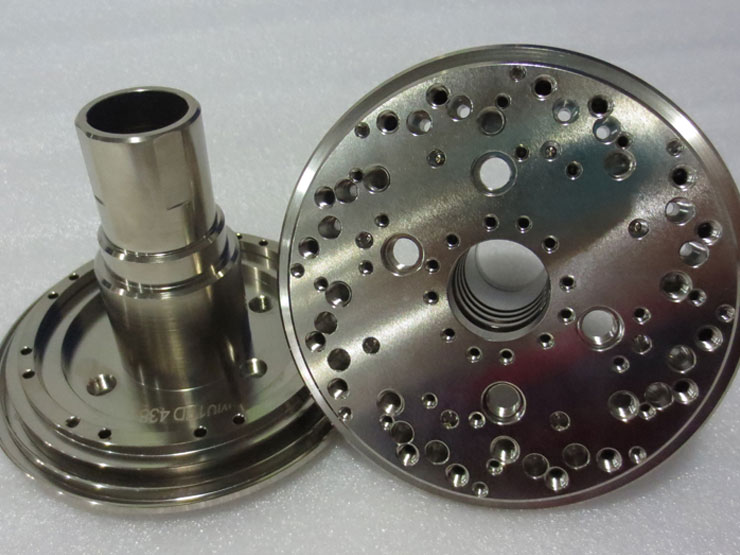
A leading industrial automation firm required a functional prototype for a fluid distribution valve disc used in high-pressure chemical injection systems. The part faced three critical challenges:
◆ Corrosion resistance against aggressive pH 2–12 media.
◆ Pressure integrity at 25 MPa (3,600 psi) without plastic deformation.
◆ Surface sealing – the mating face demanded a flatness of 0.01 mm and Ra 0.4 surface finish to ensure zero leakage.
The engineering team initially considered ceramic (too brittle) and PEEK (insufficient creep resistance at 80°C). They ultimately selected Stainless Steel 17-4 PH due to its 1,000 MPa yield strength, excellent pitting resistance, and ability to achieve the required mirror finish via hard turning. Through Start Precision's rapid prototype CNC machining, they produced 5 validated discs within 72 hours. CMM inspection confirmed all critical dimensions, and the prototype passed 1,000 pressure cycles without measurable wear, accelerating the final valve project by four weeks.
Conclusion
Selecting the correct material for rapid prototype CNC machining is a multi-dimensional puzzle involving strength, temperature, appearance, and procurement logistics. Start by identifying your prototype's single most critical failure mode—if it breaks, prioritize toughness; if it deforms, prioritize heat deflection; if the customer judges it, prioritize finish. Always involve your machining partner early to align material properties with tooling capabilities and lead times. A well-chosen material not only validates your design but also builds confidence for production-scale decisions.
Upload your drawings now and get an instant prototype quote – turn your CAD data into a tangible, testable metal or plastic part within days.
Q1: What is the most cost-effective material for a structural CNC prototype?
A: Aluminum 6061-T6 is widely regarded as the best value, offering excellent machinability, good strength, and low raw material cost, making it ideal for initial structural validations.
Q2: Can I machine a prototype in the exact material as my final production part?
A: Yes, provided your final process is also CNC machining. However, if production uses casting or forging, choose a prototype material with similar mechanical behavior (e.g., use 7075 aluminum to simulate forged steel stiffness) to get meaningful test data.
Q3: How does material hardness affect CNC machining lead time?
A: Harder materials (titanium, hardened steel) require slower cutting speeds, smaller depths of cut, and frequent tool changes, potentially increasing machining time by 2–5 times compared to soft aluminum or plastics.
Q4: Which plastic offers the best surface finish directly off the machine?
A: Acrylic (PMMA) and Polycarbonate (PC) can achieve near-optical clarity and very low surface roughness (Ra < 0.4) with proper tooling, often eliminating the need for secondary polishing.
Q5: What is the minimum wall thickness recommended for a stainless steel prototype?
A: For stainless steel, a minimum wall thickness of 0.6–0.8 mm is generally recommended to avoid vibration chatter during milling, though this depends on the part's depth and overall geometry.
Add: Building 3No.277 Zhen'an Middle Road, Chang'an Town,Dongguan,Guangdong, China
Tel:+86-769-82855591
Copyright © 2019 All Rights Reserved Dongguan Start Precision Technology Co., Ltd. Tel: +86-769-82855591
Add: No. 277 Zhen'an Middle Road, Chang'an Town, Dongguan, Guangdong, China



 中文版
中文版 English