Guide to Material Selection by Hardness and Toughness for CNC Machining Parts
Date:2026-04-29Article editor:Starting Point PrecisionViews:384Selecting the right material for CNC machined parts can feel like choosing between a diamond and a spring. Both are exceptional, but they serve entirely different purposes. The secret lies in understanding two critical mechanical properties: hardness and toughness. Misjudge this balance, and you risk a part that shatters on impact or wears out prematurely. This guide breaks down the trade-offs and provides a clear framework for your next project.
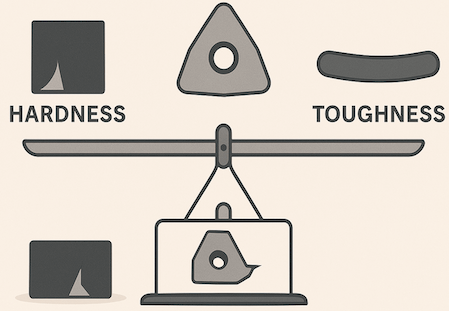
Understanding the Core Properties
Hardness measures a material’s resistance to localized surface deformation—think scratching, indentation, or wear. A hard material holds tight dimensional tolerances and resists abrasive forces. However, extreme hardness often brings brittleness.
Toughness, on the other hand, is the ability to absorb energy and plastically deform without fracturing. It’s the property that lets a part survive an unexpected impact or a sudden load spike. The classic challenge is that as hardness increases, toughness generally decreases. Visualizing this inverse relationship helps; see the trade-off in the follow Image .
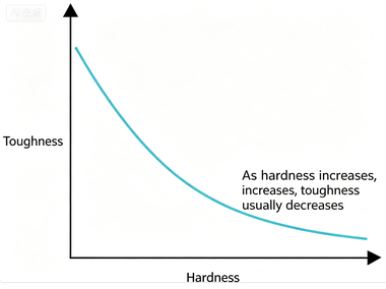
Your application dictates where you should sit on the hardness-toughness spectrum. Ask yourself: Will this component face constant friction, or is it a structural bracket absorbing vibration?
When surface wear is the primary failure mode, hardness wins. These materials are ideal for gauges, dies, and bearing surfaces.
◆ D2 Tool Steel: Exceptional wear resistance after heat treatment, but low toughness. Avoid sharp corners in design to prevent cracking during CNC cutting.
◆ 4140 Alloy Steel (Pre-hardened) : A versatile choice around 28-32 HRC offering good strength with reasonable machinability. Data from ASM International 4140 Properties Database confirms its balanced profile for shafts and gears.
If your part must bend without breaking, sacrifice some hardness. This is critical for robotics, automotive brackets, and safety equipment.
◆ 304 Stainless Steel: Excellent toughness, corrosion resistance, and strain hardening. While it gums up cutting tools, it provides incredible durability.
◆ 6061-T6 Aluminum: A superb strength-to-weight ratio with natural toughness. It’s the default for aircraft components that require damage tolerance, not just stiffness.
Some materials cheat the inverse rule through alloying or advanced processing.
◆ Titanium Grade 5 (Ti-6Al-4V) : A benchmark for biocompatible and aerospace parts. It combines the surface hardness needed for wear resistance with the fracture toughness to absorb cracks. See the microstructural explanation on ScienceDirect Titanium Alloy Review .
◆ PEEK (Polyetheretherketone) : For plastic parts that replace metal, PEEK offers outstanding impact resistance alongside a surface hardness suitable for sealing.
Applying the hardness-toughness logic becomes much clearer when you look at specific parts you machine every day. Here are proven pairings that balance performance, cost, and machinability.
◆ Gears & Sprockets: Teeth demand high surface hardness to resist pitting, yet the root needs toughness against bending fatigue. 8620 case-hardened steel with a hard case and tough core, or 4140 pre-hardened steel are top choices.
◆ Shafts & Axles: Subject to torsion, bending, and occasional shock. 1144 stressproof steel offers excellent machinability and toughness; for corrosive environments, 17-4 PH stainless steel provides a hardness-toughness upgrade. See standard data in Shaft Material Reference .
◆ Brackets & Structural Mounts: These rarely wear but must never snap. 6061-T6 aluminum wins for lightweight toughness, while 304 stainless suits corrosive or high-strength needs.
◆ Bearing Surfaces & Bushings: Continuous sliding demands extreme hardness. 52100 bearing steel through-hardened, or a tough bronze core with a hard coating, deliver low friction and long life.
◆ Housings & Enclosures: Machinability and moderate impact resistance matter most. 5052 aluminum forms complex shapes, while ABS or polycarbonate replace metals for electrical insulation.
Before finalizing your CNC drawing, run through this summary:
◆ Environment: does the part cycle through temperatures? Cryogenic conditions make most steels brittle; consult an NIST Cryogenic Material Properties Guide.
◆ Coatings: Why choose between the two properties when you can layer them? A tough 4130 steel core with a hard electroless nickel coating often outperforms monolithic metals.
◆ Fatigue Life: Hardness stops wear, but toughness stops crack propagation. A rough surface finish from aggressive CNC machining destroys both.
There is no universal “best” material for CNC machining—only the best compromise between hardness and toughness. Start by defining your part’s primary killer: is it abrasive grit or mechanical shock? Use the resources linked above, and when in doubt, order material test coupons. Machining a small batch of 4140 versus 304 can validate your assumptions before committing to full production.
Making the right choice reduces scrap, saves tooling costs, and ultimately delivers a part that excels exactly where it matters most.
Add: Building 3No.277 Zhen'an Middle Road, Chang'an Town,Dongguan,Guangdong, China
Tel:+86-769-82855591
Copyright © 2019 All Rights Reserved Dongguan Start Precision Technology Co., Ltd. Tel: +86-769-82855591
Add: No. 277 Zhen'an Middle Road, Chang'an Town, Dongguan, Guangdong, China



 中文版
中文版 English