How to Choose Coatings for CNC Machined Parts
Date:2026-04-28Article editor:Starting Point PrecisionViews:554Selecting the right coating for CNC maching parts directly influences service life, reliability, and appearance. From biomedical tools to aerospace housings, a tailored surface layer fights wear, galling, and corrosion while maintaining tight tolerances. This guide equips you with a systematic method to match coating properties with real-world demands.
Why Part Coatings Matter
A coating changes only the outermost surface, leaving the core material’s strength and machinability intact. It can deliver dry lubrication for sliding fits, chemical resistance for sterile environments, or a distinctive gold finish for brand identity. Before choosing a layer, it helps to understand how the base substrate performs under load.
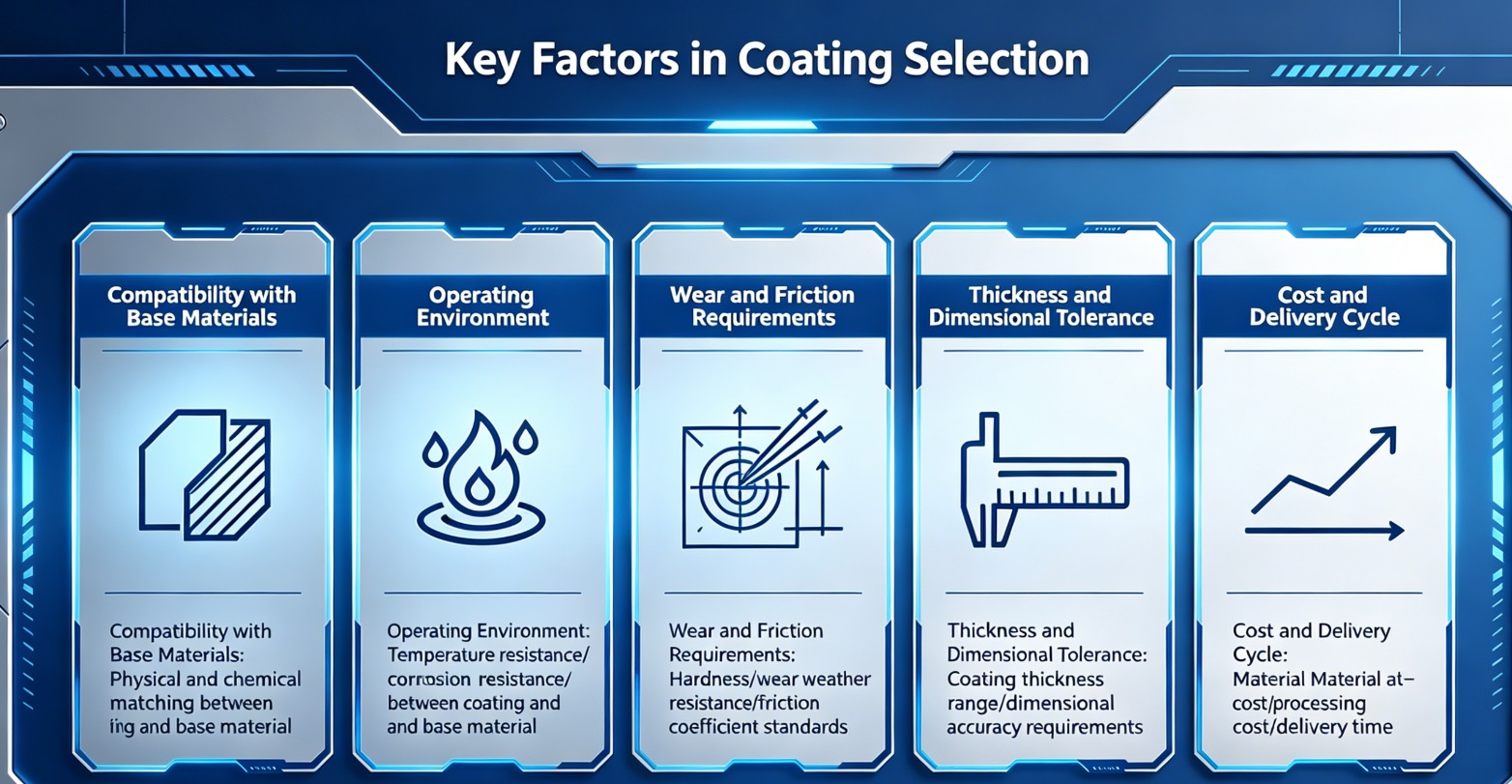
Key Factors for Coating Selection
1.Base Material Compatibility
Aluminum parts respond well to hard anodizing or electroless nickel; stainless steels often pair with CrN or DLC to fight galling. Always check adhesion potential and galvanic corrosion risks. Consult NACE Corrosion Compatibility Database for metal-to-coating couples.
2.Operating Environment
Components exposed to high heat, such as exhaust flanges, need oxidation-resistant films like AlTiN. In salt-spray or marine settings, high-phosphorus electroless nickel or CrN provides a reliable barrier.
3.Wear and Friction Requirements
Sliding contacts starved of oil demand an ultra-low coefficient of friction. DLC consistently scores below 0.1 in pin-on-disk tests. For abrasive wear, hard anodizing or TiCN dramatically prolongs part life.
4.Thickness and Dimensional Tolerance
Physical vapor deposition (PVD) films typically measure 2–5 µm, preserving tight fits. Hard anodizing or electroless nickel can grow 25–50 µm, so CNC machining must compensate at the design stage.
5.Cost and Lead Time
Batch-processed PVD coatings offer high hardness at moderate cost. Electroless nickel delivers uniform corrosion protection but may require finish grinding on sealing surfaces. Weigh the price per part against the cost of in-service failure.
◆Titanium Nitride (TiN) – Gold, hard (~85 HRC), biocompatible. Fits surgical instruments and decorative wear parts. Avoid on aluminum where adhesion weakens.
◆Chromium Nitride (CrN) – Excellent anti-galling and corrosion resistance. Used on valve stems, pump shafts, and food-contact components.
◆Diamond-Like Carbon (DLC) – Extremely low friction, high hardness. Performs in vacuum and oil-starved environments. Specified for fuel injectors, racing ◆drivetrain parts, and guidewires. For engineering limits, see VDI 2840 DLC Coating Guidelines.
◆Aluminum Titanium Nitride (AlTiN) – Withstands temperatures up to 900°C. Ideal for turbocharger parts, hot-forming tools, and aerospace fasteners.
◆Electroless Nickel (EN) Plating – Uniform thickness, supreme corrosion protection. High-phosphorus grades excel in downhole oil & gas hardware.
◆Hard Anodizing – Thick, wear-resistant aluminum oxide layer. Aerospace housings and pistons benefit most; optional PTFE sealing further reduces stick-slip.
◆ Aluminum 6061/7075: Hard anodize for wear, EN for corrosion. DLC when dry sliding is mandatory.
◆ Stainless Steel 304/316: CrN or DLC to prevent galling; avoid TiN in chloride-rich solutions.
◆ Titanium Alloys: CrN or DLC for adhesive wear; anodizing for color identification.
◆ Tool Steel: AlTiN or TiCN for high-stress wear surfaces.
◆ Engineering Plastics: Sputtered chrome or SiO2 for antireflection; traditional coatings rarely apply.
Define the part’s primary failure risk—corrosion, wear, or adhesion.
List coatings chemically compatible with the substrate.
Rank candidates by temperature range, friction target, and allowable thickness.
Validate 2–3 options through prototype testing.
Lock the specification and annotate the drawing using ISO 4287 texture parameters. For the complete protocol, visit ISO 4287 Surface Texture Standard.
Treat a coating as an engineered layer—not an afterthought. Aligning the operating environment with surface properties slashes warranty claims and elevates product performance. For tailored recommendations on your next batch of parts, connect with our specialists through Request a Quote.
Add: Building 3No.277 Zhen'an Middle Road, Chang'an Town,Dongguan,Guangdong, China
Tel:+86-769-82855591
Copyright © 2019 All Rights Reserved Dongguan Start Precision Technology Co., Ltd. Tel: +86-769-82855591
Add: No. 277 Zhen'an Middle Road, Chang'an Town, Dongguan, Guangdong, China



 中文版
中文版 English