Precision CNC Machining for Hydraulic Components: The Foundation of Reliable Fluid Power
Date:2026-04-27Article editor:Starting Point PrecisionViews:456Hydraulic systems power everything from construction excavators to aerospace flight controls. At the core of these systems lie components that must withstand extreme pressures, prevent leakage, and maintain micron-level clearances. This is exactly where precision CNC machining becomes indispensable. By leveraging multi-axis computer numerical control, manufacturers can produce complex valve blocks, pump housings, and custom manifolds with repeatable accuracy. To explore our full range of capabilities in this area, visit our CNC turning service page.
Why CNC Machining Defines Hydraulic Performance
Hydraulic components operate under savage conditions—pulsating pressures often exceeding 5,000 psi, abrasive fluid contamination, and constant thermal cycling. A machined surface tolerance error of just 0.001 inches can cause internal leakage, system inefficiency, or catastrophic failure. CNC machining eliminates the variability of manual processes. Modern 5-axis machining centers can hold tolerances down to ±0.0002 inches while simultaneously drilling angled transfer holes and finishing flat sealing faces. This ensures that spool valves shift smoothly and manifold O-ring grooves maintain a perfect seal.
Below is a representative list of parts where CNC machining delivers the required precision:
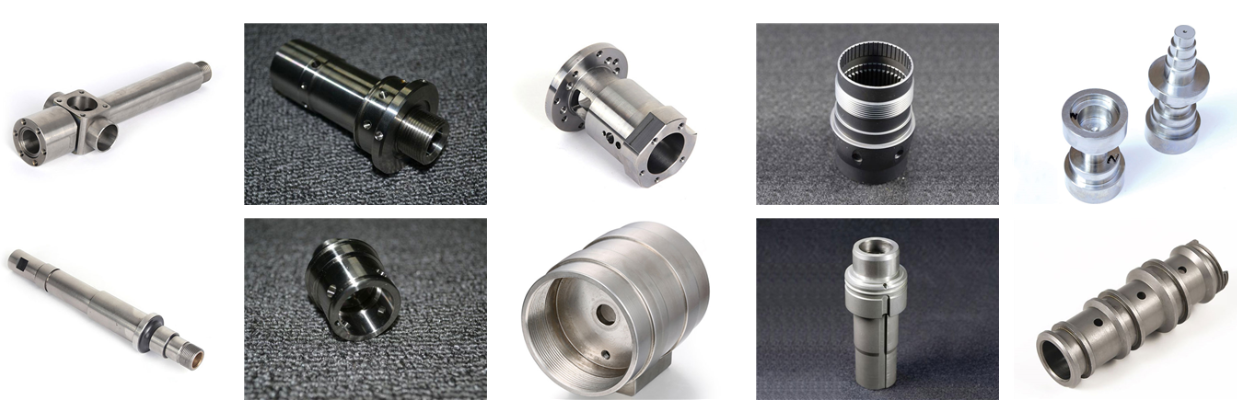
◆ Hydraulic Manifolds & Valve Blocks: Intricate internal channels machined from solid aluminum or steel.
◆ Pump Housings & End Covers: Bearing bores and flange faces machined for perfect alignment.
◆ Cylinder Glands & Pistons: Chromed rods and threaded glands requiring seamless sealing surfaces.
◆ Fittings & Adapters: High-pressure connectors with precise cone angles, such as JIC and ORFS profiles.
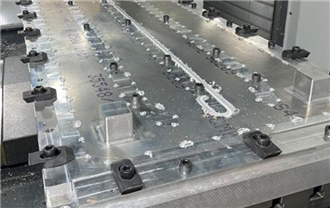
Take a machined aluminum manifold as a specific illustration. Its intersecting port geometries are impossible to cast accurately; CNC drilling and contour milling are essential to avoid sharp edges that generate turbulence and heat.
The functionality of a hydraulic component is equally dependent on material choice. CNC machining adapts seamlessly to a range of alloys. Common choices include 6061-T6 aluminum for weight-sensitive aerospace manifolds, 316 stainless steel for corrosive offshore environments, and 12L14 free-cutting steel for low-cost fittings. Post-machining treatments further enhance service life. Hard anodizing creates a wear-resistant surface on aluminum threads, while electroless nickel plating provides uniform corrosion protection deep inside drilled passages. When specifying materials, it is often helpful to reference industry-accepted standards to guarantee chemical and mechanical properties ,refer to ASTM International Metals & Alloy Standards.
One of the most demanding aspects of machining hydraulic parts is internal burr removal. A dislodged metal chip inside a finished manifold can block a pilot orifice or destroy a piston seal. Progressive CNC programming strategies now integrate high-pressure through-tool coolant and mechanical deburring tools directly into the machining cycle. Additionally, best practices in high-pressure fluid power design reinforce why such meticulous machining is non-negotiable,from NFPA Recommended Fluid Power Practices.
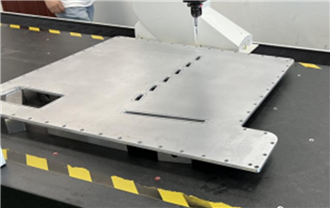
Even the most sophisticated CNC machine tool requires rigorous metrology. Hydraulic components are verified using Coordinate Measuring Machines (CMM) and surface roughness testers. A manifold might require 100% inspection on cavity depths to ensure a cartridge valve seats correctly. Pressure decay testing then proves the structural integrity of the machined body. A finished hydraulic cylinder housing on a test stand visually confirms the link between precision machining and leak-free performance.
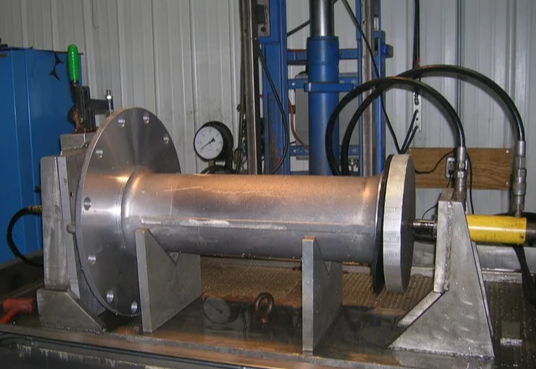
CNC-Machined Hydraulic Cylinder During Pressure Test
High-performance hydraulic systems depend entirely on the extreme precision of their metal components. CNC machining transforms raw metal stock into contoured, burr-free, and meticulously finished parts that perform reliably under pressure. From helical milling of pump gears to the drilling of deep manifold galleries, this technology remains the only scalable method for achieving the cleanliness, flatness, and dimensional accuracy that modern fluid power demands. Partnering with a shop that combines tight-tolerance machining with deep process knowledge is the most effective way to ensure your hydraulic assemblies perform as engineered.
Add: Building 3No.277 Zhen'an Middle Road, Chang'an Town,Dongguan,Guangdong, China
Tel:+86-769-82855591
Copyright © 2019 All Rights Reserved Dongguan Start Precision Technology Co., Ltd. Tel: +86-769-82855591
Add: No. 277 Zhen'an Middle Road, Chang'an Town, Dongguan, Guangdong, China



 中文版
中文版 English