Quenched & Tempered CNC Turned Parts: Precision Machining from a Leading Manufacturer
Date:2026-04-29Article editor:Starting Point PrecisionViews:377
1. Reading the Hardness Before the Cut
Tempered martensite at 45–55 HRC brings high cutting forces and intense heat. A standard carbide edge crumbles under such conditions. A seasoned CNC turned parts provider never begins without understanding the microstructure.
In our CNC turned parts facility, cubic boron nitride (CBN) is the standard for continuous cuts above 48 HRC. For interrupted profiles, whisker‑reinforced ceramics offer predictable life. We select inserts with a negative rake and a T‑land chamfer—edge reinforcement that prevents micro‑chipping.
Without the right substrate and geometry, even a rigid lathe cannot hold a 6 µm tolerance. To explore third‑party grade data, check Hard Part Turning Application Guide – Seco Tools.
Successful CNC turning of quenched and tempered parts operates in a narrow window. A moderate surface speed (100–150 m/min for CBN), paired with a robust feed (0.15–0.30 mm/rev) and a minimum 0.15 mm depth of cut, generates heat that plasticizes the chip. The result is a bright, burnished surface typical of a capable CNC turned parts supplier.
Letting the insert rub with a shallow cut glazes the surface and invites work hardening — a costly mistake.
Dry cutting often works best for CBN turning of Q&T parts, letting the chip carry heat away. But when machining long, thin‑walled CNC turned parts, thermal drift is the enemy. We deploy high‑pressure through‑tool coolant (≥70 bar) to lock in dimensional stability and flush chips instantly.
Fundamentals of Quenching and Tempering – ASM International.
Crucially, the tool‑interface temperature must never exceed the original tempering temperature. Crossing that line creates a soft, rejected skin.
Any vibration during a hard turning finish pass destroys surface finish and breaks tools. As a precision CNC turned parts manufacturer, we rely on vibration‑dampening bars, custom soft jaws, and auto‑steady rests. Clamping force is spread evenly to prevent distortion in ring‑like or hydraulic components.
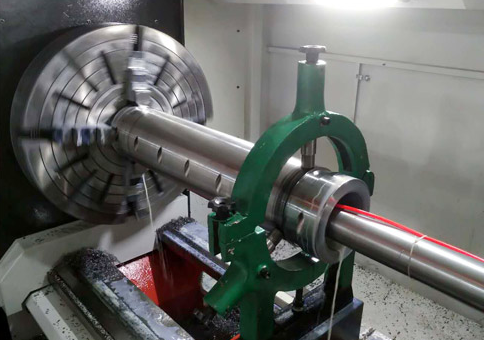
Hard‑Turned Quenched and Tempered Shaft with Steady Rest Support
On‑machine probing and post‑process CMM inspection are non‑negotiable. Every batch of CNC turned parts is checked for residual stress ovality, micro‑cracking, and surface finish. By correlating heat‑treat distortion data with final turning paths, we guarantee dimensional conformity.
Learn more about CNC Turned Parts Supplier Quality Assurance & Inspection Capabilities.
When you need hardened components delivered to print, choose a dedicated CNC turned parts manufacturer that commands the full hard‑turning process chain. From CBN tooling to thermally stable processes, the right partner turns a difficult alloy into your competitive advantage.
Contact Our CNC Turned Parts Experts for Your Q&T Project.
Add: Building 3No.277 Zhen'an Middle Road, Chang'an Town,Dongguan,Guangdong, China
Tel:+86-769-82855591
Copyright © 2019 All Rights Reserved Dongguan Start Precision Technology Co., Ltd. Tel: +86-769-82855591
Add: No. 277 Zhen'an Middle Road, Chang'an Town, Dongguan, Guangdong, China



 中文版
中文版 English