Surface Finishing for CNC Turned Parts: Insights from Expert CNC Turned Parts Manufacturers
Date:2026-04-30Article editor:Starting Point PrecisionViews:491The longevity and functionality of precision components heavily rely on surface treatment. For any CNC turned parts manufacturer, delivering components with optimal surface integrity is a baseline requirement. If you are evaluating CNC turned parts suppliers, asking about their in-house finishing and hardening capabilities saves time and improves assembly outcomes. This guide maps key processes applied to CNC turned parts and how they elevate part value.
Why Surface Finishing Elevates CNC Turned Parts
Raw machined CNC turned parts often carry tool marks, micro-burrs, and residual stress. A proper finish enhances corrosion resistance, reduces friction, and prepares surfaces for bonding or coating. For high-wear applications, thermochemical diffusion treatments such as nitriding or carburizing become essential. According to the ASTM B912 passivation standard, chemical treatments are critical for stainless steel components. Without appropriate finishing, even high-precision CNC turned parts from a qualified manufacturer may fail prematurely.
Anodizing creates a durable, corrosion-resistant oxide layer on aluminum CNC turned parts. It is widely offered by CNC turned parts manufacturers serving aerospace and consumer electronics. Type II anodizing delivers aesthetic color, while Type III hardcoat raises wear resistance dramatically.
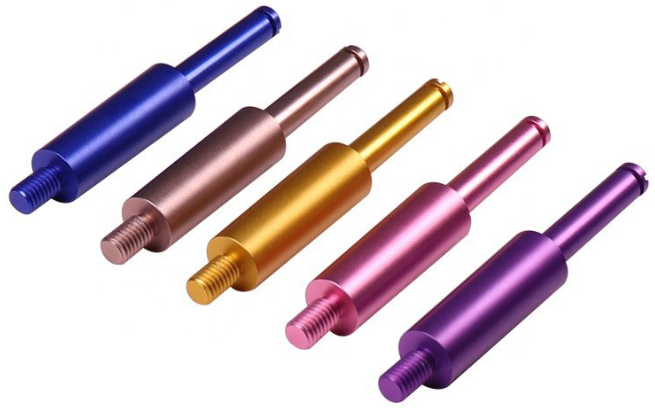
Color-anodized aluminum CNC turned parts
Zinc, nickel, and chrome plating add hardness and a bright finish to steel components. Many CNC turned parts suppliers recommend electroless nickel for uniform coverage on complex geometries. Reference the ISO 4527 autocatalytic nickel-phosphorus standard to specify requirements correctly.
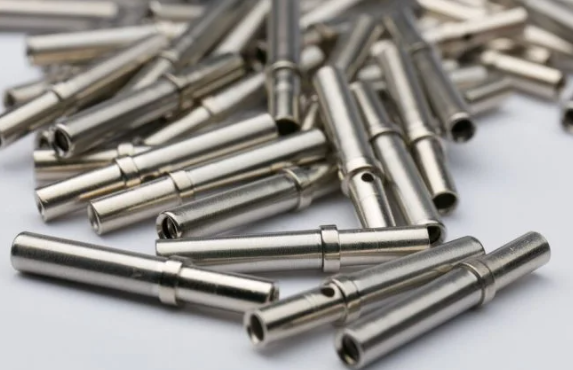
Electroless nickel parts
For stainless steel CNC turned parts, passivation removes free iron and reinforces the natural chromium oxide layer. It is a cost-effective way to guarantee cleanliness and rust resistance. Reputable CNC turned parts manufacturers validate their process through salt spray testing per ASTM B117.
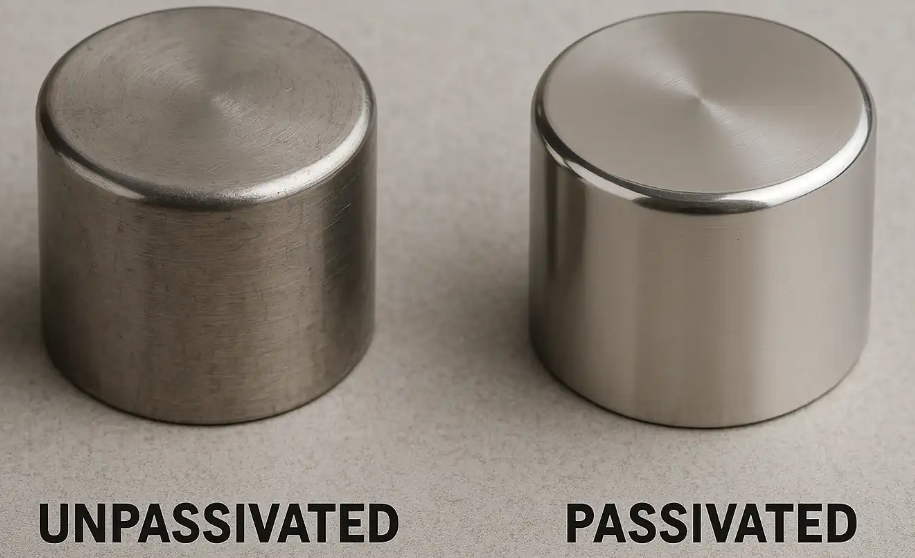
Parts before and after passivation comparison
When surface hardness and fatigue resistance are paramount, CNC turned parts benefit from diffusion-based treatments. These alter the surface chemistry without applying an external coating layer. Gas nitriding, governed by specifications like AMS 2759/10, introduces nitrogen to form a hard case on alloy steels, ideal for gears and shafts. Carburizing adds carbon to create a hard, wear-resistant surface, while carbonitriding combines both elements for performance in sliding applications. Leading CNC turned parts suppliers (Internal Link) often provide these processes in-house, ensuring seamless integration between precision machining and heat treatment.
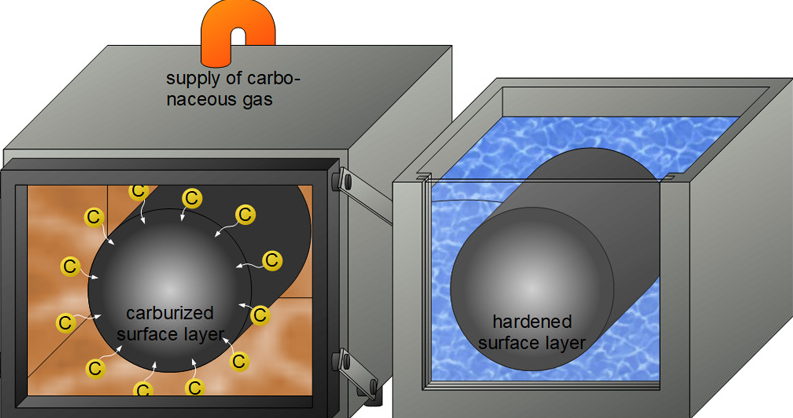
Carburizing treatment for CNC parts
Powder coating provides a thick, impact-resistant layer ideal for industrial CNC turned parts used in enclosures or brackets. It offers broader color choices than anodizing and is frequently available through integrated CNC turned parts supplier networks.
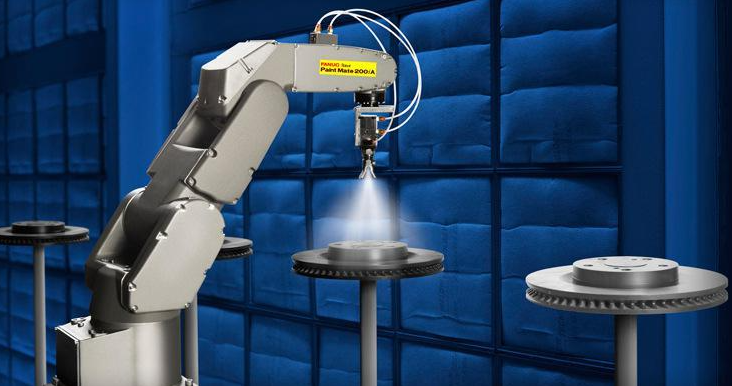
Automatic spraying of parts
These methods refine appearance and smoothness without chemical alteration. A high-quality CNC turned parts manufacturer applies precision bead blasting to achieve a uniform matte texture, often required before anodizing.
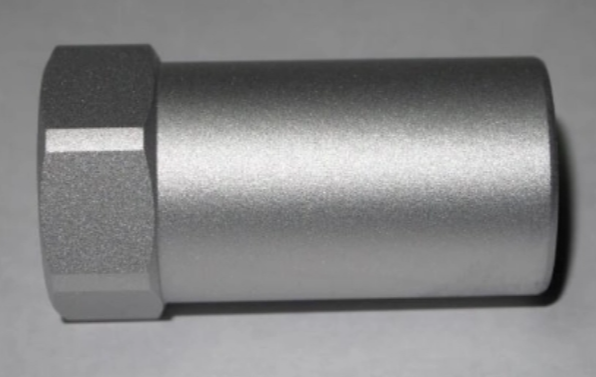
Matte bead-blasted stainless steel CNC turned part
The choice depends on material, environment, and regulatory needs. When discussing a project with a CNC turned parts manufacturer, always clarify operating temperature, chemical exposure, expected wear, and cosmetic standards. For components exposed to sliding contact or cyclic loading, ask about nitriding or carbonitriding early in the design phase. Environmental directives such as RoHS 2011/65/EU restrict certain hexavalent chromium coatings, making trivalent alternatives essential. Leading CNC turned parts suppliers provide material-appropriate recommendations and in-house quality checks, reducing secondary vendor coordination. Integrating finishing and heat treatment at the machining source ensures tighter tolerances and faster lead times for custom CNC turned parts.
Explore our CNC turned parts design guide for deeper specification support.
Surface finishing transforms standard machined components into high-performance CNC turned parts ready for demanding applications. Partnering with an experienced CNC turned parts manufacturer and knowledgeable CNC turned parts suppliers secures not only precision geometry but also the protective, aesthetic, and hardened surface that defines product excellence. Use the references above to specify your next project with confidence.
Add: Building 3No.277 Zhen'an Middle Road, Chang'an Town,Dongguan,Guangdong, China
Tel:+86-769-82855591
Copyright © 2019 All Rights Reserved Dongguan Start Precision Technology Co., Ltd. Tel: +86-769-82855591
Add: No. 277 Zhen'an Middle Road, Chang'an Town, Dongguan, Guangdong, China



 中文版
中文版 English