CNC Turning Parts: Flame-Retardant Component Machining
Date:2026-04-30Article editor:Starting Point PrecisionViews:421Flame-retardant components are essential in applications where fire safety, heat resistance, and low smoke emission are mandatory. Industries such as aerospace, electric vehicles, railway, and industrial electronics rely on CNC turning to produce high-precision parts from fire-resistant materials. This article explains how CNC turning works for flame-retardant parts, material choices, machining challenges, and quality assurance.
Why CNC Turning for Flame-Retardant Parts?
CNC turning is the preferred process for cylindrical or complex rotary components – bushings, insulators, connectors, valve seats, and threaded shafts. The process offers:
◆ Tight tolerances (up to ±0.005 mm)
◆ Excellent surface finish without secondary operations
◆ Repeatability for large or small batches
When machining flame-retardant materials, CNC turning minimizes thermal damage and preserves the fire-resistant additives inside the material.
Key Flame-Retardant Materials for CNC Turning
Material selection directly affects flame rating (e.g., UL94 V-0, V-1, 5VA) and machinability. Common materials include:
◆ Flame-retardant PEEK – V-0 rated, low smoke, excellent mechanical strength.
◆ FR4 / G10 – Glass epoxy composite; high dielectric strength and arc resistance.
◆ Phenolic (CE / linen phenolic) – Self-extinguishing, good dimensional stability.
◆ Flame-retardant PTFE – Non-stick, ideal for sealing applications in high-risk environments.
◆ Halogen-free flame-retardant polyamide (PA6/PA66 FR) – Lightweight and cost-effective.
Learn more about UL Flame-Retardant Plastics Guide – authoritative reference for material ratings.
Machining Challenges and Solutions
1.Heat Management
Flame-retardant additives (e.g., phosphorus, halogen, or ATH) can degrade under excessive cutting temperatures, reducing fire performance. Use high-pressure coolant, sharp carbide or PCD tools, and moderate cutting speeds.
Below is a typical CNC turning setup for a flame-retardant bushing:
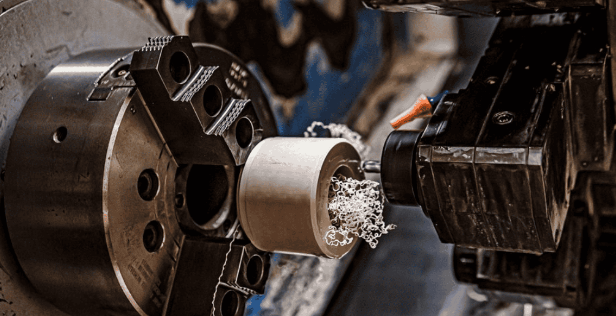
CNC lathe machining a flame-retardant PEEK component
2.Tool Wear from Abrasive Fillers
Many FR materials contain glass fibers or mineral fillers that accelerate tool wear. Recommended strategies:
◆ Diamond-like carbon (DLC) or diamond-coated inserts
◆ Regular tool inspection and change intervals
◆ Optimized chip breaking to prevent recutting
External resource on abrasive machining: tooling for FR plastics.
3.Certification and Cleanliness
Flame-retardant components must meet industry standards (UL94, FAR 25.853, IEC 60695). After CNC turning, parts are cleaned to remove dust or oils that could compromise flame retardancy.
Applications of Flame-Retardant CNC Turned Parts
◆ EV battery terminal insulators – prevent short circuits and fire spread
◆ Aircraft interior hinges and brackets – meet FAA flammability requirements
◆ Railway cable connectors – low smoke and zero halogen (LSZH)
◆ Oil & gas valve seats – fire-safe designs per API 6FA
Frequently Asked Questions (FAQ)
Q1 – What is the maximum operating temperature for flame-retardant CNC turned parts?
A1: It depends on the material. FR PEEK can withstand continuous use up to 260°C (500°F). Phenolic composites typically hold up to 150-180°C. Always check the material data sheet.
Q2 – Can you machine UL94 V-0 rated plastics without losing the rating?
A2: Yes, provided that machining does not overheat the material or contaminate the surface. We use sharp tools, coolant, and post-machining cleaning to preserve the V-0 rating. Certificates of conformance are available.
Q3 – What tolerances can you hold on flame-retardant turned parts?
A3: Standard CNC turning tolerances of ±0.025 mm are typical. For critical features, we can achieve ±0.005 mm on diameter, depending on material stability.
Q4 – Do you provide prototyping for flame-retardant components?
A4: Absolutely. We offer rapid CNC turning prototypes from flame-retardant materials. Contact us for a quick quote.
Q5 – Why should I choose CNC turning over injection molding for FR parts?
A5: CNC turning has no mold cost, allows design changes easily, and works with fully certified FR stock shapes. For small to medium volumes, turning is faster and more cost-effective.
Conclusion
CNC turning delivers high-precision, fire-safe components from specialized flame-retardant plastics and composites. By controlling heat, selecting appropriate tooling, and following certified processes, manufacturers can meet the most stringent fire safety standards. For custom CNC turning of flame-retardant parts, explore our CNC turning services.
Add: Building 3No.277 Zhen'an Middle Road, Chang'an Town,Dongguan,Guangdong, China
Tel:+86-769-82855591
Copyright © 2019 All Rights Reserved Dongguan Start Precision Technology Co., Ltd. Tel: +86-769-82855591
Add: No. 277 Zhen'an Middle Road, Chang'an Town, Dongguan, Guangdong, China



 中文版
中文版 English