What is CNC Machining? A Beginner’s Guide to CNC Precision Manufacturing
Date:2026-05-02Article editor:Starting Point PrecisionViews:455CNC machining, or Computer Numerical Control machining, is an advanced manufacturing process that uses automated machines to produce precise parts. It's widely used across industries like aerospace, automotive, and medical for its accuracy and efficiency. Here's an overview of how CNC machining works and why it's crucial in today's manufacturing world.
1. What is CNC Machining?
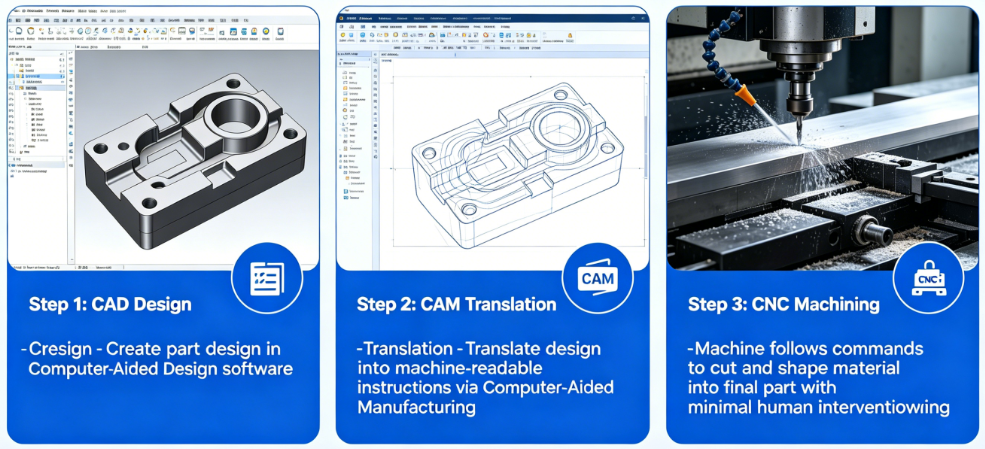
CNC machining is the use of computer-controlled machines to carve, cut, and shape materials such as metals, plastics, and composites. It relies on a pre-programmed set of instructions, often written in G-code, to guide machines in performing tasks like milling, drilling, and turning. This technology replaces manual labor, offering high precision and repeatability.
The CNC process begins with a part design created in CAD (Computer-Aided Design) software. The design is then translated into machine-readable instructions via CAM (Computer-Aided Manufacturing). The CNC machine follows these commands to accurately cut and shape the material into the final part, with minimal human intervention.Find more detailed information about CNC machining on Wikipedia here.
Common types of CNC machines include:
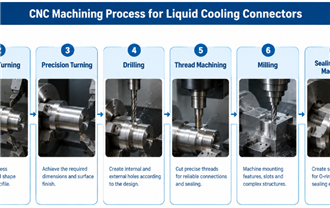
◆ CNC Milling:It uses rotating cutting tools to machine complex profiles on workpieces, commonly applied to molds and 3D curved surfaces.
◆ CNC Turning:The workpiece rotates at high speed while the cutting tool stays fixed; it is suitable for machining rotational parts such as shafts and discs.
◆ CNC Drilling:Specialized in hole machining, including drilling, hole reaming, and boring.
◆ CNC Grinding:High-speed rotating grinding wheels are used for surface finishing of parts to achieve high dimensional accuracy and superior surface finish.
◆ Non-traditional Machining:
● EDM:Metal material is eroded by electric spark discharge, used for machining ultra-hard materials and complex cavities.
● Cutting:It includes laser cutting, plasma cutting, waterjet cutting, etc., and is suitable for sheet metal cutting.
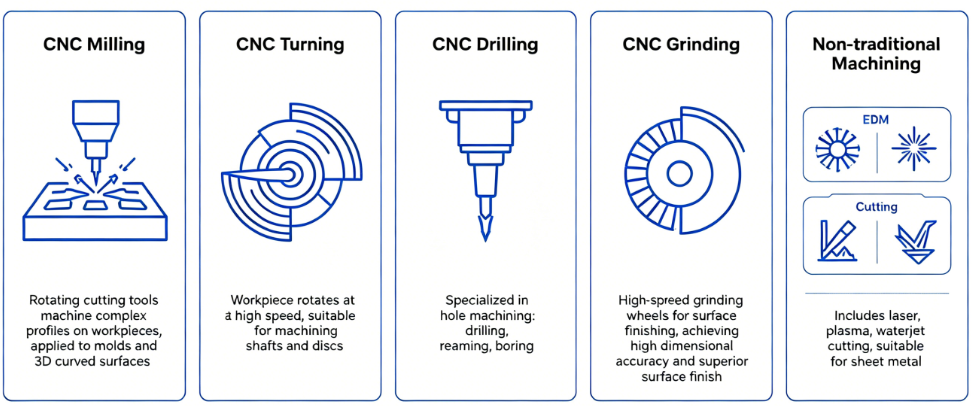
Each machine serves a specific function, allowing manufacturers to achieve a wide variety of part designs.Check out the different CNC machines here.
CNC machining offers several benefits:
This makes CNC machining ideal for industries that require high-quality, custom parts at scale.
CNC is used to manufacture parts in various industries:
Q1: How much does CNC machining cost?
Costs depend on material, complexity, and production volume. Small batches tend to be pricier, but CNC is cost-effective for complex parts.
Q2: What materials can be CNC machined?
CNC machines work with metals (like aluminum and steel), plastics, wood, and composites.
Q3: What’s the difference between CNC and manual machining?
CNC is automated, offering higher precision and repeatability than manual machining, which requires constant operator supervision.
Q4: Can CNC machining be used for prototyping?
Yes, CNC is ideal for creating functional prototypes quickly and accurately.
CNC machining is a critical technology in modern manufacturing, offering unparalleled precision, versatility, and efficiency. Whether you're developing a prototype or scaling up production, CNC machining is the go-to solution for high-quality manufacturing.
For more information on CNC machining, explore additional resources or consult a CNC service provider.
Add: Building 3No.277 Zhen'an Middle Road, Chang'an Town,Dongguan,Guangdong, China
Tel:+86-769-82855591
Copyright © 2019 All Rights Reserved Dongguan Start Precision Technology Co., Ltd. Tel: +86-769-82855591
Add: No. 277 Zhen'an Middle Road, Chang'an Town, Dongguan, Guangdong, China



 中文版
中文版 English