Custom Liquid Cold Plate Manufacturer | Thermal Management
Date:2026-09-16Article editor:Starting Point PrecisionViews:40Thermal density is rising in EVs, data centers, and power electronics. Air cooling often reaches its limit. A custom liquid cold plate removes heat through a sealed internal channel, using liquid to carry energy away from IGBTs, batteries, CPUs, or power modules. For engineers, the challenge is not only cooling. It is fit, pressure drop, flatness, corrosion, leak risk, and production consistency.
What Is a Custom Liquid Cold Plate?
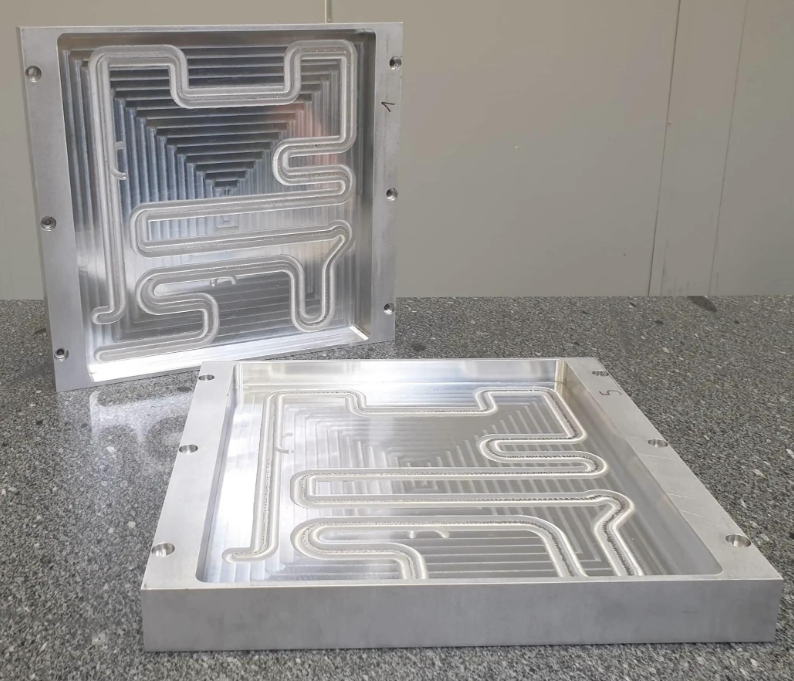
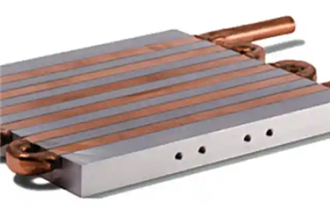
A liquid cold plate is a metal plate with internal channels or tubes. It mounts directly to heat sources. “Custom” means channel geometry, inlet/outlet, mounting holes, surface finish, and material are built around the application. Unlike a standard heat sink, it is part of the whole thermal system. See thermal management (electronics).
● Base material: copper, aluminum, or copper-aluminum hybrid
● Channel type: machined microchannel, tube-in-plate, brazed, friction stir welded
● Interface: thermal pad, paste, or direct contact
● Connectors: barb, threaded, quick-disconnect, custom manifold
Design and Material Selection
| Material | Thermal Conductivity | Best For | Notes |
| Copper C1100 | ~390 W/mK | High heat flux, IGBT | Heavy; corrosion control needed |
| Aluminum 6061 | ~167 W/mK | EV battery, data center | Lightweight, lower cost |
| Copper-aluminum hybrid | Hybrid | Weight-sensitive performance | Joining is critical |
| Stainless steel | Low | Corrosive fluids | Lower conductivity |
How We Manufacture Custom Liquid Cold Plates
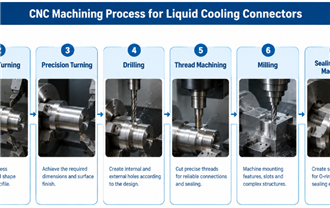
At Start Precision, we review CAD, thermal target, flow rate, and leak specification. Then we select the process. Our five-axis precision machining supports complex curved surfaces, oblique holes, and hollowed features. We machine channels, drill ports, face sealing surfaces, and inspect flatness. For volume production, we use brazing or friction stir welding.
| Item | Equipment | Brand / Model |
| 1 | Five-axis machining center | Germany DMG HSC 75 linear |
| 2 | Vertical Machining Center | Germany DMG DMC 835V |
| 3 | Vertical Machining Center | Japan LGMazak VCN-510C |
| 4 | Vertical Machining Center | United States HAAS VF3 |
| 5 | Horizontal machining center | United States HAAS EC400 |
| 6 | CNC turning machining center | Germany DMG CTX beta 800 |
| 7 | CNC turning machining center | Japan TAKZSAWA NEX-108 |
| 8 | Slow wire cutting | Japan Sodick ALN400Gs |
| 9 | Discharge spark machine | Japan MAKINO EDGE3 |
| 10 | Flat profile grinding machine | China MICCO 350 |
Quality Control and Testing
● CMM and flatness inspection
● Helium leak test or pressure decay
● Flow and pressure drop test
● Thermal cycling
● Cleanliness and particle check
● Surface treatment: anodizing, nickel plating, passivation
Applications
| Industry | Typical Heat Source | Cold Plate Focus |
| EV | Battery, inverter, OBC | Lightweight, vibration |
| Data center | CPU, GPU, power supply | High flow, low pressure drop |
| Power electronics | IGBT, SiC module | High heat flux, flatness |
| Medical | Laser, imaging | Leak-free, clean |
| Aerospace | Radar, avionics | Weight, reliability |
A customer needed a custom liquid cold plate for a 3 kW IGBT module. Heat flux was high, space was limited, and target thermal resistance was below 0.05 °C/W. We selected copper C1100, designed a serpentine microchannel, and machined the plate on a DMG HSC 75 linear. Ports were positioned to avoid hose interference. After nickel plating, each unit passed a 1.5 MPa pressure test and helium leak test. Flow testing showed 2.1 L/min at 18 kPa. The final design reduced module temperature by 22°C compared with the old aluminum heat sink. This is how we turn a thermal requirement into a production-ready cold plate.
Conclusion
Custom liquid cold plates are thermal components and precision parts. Success depends on design, material, machining, joining, testing, and supply consistency. If you need a manufacturing partner for prototypes or volume, contact us to discuss your manufacturing needs.
Q1: What is the difference between a heat sink and a liquid cold plate?
A heat sink uses air. A liquid cold plate uses a sealed liquid channel to move heat away faster.
Q2: What materials are used for custom liquid cold plates?
Copper, aluminum, copper-aluminum hybrid, and sometimes stainless steel for corrosive fluids.
Q3: Can you produce prototypes and mass production?
Yes. We support prototype machining, pilot runs, and volume production.
Q4: How do you test for leaks?
We use helium leak testing, pressure decay, and pressure testing based on customer requirements.
Q5: What information is needed for a quote?
CAD files, heat load, flow rate, pressure drop limit, material, surface finish, and annual volume.
Add: Building 3No.277 Zhen'an Middle Road, Chang'an Town,Dongguan,Guangdong, China
Tel:+86-769-82855591
Copyright © 2019 All Rights Reserved Dongguan Start Precision Technology Co., Ltd. Tel: +86-769-82855591
Add: No. 277 Zhen'an Middle Road, Chang'an Town, Dongguan, Guangdong, China



 中文版
中文版 English