Custom Machining Parts for Irregular Shapes: Advanced Clamping Solution Design
Date:2026-06-10Article editor:Starting Point PrecisionViews:430Machining custom parts with irregular shapes presents unique workholding challenges. Unlike prismatic blocks or cylinders, organic surfaces, freeform contours, and non-uniform geometries demand clamping solution designs that balance accessibility, force distribution, and vibration damping. This guide outlines proven strategies, practical examples, and key resources to help engineers and machinists optimize their setup for such complex components.
Irregular workpieces often lack flat, parallel, or concentric reference surfaces. This leads to three core issues:
● Unstable seating – The part rocks or shifts under cutting forces.
● Localized stress – Point clamping can deform thin walls or delicate features.
● Interference – Clamps block tool paths, requiring multiple repositionings.
Overcoming these requires a tailored clamping solution design that matches the unique geometry of each custom machining part.
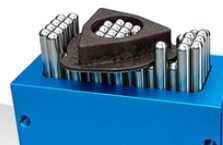
Before selecting hardware, follow these principles:
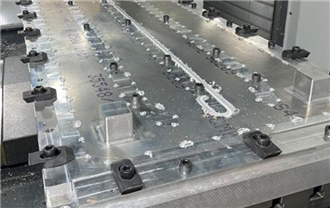
1. Maximize contact – Use conformal fixtures that mirror the part’s shape.
2. Direct forces to rigid sections – Avoid thin webs or unsupported overhangs.
3. Minimize re-fixturing – Design for single-setup machining where possible.
For a deeper understanding of foundational workholding, refer to complete workholding guide.
1. Custom Soft Jaws & Conformal Fixtures
Milling or 3D printing soft jaws to exactly match the workpiece contour provides full support and non-marring clamping. For aluminum or plastic parts, low-melt alloys can also create reusable nests. Learn more about conformal techniques from advanced workholding principles.
Additive manufacturing enables rapid production of lightweight, complex clamping aids using carbon-fiber nylon or rigid resin. A printed fixture can incorporate vacuum channels, locators, and chip evacuation holes. See an example setup in this 3D printed clamping nest for freeform part.
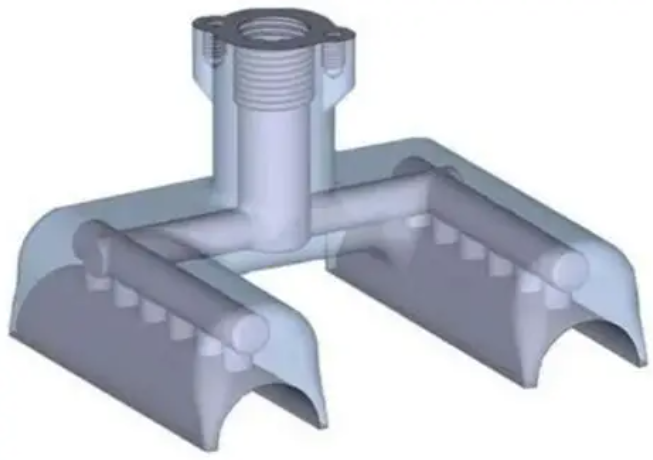
For large, thin, or non-ferrous irregular parts (e.g., carbon fiber skins or machined pockets), vacuum tables with customizable rubber seals distribute hold-down force evenly without distortion.
Adjustable clamping elements – such as ball-end clamps, articulated toes, and magnetic supports – allow fine adaptation to odd angles. They are ideal for low-volume production.
For steel or iron irregular parts, electromagnetic chucks with pole extensions can conform to step-like surfaces. Combine magnetic base with mechanical side clamps for rigid 5-axis machining.
Follow these steps when designing a clamping solution for an irregular custom machining part:
● Analyze the CAD model – Identify stable datums, thick sections, and areas needing access.
● Create negative form – In CAM or design software, derive a fixture body that mates with the part.
● Select clamping type – Choose among the solutions above based on material, batch size, and machine type.
● Simulate forces – Use finite element analysis to verify that clamping won’t cause part deflection.
● Prototype quickly – 3D print or machine a test fixture before hard tooling.
● Use low-profile clamps (e.g., toe clamps or edge clamps) to maximize tool access.
● Apply clamping force in the direction of cutting forces where possible.
● Add registration pins to eliminate rotation, especially for asymmetrical parts.
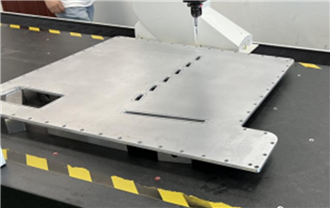
● Inspect first-off parts with a CMM to validate fixture accuracy.
By integrating these strategies, you can transform problematic custom machining part orders into reliable, repeatable processes.
Q1: How do I clamp a very thin, irregular-shaped part without warping it?
A: Use vacuum clamping or a fully supported 3D printed fixture with low-force toggle clamps. Avoid point clamps and apply pressure over large areas.
Q2: Can I use the same clamping solution for different irregular shapes in small batches?
A: Yes – modular clamping kits with adjustable arms and ball-lock pins allow reconfiguration. Alternatively, 3D print a new nest for each shape at low cost.
Q3: What is the best material for custom fixture jaws when machining aluminum irregular parts?
A: Aluminum or machinable wax for prototyping; for production, use 6061 aluminum with soft tips (brass or nylon) to avoid marking.
Q4: How do I handle undercuts or holes in the part that interfere with clamping?
A: Design fixture features that engage with existing holes (using expanding mandrels or dowel pins) or use top-clamping over reinforced bridges.
Q5: Does a magnetic solution work for stainless steel irregular parts?
A: Only for martensitic or ferritic stainless grades (400 series). Austenitic (300 series) is non-magnetic; use mechanical or vacuum clamping instead.
Add: Building 3No.277 Zhen'an Middle Road, Chang'an Town,Dongguan,Guangdong, China
Tel:+86-769-82855591
Copyright © 2019 All Rights Reserved Dongguan Start Precision Technology Co., Ltd. Tel: +86-769-82855591
Add: No. 277 Zhen'an Middle Road, Chang'an Town, Dongguan, Guangdong, China



 中文版
中文版 English