CNC Precision Turned Parts with EDM Hole Drilling
Date:2026-07-30Article editor:Starting Point PrecisionViews:324In the relentless pursuit of higher engine efficiency and thrust, turbine inlet temperatures in modern jet engines continue to soar, often exceeding the melting point of the superalloys used in their construction. This thermal reality necessitates sophisticated cooling strategies, primarily reliant on intricate networks of tiny cooling holes. Achieving these features—specifically, φ0.3mm diameter holes with a depth-to-diameter ratio of 50:1—in hard-to-machine materials presents a monumental manufacturing challenge. While laser drilling offers speed, the demand for metallurgical integrity and geometric precision has cemented the role of EDM hole drilling as a premier finishing process for complex CNC precision turned parts.
This article details the capabilities, parameters, and advantages of this critical manufacturing combination, focusing on high-value components like turbine blades and combustion chamber elements.
Electrical Discharge Machining (EDM) excels where conventional cutting fails. It is a non-contact thermal process where precisely controlled electrical sparks erode conductive materials, independent of material hardness. For micro-hole drilling, particularly using the EDM hole drilling (or "small hole EDM") method, a rotating tubular electrode (often brass or copper) is used.
The key to achieving φ0.3mm holes with extreme accuracy lies in the machine's power supply, spark gap control, and high-precision servo systems. Unlike conventional drilling, EDM produces no mechanical cutting forces, eliminating tool breakage risks and minimizing burr formation, which is critical for the thin-walled sections typical of CNC precision turned parts. The achievable surface finish (Ra < 0.8µm) and minimal recast layer (typically < 0.02mm) are vital for the long-term fatigue life of components subjected to high thermal and mechanical stress.
Producing a hole with a 50:1 depth-to-diameter ratio, such as a φ0.3mm hole that is 15mm deep, demands meticulous process control. Successful implementation relies on optimizing several key parameters:
| Parameter | Value/Range | Critical for |
| Electrode Size | φ0.1mm – φ0.3mm | Hole diameter precision and aspect ratio capability |
| Peak Current (Ip) | 1 – 10 Amperes | Material removal rate and surface finish |
| Pulse On-Time (Ton) | 5 – 50 µs | Controlling heat input and recast layer |
| Dielectric Fluid | Deionized water (high pressure 50-100 bar) | Flushing debris from the deep hole and maintaining spark stability |
| Servo/Feed Rate | Adaptive, based on spark gap voltage | Preventing electrode short-circuiting and ensuring stable erosion |
| Electrode Rotation | Up to 300 RPM | Eccentric wear compensation and improved flushing |
These parameters are not static; they require adaptive control. As the electrode penetrates deeper, flushing becomes increasingly critical. High-pressure deionized water flows through the electrode's internal bore, effectively expelling eroded particles to prevent arcing and maintain the high precision required for CNC precision turned parts.
The production of complex components combining turning and EDM drilling follows a structured process. For instance, consider a high-pressure turbine blade from a leading aerospace OEM. Our workflow integrates primary turning with secondary EDM operations:
1. Primary CNC Turning: The blade's root and outer profile are machined on high-precision CNC turning machining centers, such as the Germany DMG CTX beta 800 or Japan TAKZSAWA NEX-108, which are part of our Precision equipment list. This establishes a precise reference datum and achieves the tight tolerances required for the blade's geometry.
2. Hole Positioning: The blade is securely transferred to a specialized EDM drilling machine.
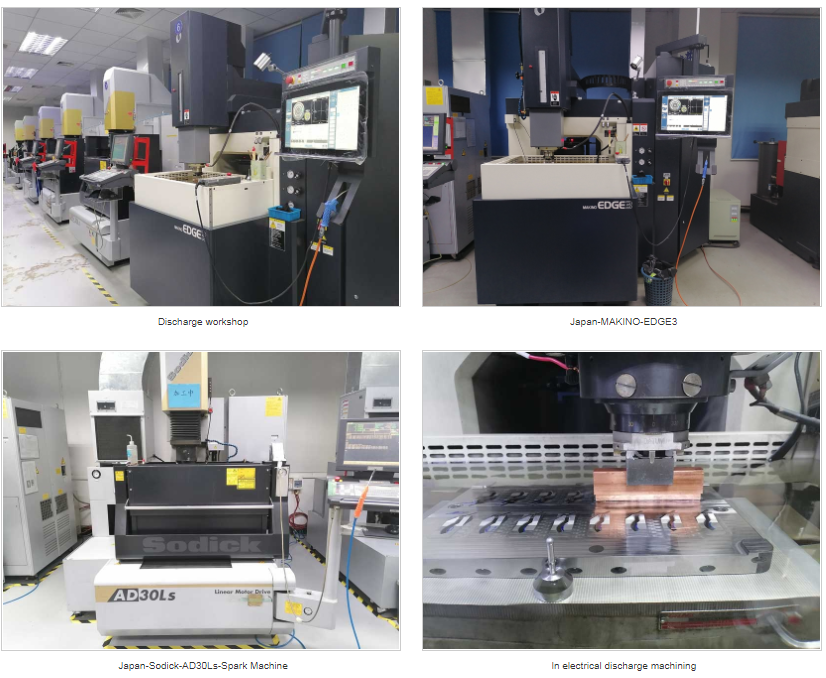
3. EDM Hole Drilling: Utilizing a machine like the Japan Sodick AD30Ls, or Japan MAKINO EDGE3 for highly precise, low-taper micro-holes, the cooling holes are machined. The EDM process excels here as it does not induce mechanical stresses that could distort the thin-walled component.
4. Precision Inspection: Post-process verification using non-contact optical measurement systems and coordinate measuring machines (CMMs) ensure the position, diameter (as low as φ0.3mm), and depth of every hole meets the stringent print requirements.
A common question in manufacturing engineering is the choice between laser and EDM for micro-hole creation. Each has distinct advantages and significant drawbacks.
| Criteria | EDM Hole Drilling | Laser Drilling |
| Hole Quality | Superior. High geometric precision, minimal taper, excellent surface finish, and a thin, predictable recast layer. | Inferior. Often results in taper, spatter, and a thicker, irregular recast layer with micro-cracks due to rapid thermal cycling. |
| Metallurgical Integrity | Excellent. Minimal thermal damage to the underlying base material. | Can be problematic. The rapid heating and cooling cycles can induce micro-cracks and alter the material's microstructure near the hole edge. |
| Material Suitability | Independent of material hardness. Ideal for superalloys (Inconel, Rene), hardened steels, and Tialloy. | Effective on most metals, but highly reflective materials (e.g., copper, aluminum) can be challenging or require specific laser types. |
| Aspect Ratio Capability | Excellent. Capable of achieving 50:1 or higher with high precision. | Limited. Maintaining quality and straightness at high aspect ratios (>20:1) is extremely difficult. |
| Production Speed | Slower. Material removal is an iterative process. | Much faster. |
| Entry/Exit Burr | Minimal or no burr. | Can produce a raised recast lip on the entry and exit points. |
For mission-critical applications like turbine blade cooling, where a failure can be catastrophic, the superior hole quality and predictable metallurgical integrity of EDM make it the preferred and often mandated process, despite its lower throughput compared to laser.
A prominent client in the aerospace industry approached us with a critical challenge. Their CNC precision turned parts—turbine blades made of a nickel-based superalloy—required a complex array of cooling holes. The laser drilling process they were using resulted in unacceptable recast layer thickness (average 0.05mm) and micro-cracks on the hole wall, leading to a 15% failure rate in subsequent thermal cycling tests.
By transitioning the operation to our EDM hole drilling department, we implemented a multi-step strategy:
1. Process: Used an Japan Sodick AD30Ls with a precise electrode guiding system.
2. Parameter Adjustment: Optimized pulse parameters to achieve an average recast layer of less than 0.015mm.
3. Outcome: The EDM-drilled holes exhibited a superior surface finish (Ra 0.6µm) with no detectable micro-cracks. This resulted in a 98% pass rate on thermal cycling tests, significantly extending the operational lifespan of the component and dramatically reducing the scrap rate, providing the client with both performance and cost benefits.
The relentless demand for higher engine performance in the aerospace and power generation industries will continue to drive the need for precision manufacturing. The combination of CNC precision turned parts with specialized EDM hole drilling represents a mature yet highly effective solution for creating the vital cooling networks required for modern high-performance systems.
While laser drilling offers speed, it cannot consistently match the superior geometric quality, surface finish, and structural integrity provided by EDM, especially for critical features like φ0.3mm holes with 50:1 depth-to-diameter ratios. The capabilities of our equipment, including the Japan Sodick AD30Ls and Japan MAKINO EDGE3, as detailed in our Precision equipment list, are fundamental to delivering these exacting standards. At our factory, we have successfully applied this expertise across numerous demanding projects, proving the value of precision engineering for high-stakes applications.
Contact us to discuss your manufacturing requirements.
1. What is the smallest hole diameter achievable with EDM drilling on your equipment?
We can reliably machine holes as small as φ0.1mm. However, for high aspect ratio applications in your industry, φ0.3mm is a very common and highly controlled specification.
2. What is the maximum depth-to-diameter ratio you guarantee for EDM drilling?
We have extensive experience with ratios of 50:1 and can execute up to 100:1 on our advanced machines, depending on material and hole orientation.
3. How does EDM drilling affect the surface integrity of the component compared to laser drilling?
EDM produces a much thinner recast layer (typically < 0.015mm) that is more uniform and free of micro-cracks, unlike laser drilling which can cause significant heat-affected zones and stress fractures.
4. Can you perform EDM drilling on previously CNC turned parts?
Yes, absolutely. The majority of our projects follow this workflow. The precise datum established by CNC turning allows us to position and machine the EDM holes with extremely high accuracy.
Add: Building 3No.277 Zhen'an Middle Road, Chang'an Town,Dongguan,Guangdong, China
Tel:+86-769-82855591
Copyright © 2019 All Rights Reserved Dongguan Start Precision Technology Co., Ltd. Tel: +86-769-82855591
Add: No. 277 Zhen'an Middle Road, Chang'an Town, Dongguan, Guangdong, China



 中文版
中文版 English