Turned Parts Manufacturer for Green Manufacturing
Date:2026-07-30Article editor:Starting Point PrecisionViews:247The manufacturing industry is at a pivotal juncture. While the demand for high-precision components continues to soar, so does the pressure to reduce the environmental footprint of production processes. For the modern turned parts manufacturer, sustainability is no longer just a compliance issue; it is a competitive advantage and a moral imperative.
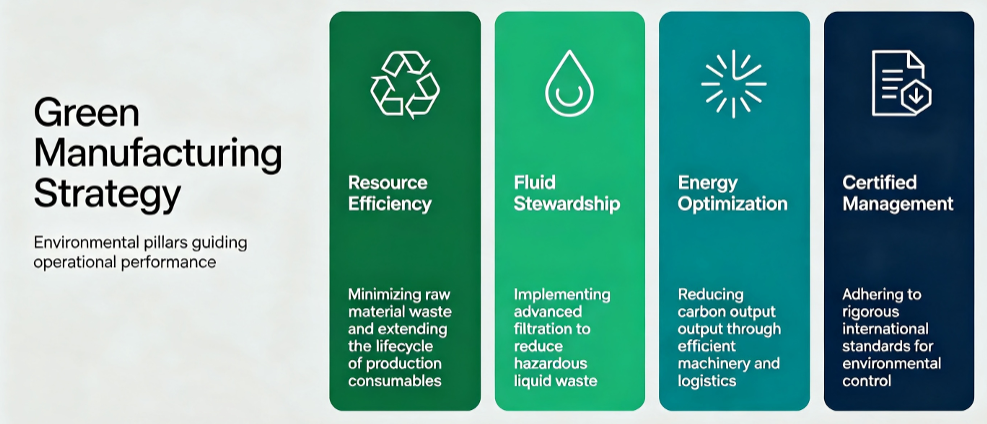
To achieve holistic green manufacturing, we focus on four core environmental pillars that guide our operational strategy:
♻️ Resource Efficiency: Minimizing raw material waste and extending the lifecycle of production consumables.
💧 Fluid Stewardship: Implementing advanced filtration to reduce hazardous liquid waste.
⚡ Energy Optimization: Reducing carbon output through efficient machinery and logistics.
📜 Certified Management: Adhering to rigorous international standards for environmental control.
A significant environmental challenge in CNC machining is the management of cutting fluids and metal byproducts. A forward-thinking turned parts manufacturer implements systematic solutions to tackle these issues head-on.
1. Cutting Fluid Circulation and Filtration
By employing high-efficiency filtration units, we extend the life of the coolant, reduce the frequency of fluid changes, and minimize hazardous waste. This not only conserves water and chemicals but also lowers operational costs and protects operator health.
2. Waste Chip Recycling and Reus
Materials like steel, aluminum, and brass are highly recyclable. Through a rigorous on-site chip collection and baling system, we ensure over 95% of our metal waste is sent to certified recyclers, drastically reducing the demand for virgin raw materials and the immense energy required for primary metal production.
To provide clarity on our environmental performance, here is a summary of our key sustainability metrics achieved in the last fiscal year:
| Green Initiative | Implementation Method | Annual Environmental Benefit |
| Fluid Filtration | High-precision coolant filtration systems | Reduced fluid disposal volume by 40% |
| Chip Recycling | On-site baling & certified scrap buyer program | Recycled 80+ tons of steel & aluminum |
| Carbon Reduction | Renewable energy procurement & logistics optimization | Lowered Scope 1 & 2 emissions by 15% |
| Waste Management | Segregated waste streams for hazardous materials | Achieved Zero Landfill for non-hazardous waste |
To structure and validate these efforts, our green manufacturing strategy is anchored in the ISO14001 environmental management standard. This certification ensures we systematically manage our environmental responsibilities, from regulatory compliance to achieving ambitious sustainability targets. For a turned parts manufacturer, ISO14001 is a clear signal to clients (especially in the medical and automotive sectors) that we operate with the highest levels of environmental integrity.
Achieving these green goals requires a stable and precise foundation. Our commitment to sustainability does not come at the expense of quality. This is why we have equipped our factory with energy-efficient, world-renowned machinery from our comprehensive Precision Equipment List, including the Germany DMG CTX beta 800 and Japan TAKZASAWA NEX-108 turning centers. These advanced systems allow for tighter tolerances, significantly reducing material waste and the energy consumption associated with rework.
To illustrate our commitment in action, consider a recent project for a medical device client. We faced the challenge of producing high-volume, complex components with strict surface finish requirements.
● Challenge: High cutting fluid consumption and significant aluminum chip waste.
● Our Green Solution:
◆ Transitioned to a high-efficiency, long-life cutting fluid paired with a closed-loop filtration system.
◆ Collaborated with a local recycler to guarantee all generated chips were directly repurposed.
● Outcome: We reduced the component's fluid consumption and disposal costs by 30%, while successfully diverting 100% of the metal waste from landfills, turning a waste stream into a valuable resource for the recycling industry.
In conclusion, the future of turned parts manufacturing is green. By integrating cutting fluid filtration, metal recycling, ISO14001 standards, and carbon reduction strategies, we prove that high precision and environmental responsibility can, and must, coexist. Our aim is not only to meet your technical specifications but to do so in a way that protects our planet for future generations.
Contact us to discuss your manufacturing needs and learn how our green initiatives can add value to your supply chain.
1. Why is cutting fluid filtration important in green manufacturing?
Filtration extends the life of cutting fluids, reduces the volume of hazardous waste, improves part quality by ensuring consistent cooling, and lowers operational costs by reducing the frequency of fluid purchases and disposal.
2. How is metal scrap from turning operations typically recycled?
Metal chips are collected, often compacted into briquettes to remove excess coolant, and then sent to specialized recycling facilities. These facilities melt down the scrap, refine it, and turn it into new metal bars or ingots, which can be used again in manufacturing.
3. What are the key benefits of ISO14001 for a turned parts manufacturer?
ISO14001 provides a structured framework for managing environmental responsibilities. It demonstrates a commitment to sustainability to customers and regulators, leads to cost savings through resource efficiency, and helps ensure compliance with environmental laws.
4. How does Start Precision measure its carbon footprint?
We measure our carbon footprint by tracking direct emissions from our operations (Scope 1) and indirect emissions from purchased energy (Scope 2). We also analyze our supply chain (Scope 3) to identify further reduction opportunities, focusing on energy efficiency and logistics.
5. Does going green increase the cost of my precision parts?
While there are initial investments, sustainable practices often lead to long-term cost reductions through material savings, energy efficiency, and reduced waste disposal fees. We are committed to providing competitive pricing while delivering on our sustainability promises.
Add: Building 3No.277 Zhen'an Middle Road, Chang'an Town,Dongguan,Guangdong, China
Tel:+86-769-82855591
Copyright © 2019 All Rights Reserved Dongguan Start Precision Technology Co., Ltd. Tel: +86-769-82855591
Add: No. 277 Zhen'an Middle Road, Chang'an Town, Dongguan, Guangdong, China



 中文版
中文版 English