Turning and Grinding Technology: Multi-Process Coordination Precision
Date:2026-04-21Article editor:Starting Point PrecisionViews:453Modern precision manufacturing demands both high material removal rates and exceptional surface finishes. No single process achieves both efficiently—turning excels at shaping, grinding at finishing. Multi-process coordination integrates these two technologies into one seamless workflow, eliminating re-clamping errors and unlocking sub-micron tolerances. This article explains how coordinated turning and grinding works, its key strategies, and why it defines next-generation CNC production.
1. The Role of Turning in Pre-Machining
Turning rapidly generates cylindrical geometry, removing up to 80% of stock. However, turning leaves tool marks, waviness, and residual stress. For components like hydraulic pistons, bearing journals, or turbine shafts, the turned part serves as a pre‑machined blank with a consistent grinding allowance—typically 0.1–0.3 mm per side. The coordination starts here: turning parameters (feed rate, depth of cut) must be optimized to avoid excessive heat or work hardening, which would later disturb grinding.
2. Precision Grinding as the Final Arbiter
Grinding uses bonded abrasives to remove microscopic chips, achieving surface roughness down to Ra 0.05 µm and geometric tolerances within 1–2 µm. In a coordinated turn-grind cell, the grinding cycle is not independent. In-process measurement probes check the turned diameter and roundness; the CNC then adjusts grinding wheel infeed, speed, or spark-out time. This closed‑loop coordination compensates for any thermal drift or tool wear from the turning stage.
3. Core Strategies for Multi-Process Coordination
Successful turn-grind integration relies on three technical pillars:
· Unified CNC architecture – One controller manages both turning toolpaths and grinding cycles, synchronizing spindles, coolant, and axis movements. This avoids data handover errors.
· Thermal stability – Turning generates heat; grinding adds more. Integrated cooling systems (through-spindle coolant, external mist) and real‑time thermal sensors maintain positional accuracy. Some machines use thermosymmetric design to minimize growth.
· Intelligent tool/wheel management – Automatic tool changers (ATC) for turning inserts must coexist with grinding wheel dressers and balancing systems. Coordination software prevents collisions and schedules wheel touch‑up cycles during non‑cutting phases.
Machines like the EMAG VTC 100 GT or Mazak Integrex i-200S exemplify this approach. They allow turn-grind on a single chucking, reducing alignment errors from typical 10 µm (re‑chucking) to below 2 µm.
4. Key Benefits of Coordinated Turning and Grinding
✔ Higher accuracy – No re‑fixturing means perfect coaxiality and roundness.
✔ Shorter cycle times – Combined operations reduce idle and handling time by up to 40%.
✔ Lower capital cost – One machine replaces a turning center plus a separate grinder.
✔ Better surface integrity – Grinding removes the re‑hardened layer from turning, improving fatigue life.
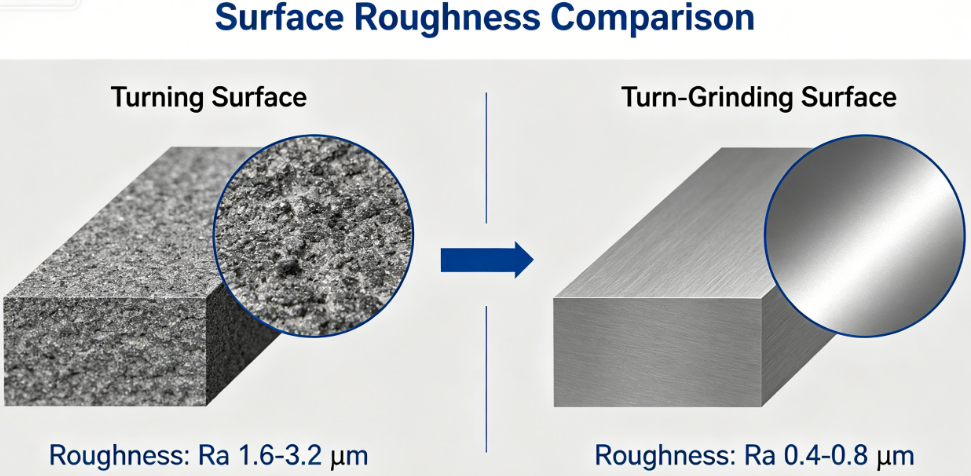
Comparison of surface roughness after turning vs. turn-grinding
5. Challenges and Smart Solutions
Despite its advantages, turn-grind coordination faces practical hurdles:
· Chip interference – Grinding swarf (abrasive dust) contaminates turning tools and guideways. Solution: High‑pressure coolant with directional nozzles and chip conveyors that separate ferrous chips from abrasive sludge.
· Coolant incompatibility – Turning often uses oil-based lubricants, while grinding prefers water-based fluids for cooling. Solution: Dual‑system coolant management or miscible semi‑synthetic fluids.
· Wheel wear monitoring – Grinding wheels lose profile during production. Solution: Acoustic emission sensors and in‑process dressing cycles triggered by measured part geometry.
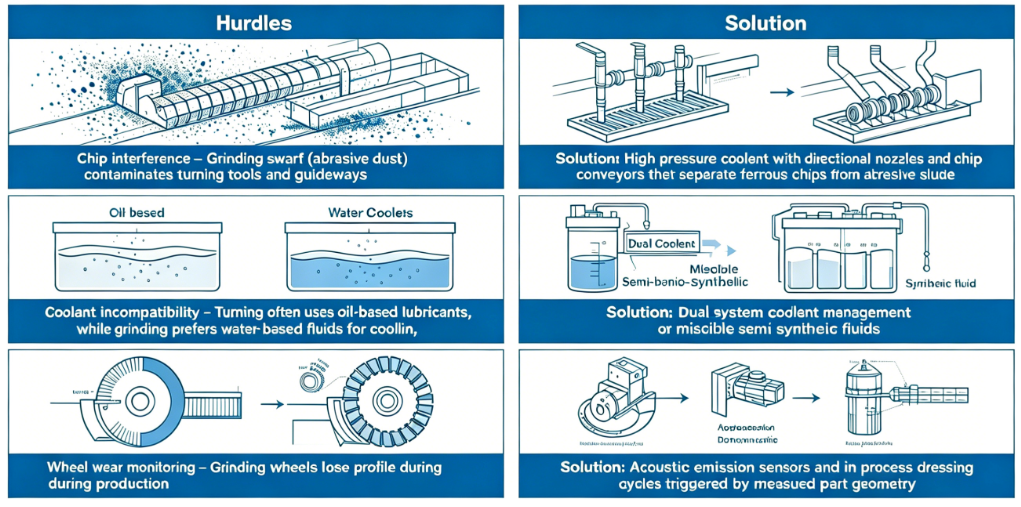
Practical Hurdles and Solutions in Turn-Grind Coordination
Recent studies from the Journal of Manufacturing Processes show that adaptive coordination reduces scrap rates by 60% in high‑volume production.
6. Future Outlook
With Industry 4.0, digital twins and AI-based process optimization will further refine turn-grind coordination. Machine learning models will predict thermal drift and compensate in real time, pushing precision toward the nanometer range. Fully autonomous “measure‑turn‑measure‑grind‑measure” closed loops are already appearing in prototype lines.
Add: Building 3No.277 Zhen'an Middle Road, Chang'an Town,Dongguan,Guangdong, China
Tel:+86-769-82855591
Copyright © 2019 All Rights Reserved Dongguan Start Precision Technology Co., Ltd. Tel: +86-769-82855591
Add: No. 277 Zhen'an Middle Road, Chang'an Town, Dongguan, Guangdong, China



 中文版
中文版 English