CNC Turned Parts: A Comprehensive Guide for Precision CNC Turning Machining
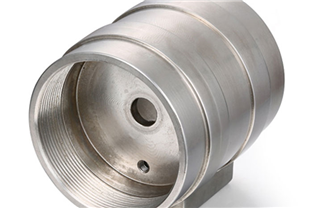
Date:2026-04-20Article editor:Starting Point PrecisionViews:493CNC Turned Parts refer to precision components manufactured by CNC Lathes (CNC Turning Centers) for precision turned parts production. They are one of the most widely used precision parts in industries such as mechanical manufacturing, electronics, and medical equipment. This guide covers all key aspects of CNC turned parts, including their working principles, features, materials, CNC turning tools, applications, and comparisons with other CNC machining processes.
1. Core Working Principles
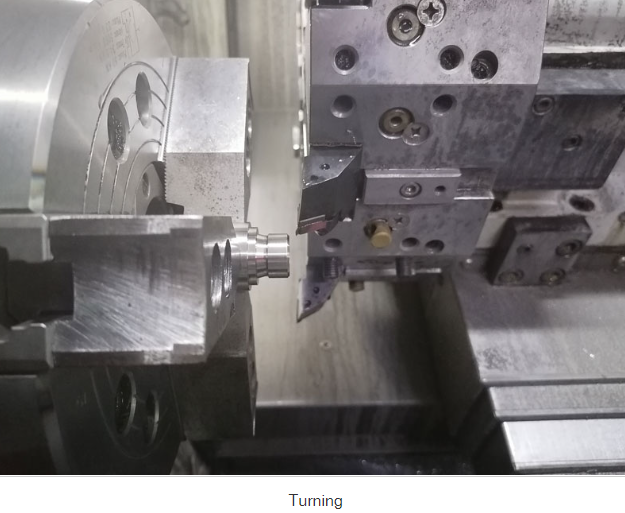
1.1 Workpiece Rotation, Tool Fixation: The material is clamped and rotated at high speed by a chuck, while a fixed cutting tool performs machining. The tool’s feed path is controlled by a program to achieve precise part processing.
1.2 Core Feature: Rotational symmetry (mainly shaft, disk, and sleeve parts, with mostly circular cross-sections).
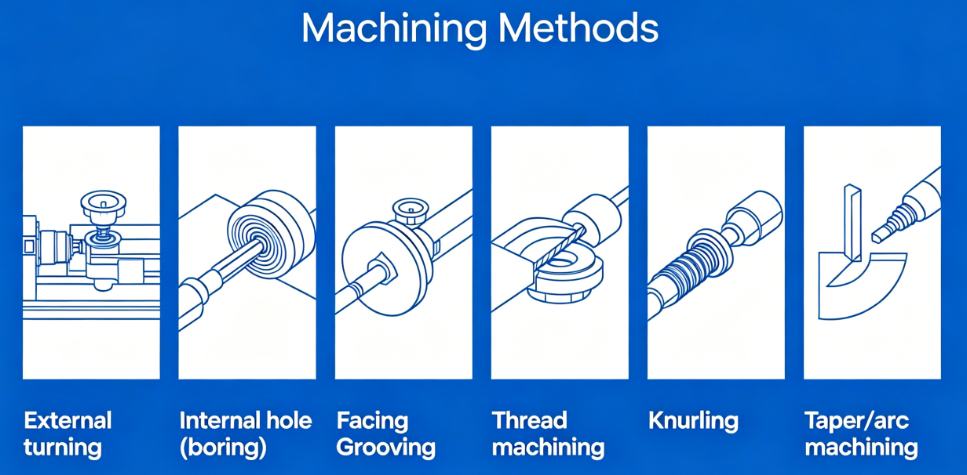
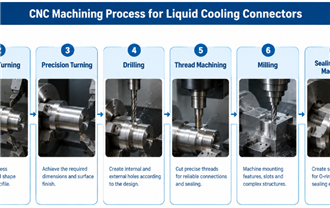
1.3 Machining Methods: External turning, internal hole (boring), facing, grooving, thread machining, knurling, taper/arc machining, etc. Multiple processes can be completed in one operation, making CNC turned parts processing more efficient and cost-effective.
2. Key Features
The superior performance of CNC turned parts is reflected in the following key features:
2.1 High Precision: Tolerances can reach ±0.001~0.005 mm, meeting the assembly requirements of precision equipment and ensuring part interchangeability for CNC turned parts.
2.2 High Efficiency: CNC lathes can achieve automated machining, suitable for mass production and rapid prototyping of CNC turned parts, reducing manual intervention and improving production efficiency.
2.3 Smooth Surface Finish: The surface roughness of CNC turned parts is low, often eliminating the need for secondary polishing and reducing production costs.
2.4 Strong Consistency: Machining programs can be reused, ensuring high dimensional and precision stability of batch CNC turned parts and avoiding errors caused by manual operation.
3. Common Materials
3.1 Metals: Aluminum and aluminum alloys (lightweight and easy to machine), stainless steel (corrosion-resistant and high-strength), copper/brass (good electrical and thermal conductivity), titanium alloys (high-strength and resistant to high and low temperatures), alloy steel (wear-resistant and tough).
3.2 Plastics: POM (poly oxy methylene, wear-resistant and dimensionally stable), PA66 (nylon, tough), PEEK (high-temperature and chemical corrosion resistant), PTFE (polytetrafluoroethylene, friction-resistant), ABS, PMMA (acrylic).
3.3 Others: Composite materials, cemented carbide, etc., which can be selected according to the part’s application scenario to ensure the quality of CNC turned parts.
4. CNC Turning Tools
CNC turning tools are the core components of turning operations for CNC turned parts. Their type, material, and precision directly affect part processing quality, efficiency, and tool life. They should be reasonably selected based on processing materials and process requirements. For professional guidance on CNC turning tools and machining techniques, you can visit CNC Cookbook, a leading online resource for CNC machining expertise.
4.1 Tool Classification (by Processing Function)
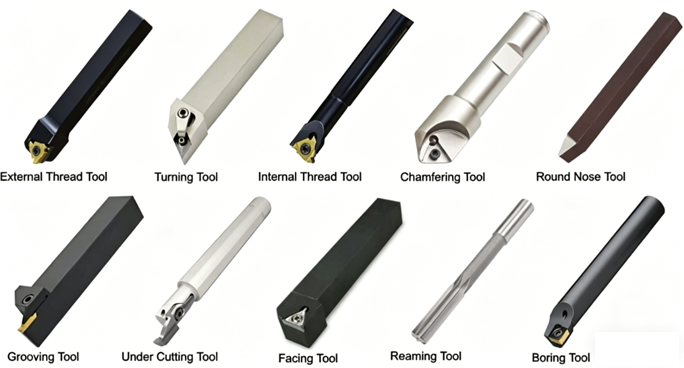
• External Turning Tools: The most commonly used tools for machining external circles, end faces, tapers, and arcs of parts. They are divided into rough turning tools and finish turning tools. Rough turning tools focus on removing material with high tool head strength; finish turning tools focus on ensuring precision and surface quality with sharp cutting edges.
• Internal Turning Tools (Boring Tools): Used for machining internal holes, internal steps, and internal threads of parts. They are divided into through-hole boring tools and blind-hole boring tools. The appropriate tool shank length should be selected according to the internal hole diameter and depth to avoid vibration during processing.
• Grooving/Cutting Tools: Used for grooving (circular grooves, axial grooves) on the part surface or cutting off parts. The tool head is narrow, and sufficient strength must be ensured to prevent breakage during cutting.
• Thread Turning Tools: Used for machining external and internal threads. They are divided into metric thread tools, imperial thread tools, and pipe thread tools. The corresponding tool should be selected according to thread specifications (pitch, thread form).
• Knurling Tools: Used for machining knurling (reticulate, straight grain) on the part surface to increase surface friction for easy gripping or assembly. They are divided into single-wheel and double-wheel knurling tools.
• Form Turning Tools: Used for machining complex formed surfaces (such as spherical surfaces, special curves). The tool head shape is consistent with the formed surface of the part, enabling one-time forming processing and improving efficiency.
4.2 Tool Materials
• High-Speed Steel (HSS): Good toughness and impact resistance, suitable for processing soft metals (aluminum, copper), low-speed cutting, or simple processes. Low cost, and the cutting edge can be reground repeatedly.
• Carbide: High hardness, wear resistance, and high-temperature resistance, suitable for processing hard metals (stainless steel, alloy steel, titanium alloy) and high-speed cutting. It is the most commonly used tool material in CNC turning currently, divided into solid carbide and indexable carbide (replaceable tool heads, reducing costs).
• Coated Tools: A wear-resistant coating (such as TiN, TiAlN) is applied to the surface of carbide or HSS tools, which can improve tool hardness, wear resistance, and lubricity, extend service life, and reduce cutting force and built-up edge.
• Diamond (PCD)/Cubic Boron Nitride (CBN): Extremely high hardness, suitable for processing super-hard materials, high-precision parts, or mirror finishing. High cost, mostly used in precision and high-end processing scenarios.
4.3 Key Points for Tool Selection
• Select based on processing materials: For soft metals (aluminum, copper), use HSS or coated HSS tools; for hard metals (stainless steel, alloy steel), use carbide or coated carbide tools.
• Select based on processing procedures: For rough machining, choose tools with high strength and impact resistance; for finish machining, choose tools with sharp cutting edges and high precision.
• Select based on part precision: For high-precision parts, use solid carbide or coated tools to avoid precision loss caused by tool wear.
• Match lathe parameters: Tool length and shank diameter should match the lathe chuck and spindle specifications to prevent vibration during processing.
5. Typical CNC Turned Parts and Applications
• Shafts/Rods/Pins: Drive shafts, mandrels, locating pins, worms, widely used in motors, machine tools, automobiles, and other equipment.
• Sleeves/Bushings/Rings: Bushings, shaft sleeves, bearing rings, sealing rings, used for guiding, sealing, and supporting equipment.
• Threads/Fasteners: Bolts, nuts, joints, pipe fittings, used for connecting and fixing parts.
• Disks/Flanges/Wheels: Flanges, gear blanks, pulleys, disks, used for transmission and connection of equipment.
• Valves/Hydraulic Parts: Valve cores, valve stems, joints, nozzles, applied in hydraulic and pneumatic systems.
• Medical/Electronic Parts: Surgical instruments, implants, connectors, probes, requiring high precision and cleanliness, mostly processed with titanium alloy or medical stainless steel.
6. CNC Turning vs. CNC Milling for CNC Turned Parts Production
Comparison Items | CNC Turning | CNC Milling |
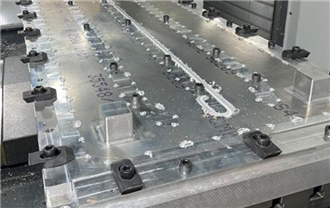
Movement Mode | Workpiece rotates, tool moves | Tool rotates, workpiece is fixed |
Suitable Shapes | Circular/symmetrical/shaft/disk/sleeve | Asymmetrical/complex 3D/plane/groove/cavity |
Efficiency | Extremely fast for circular parts | More flexible for complex structures |
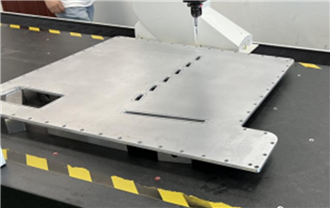
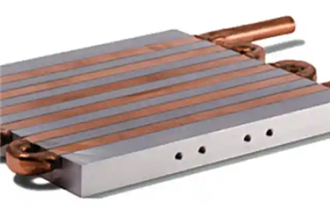
Typical Parts | Shafts, pins, sleeves, threads, flanges | Blocks, plates, housings, special-shaped parts |
7. Application Scenarios
7.1 Parts with a rotational main body (cylinder, cone, spherical surface, thread) that require rotational precision.
7.2 Parts requiring high roundness, coaxiality, and concentricity to meet precision assembly needs.
7.3 Production of small to mass batches of precision parts, suitable for automated machining.
7.4 Materials include metals, plastics, composite materials, etc., which can be flexibly selected according to application scenarios to meet the needs of CNC turned parts processing. For reliable wholesale CNC turned parts suppliers, you can refer to our production list.
In short: All circular, symmetrical, and high-precision parts are basically CNC Turned Parts. To produce high-quality CNC turned parts, suitable CNC turning tools and professional CNC lathe operation are the key factors. For a deeper understanding of CNC precision machining technology, you can refer to the authoritative resources from the Manufacturing Industry Knowledge Center.
Add: Building 3No.277 Zhen'an Middle Road, Chang'an Town,Dongguan,Guangdong, China
Tel:+86-769-82855591
Copyright © 2019 All Rights Reserved Dongguan Start Precision Technology Co., Ltd. Tel: +86-769-82855591
Add: No. 277 Zhen'an Middle Road, Chang'an Town, Dongguan, Guangdong, China



 中文版
中文版 English