
Robot Joint Parts for Humanoid Motion
Date:2026-11-23Article editor:Starting Point PrecisionViews:89Humanoid robots rely on precisely engineered Robot Joint Parts to achieve natural movement, balance, and flexible interaction with their surroundings. From walking and climbing to grasping objects and rotating the head, every movement depends on accurately manufactured mechanical components. The quality of these parts directly affects joint performance, structural stability, motion accuracy, and service life.
Unlike conventional industrial robotic arms, humanoid robots require integrated joint structures throughout the head, torso, arms, hands, legs, and feet. Each body section has different mechanical requirements and needs specially designed precision components.
1. What Are the Main Robot Joint Parts in Humanoid Robots?
A humanoid robot contains multiple interconnected joints. Each joint combines mechanical components that transmit force, support loads, and enable controlled movement.
The following table highlights commonly used precision-machined parts and their applications.
| Robot Body Part | Typical Robot Joint Parts | Main Function |
| Neck | Rotating shafts, bearing housings, motor brackets | Head rotation and positioning |
| Shoulder | Joint housings, output flanges, bearing seats | Arm lifting and rotation |
| Elbow | Drive shafts, connecting brackets, reducer housings | Arm bending and extension |
| Wrist | Miniature shafts, precision flanges, bearing retainers | Multi-directional wrist movement |
| Fingers | Small connecting links, hinge pins, joint brackets | Fine gripping and manipulation |
| Hip | Large joint housings, output shafts, mounting flanges | Leg rotation and body support |
| Knee | Actuator housings, transmission shafts, connecting links | Leg bending and load transmission |
| Ankle | Bearing supports, joint brackets, precision connectors | Balance and foot positioning |
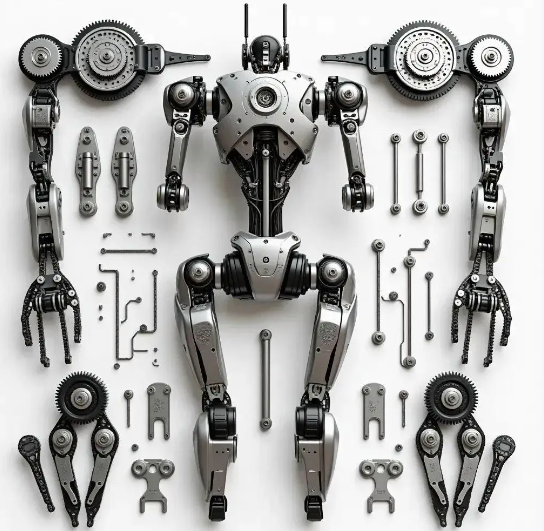
2. Essential Mechanical Components Behind Humanoid Motion
Humanoid robot joints consist of several interconnected mechanical components. Each component performs a specific function to ensure smooth movement, accurate positioning, and reliable force transmission.
2.1 Joint Housings and Bearing Seats
Joint housings provide structural protection and support for internal drive mechanisms. Bearing seats maintain the correct position of rotating components and help ensure stable movement.
● Applications: Shoulders, elbows, hips, knees, and ankles.
● Manufacturing requirements: Accurate dimensions, concentricity, surface finish, and bearing-fit tolerances.
● Common materials: Aluminum alloys and high-strength steel.
2.2 Precision Shafts and Output Flanges
Precision shafts transmit rotational force between the motor, reducer, and joint output. Output flanges connect the drive mechanism to the robot's limbs.
● Applications: Neck rotation, shoulder joints, wrists, hips, and knees.
● Manufacturing requirements: Shaft diameter accuracy, concentricity, roundness, and surface quality.
● Common materials: Alloy steel, stainless steel, and titanium alloys.
2.3 Reducer Housings and Transmission Components
Reducer housings accommodate internal transmission mechanisms, while associated precision components help transfer torque and control rotational movement.
● Applications: Shoulder, elbow, hip, and knee joints.
● Manufacturing requirements: Accurate mounting holes, bearing positions, dimensional consistency, and structural rigidity.
● Common materials: Aluminum alloys and steel.
2.4 Connecting Brackets and Structural Links
Connecting brackets and mechanical links join different sections of a humanoid robot's body. They must provide sufficient strength without adding unnecessary weight.
● Applications: Shoulder-to-arm connections, elbow links, finger joints, hip structures, and lower-leg assemblies.
● Manufacturing requirements: Accurate hole positioning, lightweight structures, and reliable assembly interfaces.
● Common materials: Aluminum alloys and stainless steel.
These components work together to support coordinated movement throughout the humanoid robot, from large-scale leg motion to delicate finger manipulation.
Related manufacturing reference: Precision machining equipment and workshop capabilities.
3. Precision Machining Requirements for Robot Joint Parts
Humanoid robot components often combine complicated geometries, lightweight structures, and demanding assembly requirements.
Important manufacturing considerations include:
● Dimensional accuracy: Maintain critical dimensions and fitting tolerances according to engineering drawings.
● Geometric accuracy: Control concentricity, flatness, perpendicularity, and positional relationships.
● Material selection: Aluminum alloys are useful for lightweight housings, while stainless steel, alloy steel, and titanium alloys may suit shafts and load-bearing components.
● Surface treatment: Anodizing, nickel plating, heat treatment, and other specified processes can improve surface properties.
● Quality inspection: Verify critical dimensions, surface quality, and assembly interfaces before delivery.
Five-axis machining is particularly useful for producing complex joint housings, angled mounting features, and multi-surface structural components.
4. Precision Manufacturing Capabilities for Humanoid Robot Components
For custom humanoid robot projects, manufacturing flexibility is important because joint designs vary between robot models.
Dongguan Start Precision Technology Co., Ltd. provides precision machining services, including five-axis machining, CNC milling, CNC turning, grinding, and wire cutting.
Its published precision equipment list includes:
| Equipment | Brand and Model |
| Five-axis machining center | Germany DMG HSC 75 Linear |
| Vertical machining center | Germany DMG DMC 835V |
| Vertical machining center | Japan Mazak VCN-510C |
| Vertical machining center | USA HAAS VF3 |
| Horizontal machining center | USA HAAS EC400 |
| CNC turning center | Germany DMG CTX beta 800 |
| CNC turning center | Japan TAKZAWA NEX-108 |
These machines provide manufacturing options for complex housings, precision shafts, brackets, and custom mechanical components.
5. Practical Example: Manufacturing a Humanoid Robot Knee Joint Housing
Consider a knee joint housing designed for a bipedal humanoid robot.
This component must accommodate the actuator and bearing assembly while connecting the upper and lower leg structures.
Its manufacturing process may involve:
1. Selecting a suitable aluminum alloy or other specified material.
2. CNC milling the main housing structure.
3. Precision machining bearing seats and mounting interfaces.
4. Finishing critical surfaces and holes.
5. Inspecting dimensions and geometric relationships.
6. Verifying the component against the customer's engineering drawings.
A properly manufactured housing helps maintain alignment, supports reliable assembly, and contributes to consistent knee movement.
Conclusion
Robot Joint Parts are fundamental to the performance of humanoid robots. From large hip and knee housings to miniature wrist and finger connectors, every component must meet its specific structural and motion requirements.
Choosing an experienced precision machining partner helps robot developers turn complex designs into manufacturable components while maintaining dimensional consistency and production flexibility.
Dongguan Start Precision Technology Co., Ltd. welcomes custom machining inquiries, prototype projects, and production requirements.
Contact us to discuss your manufacturing requirements. Share your drawings, material specifications, and project expectations with our engineering team for a professional manufacturing assessment.
Frequently Asked Questions
Q1: What are Robot Joint Parts used for in humanoid robots?
Robot Joint Parts connect different body sections and enable controlled movement. They are used in the neck, shoulders, elbows, wrists, fingers, hips, knees, and ankles.
Q2: Which materials are commonly used for humanoid robot joint components?
Aluminum alloys, stainless steel, alloy steel, copper alloys, and titanium alloys are commonly considered, depending on weight, strength, wear resistance, and operating conditions.
Q3: Which machining processes are suitable for humanoid robot joint parts?
CNC milling, five-axis machining, CNC turning, cylindrical grinding, surface grinding, and wire EDM are suitable for different component geometries and precision requirements.
Q4: Can Start Precision manufacture customized humanoid robot components?
Yes. Start Precision provides custom precision machining based on customer drawings and specifications, including CNC milling, turning, five-axis machining, grinding, and wire cutting.
Q5: What information is needed for a robot joint parts quotation?
Customers can provide:
◆ 2D engineering drawings and 3D CAD files.◆ Material and surface treatment requirements.
◆ Critical tolerances and inspection standards.
◆ Prototype or production quantities.
◆ Expected delivery schedule.
Q6: Why is machining accuracy important for humanoid robot joints?
Accurate machining helps maintain bearing alignment, reduce unwanted clearance, improve assembly consistency, and support smooth and repeatable joint movement.






Add: Building 3No.277 Zhen'an Middle Road, Chang'an Town,Dongguan,Guangdong, China
Tel:+86-769-82855591
Copyright © 2019 All Rights Reserved Dongguan Start Precision Technology Co., Ltd. Tel: +86-769-82855591
Add: No. 277 Zhen'an Middle Road, Chang'an Town, Dongguan, Guangdong, China



 中文版
 English
