
Custom Liquid Cooling Connectors for Memory Modules
Date:2026-11-19Article editor:Starting Point PrecisionViews:114Custom Liquid Cooling Connectors play an important role in connecting compact cooling channels, cold plates, and coolant distribution systems. For memory module applications, connectors must combine miniature dimensions, controlled flow, reliable sealing, and convenient installation without compromising system performance.
As high-performance computing and AI servers continue to evolve, memory modules require increasingly efficient thermal management. Traditional air cooling may struggle to maintain stable temperatures in high-density systems. Liquid cooling offers a more direct approach, but its performance depends heavily on the precision and reliability of every fluid connection.
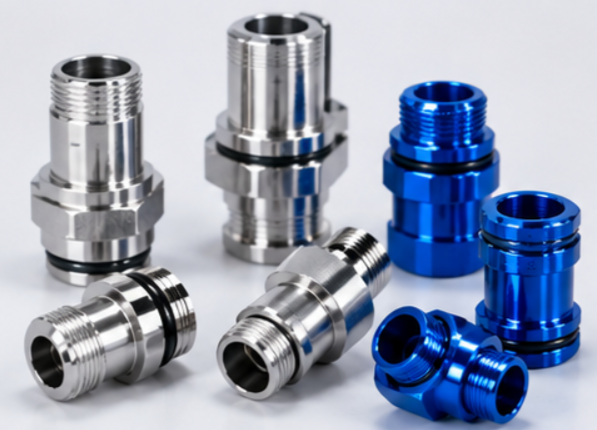
1. Why Memory Modules Need Custom Liquid Cooling Connectors
Memory modules are becoming more densely integrated, leaving less space for cooling components. Connector designs must accommodate limited installation areas while maintaining sufficient coolant circulation.
Key engineering requirements include:
● Miniaturization: Reduce connector dimensions to fit compact memory module assemblies.
● Low-flow control: Maintain stable coolant delivery while minimizing unnecessary pressure loss.
● Leak prevention: Provide dependable sealing to protect sensitive electronic components.
● Easy installation: Simplify assembly, maintenance, and connector replacement.
● Dimensional consistency: Ensure repeatable interfaces across production batches.
2. How We Engineer Custom Liquid Cooling Connectors
Our manufacturing approach focuses on precision machining, structural optimization, and application-specific customization.
A. Miniaturized Connector Structures
Smaller connectors require accurate machining of internal passages, mating surfaces, threads, and positioning features.
We use precision CNC milling, turning, and multi-axis machining to manufacture complex geometries according to customer drawings and 3D models.
B. Low-Flow Passage Optimization
In memory cooling applications, excessive flow resistance can affect the performance of the entire cooling loop.
Our engineering considerations include:
● Optimizing internal passage geometry.
● Controlling bore diameter and concentricity.
● Reducing unnecessary flow restrictions.
● Maintaining consistent dimensions between mating components.
Flow performance should be validated under the specified coolant, pressure, and temperature conditions.
C. Reliable Sealing Design
Leak prevention is essential when liquid connections operate close to sensitive electronic components.
Depending on the application, connector designs can incorporate:
● O-ring sealing grooves.
● Precision-machined mating surfaces.
● Controlled interference and clearance fits.
● Suitable corrosion-resistant materials.
● Drip-minimizing quick-disconnect structures.
Seal material and compression must be selected according to coolant compatibility and operating conditions.
D. Installation and Maintenance
Compact equipment often creates installation challenges. We consider connector orientation, insertion depth, assembly clearance, fastening methods, and alignment tolerances during the machining process.
Hand-mated and blind-mate interfaces may require different structural solutions. The appropriate design depends on the memory module assembly and maintenance requirements.
3. Our Precision Manufacturing Capabilities
Dongguan Start Precision Technology provides custom precision machining services for complex mechanical components.
Our manufacturing capabilities relevant to connector development include:
| Manufacturing process | Application |
| Five-axis CNC machining | Complex connector geometries |
| CNC milling | Precision slots, grooves, and passages |
| CNC turning | Cylindrical connector bodies and threads |
| Wire EDM | Fine profiles and precision features |
| Surface and cylindrical grinding | Dimensional and surface control |
Our equipment includes the DMG HSC 75 linear five-axis machining center, DMG DMC 835V vertical machining centers, MAZAK VCN-510C machines, and HAAS VF3 machining centers.
Explore our precision machining capabilities and custom manufacturing services.
4. Critical Design Factors at a Glance
| Design factor | Engineering focus | Expected benefit |
| Miniaturization | Compact geometry | Space-efficient integration |
| Flow performance | Passage dimensions | Controlled coolant circulation |
| Sealing | Groove and mating accuracy | Reduced leakage risk |
| Installation | Alignment and tolerances | Easier assembly |
| Material selection | Coolant compatibility | Improved service reliability |
| Quality control | Dimensional inspection | Consistent production |
Connector specifications should be established according to the actual application rather than relying on nominal dimensions alone.
5. From Prototype to Production
Our typical manufacturing workflow includes:
1. Drawing review: Evaluate 2D drawings, 3D models, materials, and critical dimensions.
2. Manufacturing assessment: Identify machining methods and potential structural challenges.
3. Prototype machining: Produce initial components for dimensional verification.
4. Quality inspection: Check critical dimensions, surface finish, and mating features.
5. Production support: Maintain process consistency for repeat orders.
For additional technical guidance, refer to the Open Compute Project's liquid cooling cold plate requirements, which discusses quick-disconnect interfaces, sealing, and serviceability.
6. Custom Manufacturing for Next-Generation Memory Cooling
Reliable liquid cooling starts with carefully engineered connection components. From miniature connector bodies to precision sealing grooves and complex internal passages, manufacturing accuracy directly influences assembly compatibility and long-term performance.
Dongguan Start Precision Technology supports custom precision-machined components based on customer drawings, material requirements, and application specifications.
Contact us to discuss your manufacturing requirements. Our engineering team welcomes inquiries about custom liquid cooling connectors, precision components, prototype development, and production machining.
Frequently Asked Questions
Q1: What are Custom Liquid Cooling Connectors for memory modules?
They are application-specific fluid connection components designed to connect cooling channels, cold plates, or coolant lines in memory module cooling assemblies.
Q2: Can connectors be customized for limited installation space?
Yes. Connector dimensions, internal passages, mounting features, and interface geometries can be customized according to drawings and assembly requirements.
Q3: How do you reduce leakage risks?
We focus on precision sealing grooves, mating surface accuracy, suitable seal materials, and dimensional consistency. Application-specific leak testing should also be defined.
Q4: Can you manufacture low-flow liquid cooling connectors?
Yes. We can machine customized internal passages and precision flow-related features. Final hydraulic performance should be verified against the customer's flow and pressure requirements.
Q5: What information is needed for a manufacturing quotation?
Please provide 2D drawings or 3D files, material specifications, critical tolerances, surface treatment requirements, estimated quantities, and any relevant testing criteria.
Q6: Do you support prototypes and mass production?
Yes. We support custom machining projects from prototype development to repeat production, subject to technical and capacity evaluation.






Add: Building 3No.277 Zhen'an Middle Road, Chang'an Town,Dongguan,Guangdong, China
Tel:+86-769-82855591
Copyright © 2019 All Rights Reserved Dongguan Start Precision Technology Co., Ltd. Tel: +86-769-82855591
Add: No. 277 Zhen'an Middle Road, Chang'an Town, Dongguan, Guangdong, China



 中文版
 English
