5 Key Parameters for Reading CNC Turning Parts Drawings – A Practical Guide
Date:2026-04-18Article editor:Starting Point PrecisionViews:539Understanding CNC turning part drawings is essential for machinists, quality engineers, and procurement specialists. Misinterpreting a single callout can lead to scrapped parts, tool damage, or assembly failures. This guide focuses on 5 key parameters you must check on every drawing before starting production.
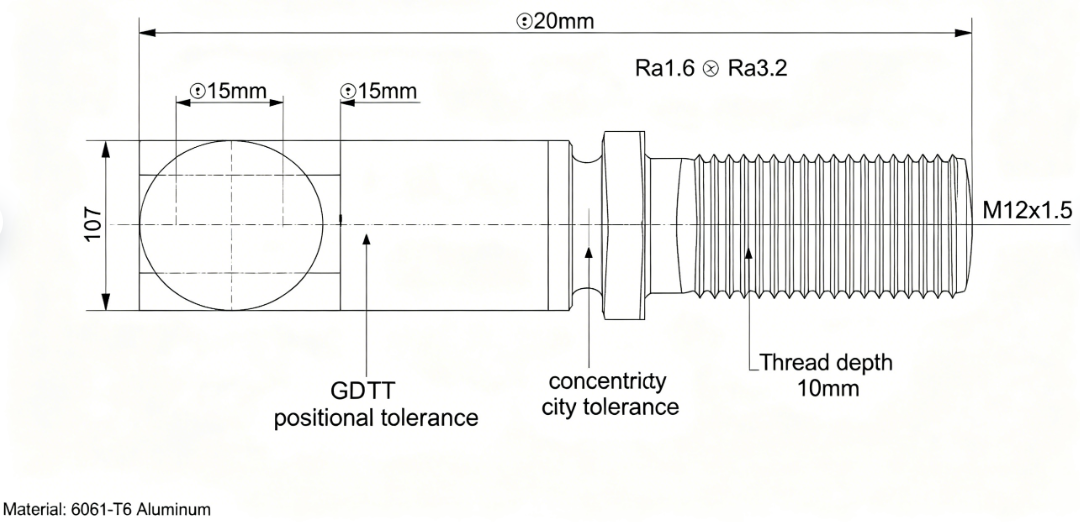
Annotated cnc turning drawing example – shows diameter, roughness, GD&T, thread, and material note.
1. Diameter & Length Tolerances (Linear Dimensions)
Unlike milling, turning produces cylindrical features. Pay special attention to:
● External diameters (e.g., Ø25±0.01 mm)
● Internal diameters (holes or bores)
● Lengths (shoulder distances, overall length)
Tolerances are often expressed as direct limits or ISO fit codes (e.g., H7/g6). For tight tolerances (±0.005 mm or less), specify grinding or hard turning.Refer to ISO fit chart.
2. Surface Roughness
Turning leaves characteristic tool marks. The drawing will show a roughness symbol (e.g., Ra 1.6 µm, Rz 6.3).
● Ra 0.4 – 0.8 : Requires fine feed, sharp insert, or secondary burnishing.
● Ra 1.6 – 3.2 : Standard finish for most functional surfaces.
● Ra 6.3 or higher : Rough turning only.
Tip: Sealing surfaces (hydraulic fittings) need Ra ≤ 0.8, while clamping diameters can be rougher.
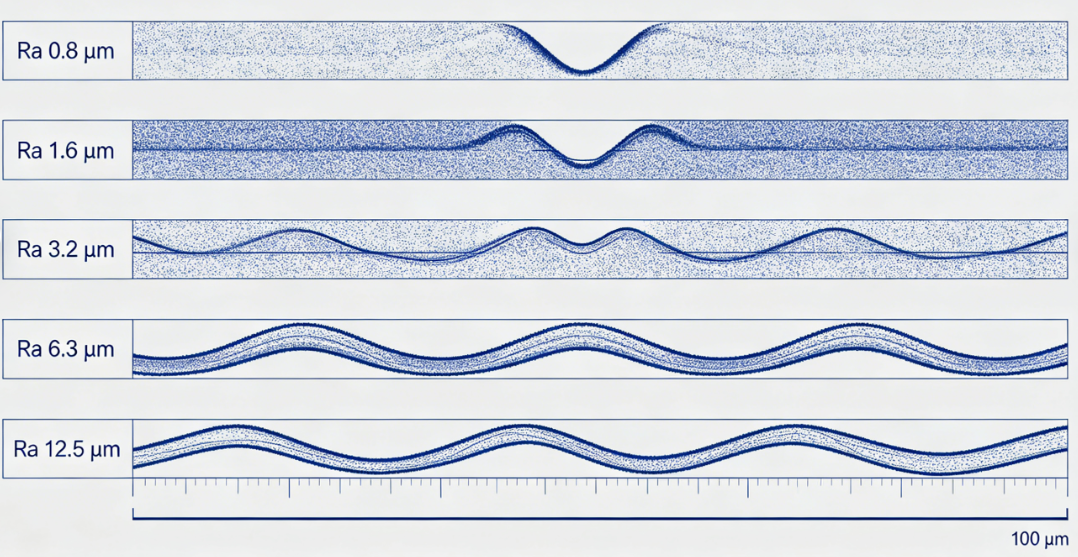
cnc turning surface roughness chart
Surface roughness chart cnc turning – shows different Ra values with microscopic profiles.
3. Geometric Dimensioning & Tolerancing (GD&T)
For rotating parts, concentricity and roundness are critical. The most common GD&T callouts on turned parts are:
● Concentricity / Coaxiality – ensures a bore is centered to an outer diameter.
● Circular runout – controls both roundness and concentricity simultaneously.
● Cylindricity – combines roundness, straightness, and taper.
Refer to GD&T runout explanation.
4. Thread Specifications
Many CNC turned parts (fittings, bolts, valve stems) include internal or external threads. The drawing must specify:
● Thread type – Metric (M), UNF/UNC, NPT, BSPP, etc.
● Size and pitch – e.g., M10×1.5, 1/4-20 UNC.
● Class of fit – 6H for internal, 6g for external (metric).
● Thread depth or length (e.g., “full thread 15 mm min.”)
Common mistake: Missing thread start or chamfer callout. Always look for a chamfer note (e.g., 0.5×45°) to prevent damaged first threads.
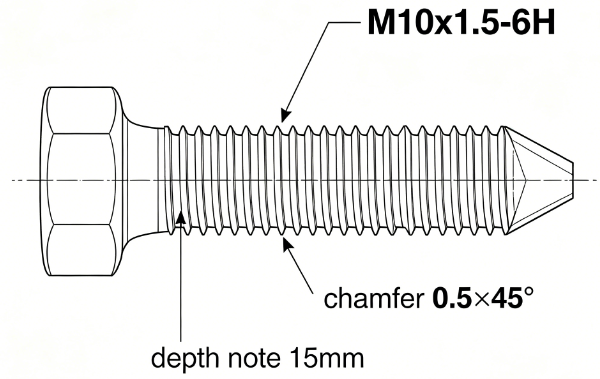
Thread callout on drawing – highlights M10x1.5-6H, chamfer, and depth note.
5. Material & Heat Treatment
The title block or a separate note must state:
● Material grade – e.g., 6061-T6 aluminum, 316 stainless, C36000 brass, PEEK.
● Heat treatment – annealing, stress relieving, case hardening (e.g., HRC 50-55).
● Surface treatment – anodizing, zinc plating, passivation, or as-machined.
If missing, contact the designer. Using wrong raw material (e.g., 303 instead of 304 stainless) can ruin corrosion resistance or weldability.You can refer to material property database.
Summary
Always scan a CNC turning drawing in this order:
1. Tolerances → 2. Roughness → 3. GD&T → 4. Threads → 5. Material
Skipping any of these five parameters risks non-conforming parts, rework costs, and delayed deliveries. Bookmark this guide and share it with your team.

Add: Building 3No.277 Zhen'an Middle Road, Chang'an Town,Dongguan,Guangdong, China
Tel:+86-769-82855591
Copyright © 2019 All Rights Reserved Dongguan Start Precision Technology Co., Ltd. Tel: +86-769-82855591
Add: No. 277 Zhen'an Middle Road, Chang'an Town, Dongguan, Guangdong, China



 中文版
中文版 English