The Basics of CNC Turned Machining: Understanding the Process
Date:2026-04-17Article editor:Starting Point PrecisionViews:477CNC turned machining is a subtractive manufacturing method used to create cylindrical parts with high precision. It relies on computer-controlled lathes to rotate a workpiece while a cutting tool removes material. This article explains the fundamentals, key steps, advantages, and common uses of CNC turning.
What Is CNC Turned Machining?
CNC (Computer Numerical Control) turning automates the operation of a lathe machine. Unlike manual lathes, CNC lathes follow programmed instructions (G-code) to control spindle speed, tool movement, and feed rate. The process is ideal for producing symmetrical components like shafts, bushings, and threaded rods.
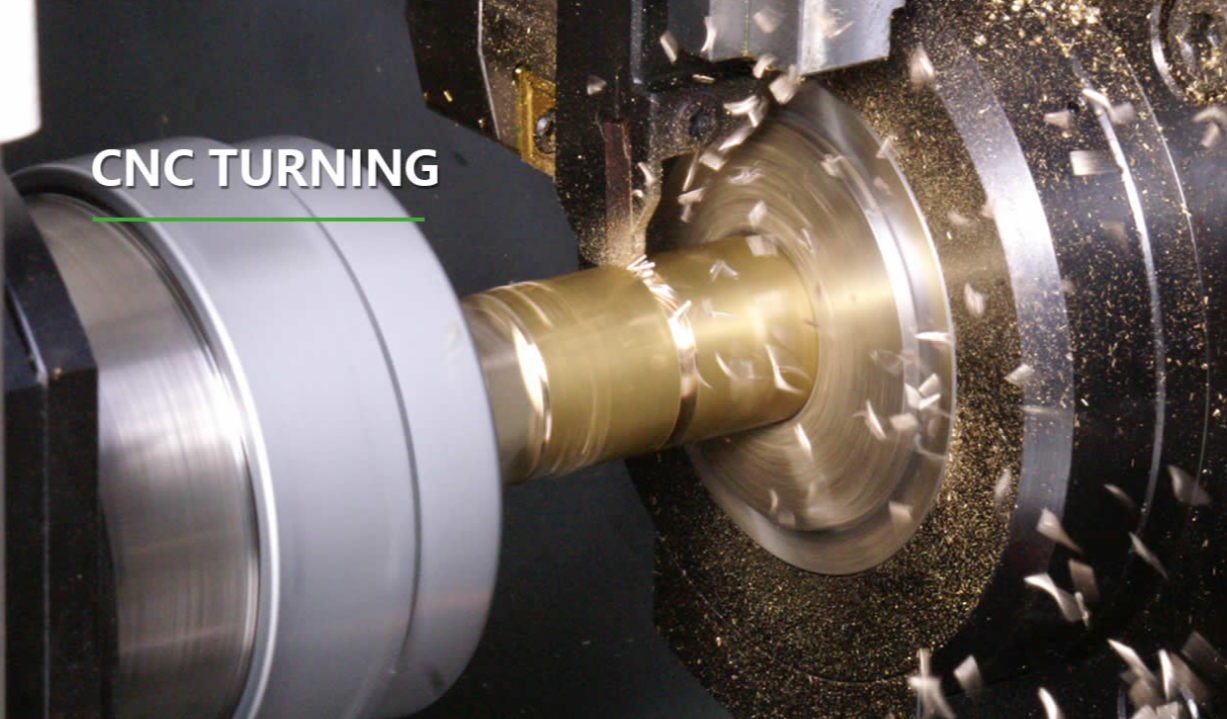
workpiece clamped in chuck, cutting tool on turret
Key Steps in the CNC Turning Process
1. Design & Programming
Engineers create a 3D CAD model, then convert it into machine-readable G-code using CAM software. The code defines toolpaths, cutting depths, and spindle speeds.
2. Material Setup
Raw material (e.g., aluminum, steel, brass, or plastic) is securely clamped in the lathe’s chuck. Proper alignment prevents vibration and inaccuracies.
3. Tool Selection & Calibration
Different operations require specific tools: turning tools for outer diameter reduction, boring bars for internal holes, and parting tools for cutoff. Tools are calibrated to a known reference point.
4. Machining Execution
The spindle rotates the workpiece (typically at 500–4000 RPM), and the cutting tool moves linearly along the X and Z axes to remove material. Coolant is applied to reduce heat and improve surface finish.
5. Inspection & Finishing
Finished parts are measured with calipers, micrometers, or CMMs. Secondary processes like threading or knurling may be added.
Example G-code tutorial for CNC turning.
Advantages of CNC Turned Machining
● High Precision: Tolerances as tight as ±0.005 mm are achievable.
● Repeatability: Identical parts can be produced thousands of times without deviation.
● Complex Geometries: Tapers, contours, and eccentric diameters are possible with live tooling.
● Material Efficiency: Minimal waste compared to casting or forging.
● Automation: One operator can manage multiple machines, reducing labor costs.
Common Applications
CNC turned parts are found in virtually every industry:
● Automotive: Engine valves, transmission shafts, wheel hubs.
● Aerospace: Landing gear components, hydraulic fittings.
● Medical: Bone screws, surgical instrument handles.
● Electronics: Connectors, heat sinks, battery terminals.
● Industrial Machinery: Rollers, pulleys, pneumatic couplings.
Conclusion
CNC turned machining is a core process for producing round metal and plastic parts with speed and accuracy. Understanding the basic workflow – from CAD design to final inspection – helps engineers and buyers make informed sourcing decisions. Whether you need prototype bushings or high-volume shafts, CNC turning offers a reliable, cost-effective solution.
Add: Building 3No.277 Zhen'an Middle Road, Chang'an Town,Dongguan,Guangdong, China
Tel:+86-769-82855591
Copyright © 2019 All Rights Reserved Dongguan Start Precision Technology Co., Ltd. Tel: +86-769-82855591
Add: No. 277 Zhen'an Middle Road, Chang'an Town, Dongguan, Guangdong, China



 中文版
中文版 English