Aluminum CNC Turned Parts: 6061 vs 7075 – How to Choose the Right Material?
Date:2026-04-18Article editor:Starting Point PrecisionViews:477Selecting the optimal aluminum alloy is the cornerstone of a successful CNC turning project. While both 6061 and 7075 aluminum are aerospace-grade materials frequently machined into precision turned parts, they serve distinctly different engineering purposes. Choosing incorrectly can lead to premature part failure, excessive tool wear, or unnecessary material costs. This guide breaks down the mechanical properties, machinability, and ideal applications of these two industry heavyweights to help you make an informed decision.
★ Overview of 6061 Aluminum in CNC Turning
6061 aluminum is the most versatile and widely used alloy in the CNC turning industry. It is a precipitation-hardened alloy containing magnesium and silicon as its major alloying elements. For turned parts—such as spacers, bushings, fittings, and electronic housings—6061 is often the default recommendation.
Key Advantages for Turned Parts:
● Superior Corrosion Resistance: 6061 offers excellent resistance to atmospheric corrosion and is well-suited for marine applications when anodized.
● Excellent Weldability: If the turned part requires secondary welding, 6061 is the clear winner.
● Formability and Surface Finish: In CNC Swiss turning operations, 6061 yields a smoother surface finish right off the machine due to its lower hardness and better chip formation.
★ Overview of 7075 Aluminum in CNC Turning
7075 aluminum is the go-to material when strength-to-weight ratio is the absolute priority. Alloyed primarily with zinc, 7075 rivals the strength of many low-carbon steels while maintaining the lightweight characteristics of aluminum. It is a staple in the defense, aerospace, and high-performance motorsports sectors.
Key Advantages for Turned Parts:
● Exceptional Tensile Strength: In the T6 temper, 7075 has nearly double the yield strength of 6061.
● High Fatigue Resistance: Ideal for components subjected to cyclical loading or vibration.
However, this strength comes at a trade-off. 7075 has poor corrosion resistance (often requiring protective coatings like hard anodizing) and is notoriously difficult to weld. During the CNC turning process, 7075 produces small, broken chips rather than long curls, which is beneficial for swarf management but harder on cutting tools.
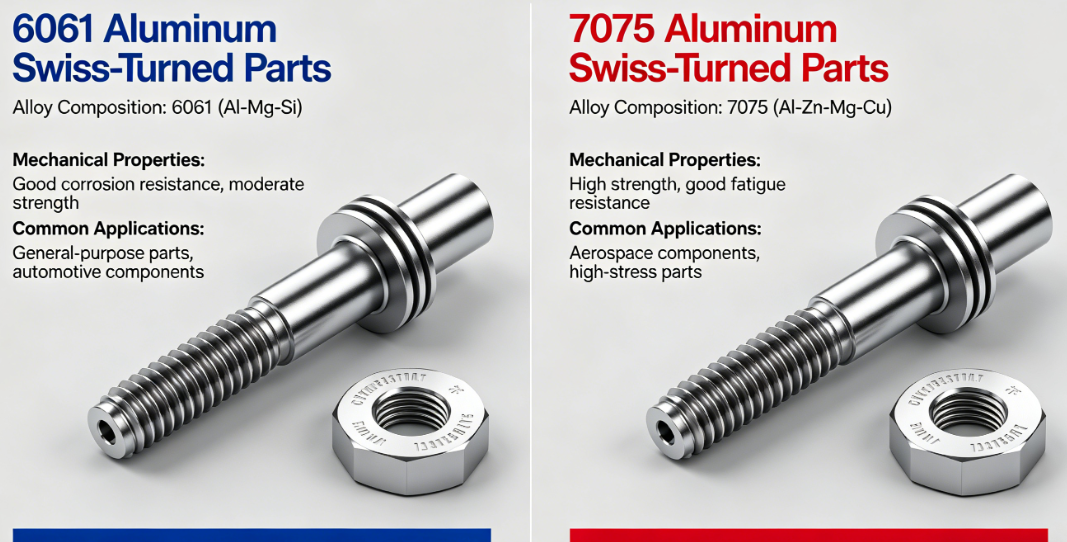
comparison-of-6061-vs-7075-aluminum-swiss-turned-parts
Head-to-Head Comparison: Mechanical Properties & Machinability
When programming for CNC lathes, the differences in hardness and elasticity between these alloys dictate speeds, feeds, and tooling choices. The table below outlines the critical data points for the T6 temper (the most common condition for turned parts).
Property | 6061-T6 Aluminum | 7075-T6 Aluminum |
Ultimate Tensile Strength | 45,000 psi (310 MPa) | 83,000 psi (572 MPa) |
Yield Strength | 40,000 psi (276 MPa) | 73,000 psi (503 MPa) |
Brinell Hardness | 95 HB | 150 HB |
Elongation at Break | 12% | 11% |
Machinability Rating | Good (50%) | Fair (70% of 6061) |
Corrosion Resistance | Excellent | Poor (prone to stress-corrosion cracking) |
Relative Cost | Baseline (Low) | Higher (Approx. +25-30%) |
Data aggregated from ASM International standards.
Impact on CNC Turning Tooling
Due to its high hardness (150 HB), 7075 aluminum accelerates tool wear on carbide inserts compared to 6061. Shops often reduce cutting speeds by 15-20% when switching from 6061 to 7075 to maintain tight tolerances. Furthermore, the lower elongation of 7075 means it is less forgiving of interrupted cuts or aggressive feed rates; it tends to shear rather than deform.
How to Choose the Right Material for Your Project
The decision ultimately rests on the functional requirements of your turned component. Here is a decision framework based on common engineering scenarios:
★ Choose 6061 Aluminum If:
● Corrosion Resistance is Required: Your part will be exposed to moisture, salt spray, or chemicals without a robust coating budget.
● Cost is a Primary Driver: For high-volume production runs of non-structural spacers, connectors, or cosmetic parts, 6061 is the economical choice.
● Secondary Processing is Needed: You plan to weld the turned part into a larger assembly.
● Electrical Conductivity Matters: 6061 offers better conductivity than 7075 for electronic chassis or heat sinks.
★ Choose 7075 Aluminum If:
● Weight Reduction is Critical: You need maximum strength with minimal mass (e.g., drone components, bicycle hubs, or firearm receivers).
● High-Stress Cyclical Loading: The part is a shaft, gear, or structural pin that will endure significant vibration or torque.
● Stiffness Over Toughness: You need a part that resists deflection under heavy load.
Conclusion
Both 6061 and 7075 aluminum have cemented their place in the world of CNC turned parts, but they are not interchangeable. While 6061 offers the best balance of cost, corrosion resistance, and manufacturability, 7075 is the undisputed champion of mechanical strength.
Before finalizing your design, consult with your precision machining partner regarding tool availability and tolerance capabilities for these specific alloys. Selecting the correct material upfront eliminates costly production delays and ensures your turned components perform flawlessly in the field. For a full overview of our aluminum turning capabilities, please visit our services page.
Add: Building 3No.277 Zhen'an Middle Road, Chang'an Town,Dongguan,Guangdong, China
Tel:+86-769-82855591
Copyright © 2019 All Rights Reserved Dongguan Start Precision Technology Co., Ltd. Tel: +86-769-82855591
Add: No. 277 Zhen'an Middle Road, Chang'an Town, Dongguan, Guangdong, China



 中文版
中文版 English