Custom PEEK & PTFE CNC Machining Parts for Medical & Chemical Plastic Parts
Date:2026-07-03Article editor:Starting Point PrecisionViews:384In high-stakes industries like medical device manufacturing and chemical processing, material selection is only half the battle. The other half is precision machining. Custom PEEK and PTFE CNC machining services bridge the gap between advanced polymer performance and real-world application reliability. For over a decade, our facility has specialized in transforming these high-performance thermoplastics into mission-critical components with tolerances as tight as ±0.01mm.
PEEK (Polyether Ether Ketone) offers an exceptional strength-to-weight ratio, with a tensile strength of 90–100 MPa and a continuous service temperature of 260°C. Its inherent biocompatibility (ISO 10993) makes it the gold standard for spinal cages, dental abutments, and trauma fixation devices. Meanwhile, PTFE (Polytetrafluoroethylene) delivers the lowest coefficient of friction (0.05–0.10) and outstanding chemical inertness, capable of withstanding aggressive acids and solvents up to 260°C. For chemical corrosion resistant parts, PTFE’s non-stick surface and dielectric strength (50 kV/mm) are indispensable.
We employ a suite of advanced machining centers to handle the unique challenges of these materials. Unlike metals, PEEK and PTFE require specialized tooling and cooling strategies to prevent stress cracking and dimensional creep. Our equipment list, verified on our precision machining page, includes:
| Equipment | Specification | Capability for PEEK/PTFE |
| 5-Axis CNC Mill | Germany DMG HSC 75 linear | Complex freeform surfaces for spinal implants |
| Vertical Machining Center | Germany DMG DMC 835V / Japan LGMazak VCN-510C | High-efficiency roughing and finishing for housing components |
| CNC Turning Machining Center | Germany DMG CTX beta 800 | Precision rotational parts for fluid handling systems |
| Slow Wire Cutting (EDM) | Japan Sodick ALN400Gs / Seibu M50B | Burr-free features for PTFE seals and intricate gaskets |
| Discharge Spark Machine (EDM) | Japan Sodick AD30Ls | High-detail cavity work for chemical-resistant manifolds |
| Inspection CMM | In-house quality lab | Real-time dimensional validation at 22°C ±1°C |
Our process integrates cryogenic cooling to maintain material stability. For instance, when machining a PEEK acetabular shell, we implement a roughing strategy with high-feed milling (1500 mm/min) followed by a finishing pass using diamond-coated tools to achieve a surface roughness of Ra 0.4–0.8μm.
Based on our equipment capabilities and material expertise, we routinely produce the following high-precision components. The table below outlines the common parts, their primary material, and the corresponding industries they serve.
| Part Category | Typical Materials | Industry Application | Key Feature Requirement |
| Spinal Cages & Interbody Fusion Devices | PEEK (Victrex 450G) | Medical – Orthopedics | Complex lattice structures, radiolucency |
| Dental Abutments & Implant Healing Caps | PEEK (BioHPP) | Medical – Dental | High surface finish (Ra < 0.6μm), biocompatible color |
| Cardiovascular Guidewire Hubs & Handles | PEEK (glass-filled) | Medical – Cardiovascular | Ergonomic grip, torque transmission stability |
| PTFE Gaskets & Sealing Rings | Virgin PTFE / Modified PTFE | Chemical Processing | Low creep, chemical resistance to strong acids |
| Fluid Manifolds & Valve Seats | PTFE / PEEK (for high temp) | Chemical / Pharmaceutical | Leak-proof sealing surfaces, internal smooth channels |
| Insulating Bushing & Connector Housings | PEEK (unfilled) | Electrical / Semiconductor | Dielectric strength, low outgassing |
| Biopsy Needle Guides & Instrument Tips | PEEK (radiopaque grades) | Medical – Diagnostics | Sterilization compatibility, sharp edge retention |
| Pump Impellers & Wear Rings | PTFE / PEEK (CFR-PEEK) | Chemical / Petrochemical | Dimensional stability under abrasive slurry conditions |
| Surgical Instrument Handles & Actuators | PEEK (colored) | Medical – Surgical Tools | Lightweight, autoclave-resistant (134°C) |
| Custom Micro-Fluidic Chips & Sensor Housings | PEEK / PTFE | Biotech / Lab Automation | High-precision micro-channels, non-contaminating |
For each of these parts, we offer complete documentation including material certifications, dimensional inspection reports (CMM & vision systems), and process validation records.
Quality is non-negotiable. We adhere to ISO 13485:2016 for medical devices and AS9100D for aerospace-grade chemical components. Every batch undergoes rigorous testing, including tensile pull-off tests and accelerated aging simulations. For materials, we source verified resins from Victrex and Chemours, ensuring traceability. For detailed material verification, refer to the ISO 10993 biocompatibility standards and ASTM D4894 for PTFE.
We utilize adaptive machining algorithms to counteract material deflection. For PTFE, which can deform under standard fixturing, we use vacuum chucks and soft jaws with optimized clamping pressures. Furthermore, our post-machining processes include:
● Annealing: Stress-relief cycles to stabilize molecular structure.
● Surface Modification: Plasma treatment to enhance adhesion for secondary bonding without compromising the bulk material properties.
A recent project from a major chlor-alkali plant required a custom PTFE manifold for their corrosive chemical dosing system. The manifold featured multiple internal flow channels with a critical sealing face, demanding exceptional chemical resistance and zero leakage under 250 psi operating pressure. The material chosen was modified PTFE with enhanced creep resistance, which poses challenges in conventional machining due to its softness and tendency to deform.
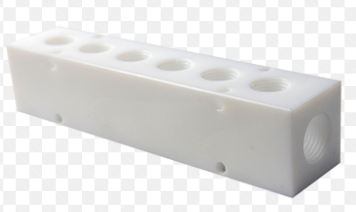
Using our 5-axis DMG HSC 75 linear mill and Sodick AD30Ls EDM for intricate cavity details, we achieved a surface finish of Ra 0.4μm on all wetted surfaces and maintained a flatness tolerance of ±0.01mm on the sealing flange. Our cryogenic cooling strategy prevented material smearing, while vacuum fixturing eliminated clamping distortion. The finished manifold passed a 300 psi hydrostatic pressure test with no measurable leakage. We delivered 150 units in just 4 weeks, helping the client reduce their planned maintenance shutdowns by 40% and extend service life by over 200%.
Machining PEEK and PTFE is a science that demands precision, experience, and the right equipment. Whether you require a single, complex medical implant prototype or high-volume chemical corrosion resistant parts, our custom CNC service guarantees performance, traceability, and rapid turnaround. We combine state-of-the-art technology with deep material knowledge to bring your most challenging designs to life. For inquiries regarding your specific application, please visit our contact page for more technical data.
Q1: What is the main difference between machining PEEK and PTFE?
A: PTFE is softer and more prone to deformation (creep), requiring sharper tooling and lower clamping forces. PEEK is more rigid and thermally stable, but requires careful heat management to avoid surface degradation, often necessitating cryogenic cooling.
Q2: Can you machine PEEK implants that require sterilization?
A: Yes. We machine to specifications that accommodate autoclave and ethylene oxide (EtO) sterilization. Our process ensures dimensional stability so that post-sterilization, the implant remains within the defined critical tolerances.
Q3: What surface finishes can you achieve on PTFE chemical parts?
A: We achieve a standard Ra of 0.8μm and can reach Ra 0.4μm with diamond polishing. For sealing surfaces, we can produce a lapped finish to ensure leak-proof connections in high-pressure chemical environments.
Q4: Do you offer support for prototype development and scaling?
A: Absolutely. We offer rapid prototyping (1–10 pieces) and bridge-to-production volumes, allowing clients to validate designs before moving to high-volume manufacturing (1000+ pieces) using the same validated processes.
Q5: How do you ensure the cleanliness of medical components?
A: All medical components are machined in a controlled environment, followed by ultrasonic cleaning and UV sterilization. Parts are then double-bagged in Class 100 cleanroom conditions before shipment.
Add: Building 3No.277 Zhen'an Middle Road, Chang'an Town,Dongguan,Guangdong, China
Tel:+86-769-82855591
Copyright © 2019 All Rights Reserved Dongguan Start Precision Technology Co., Ltd. Tel: +86-769-82855591
Add: No. 277 Zhen'an Middle Road, Chang'an Town, Dongguan, Guangdong, China



 中文版
中文版 English