Custom Machining Parts: Common Issues & Solutions for Stainless Steel CNC Machining
Date:2026-06-12Article editor:Starting Point PrecisionViews:393Stainless steel is a top choice for custom machining parts due to its strength, corrosion resistance, and durability. However, CNC machining this alloy presents unique challenges. This guide covers frequent problems and practical solutions to help you achieve high-quality results. For precision components, working with an experienced partner like Dongguan Start Point Precision Technology Co., Ltd. can make a significant difference.
Issue: Austenitic stainless steels (e.g., 304, 316) harden rapidly under heat and friction. This leads to built-up edge (BUE) on the cutting tool, ruining surface finish and causing dimensional errors.
Solution:
● Use sharp, positive-rake carbide tools.
● Maintain a consistent chip load; avoid light cuts that rub instead of shear.
● Apply high-pressure coolant to flush chips and reduce heat.
For a visual guide, see The work hardening effect on stainless steel .
Issue: Gummy stainless steel chips tend to form long, stringy ribbons that wrap around the tool and workpiece, leading to tool breakage and surface scratches.
Solution:
● Employ chip-breaking tool geometries with narrow, deep grooves.
● Optimize feed rates – increase feed slightly to thicken chips, making them break naturally.
● Use through-tool coolant or high-pressure external nozzles directed at the cutting zone.
For advanced chip control strategies, refer to : Guide to Stainless Chip Control .
Issue: The high heat and abrasion resistance of stainless steel cause accelerated flank wear and notching on cutting tools, increasing costs and downtime.
Solution:
● Choose grade-specific carbide (e.g., micro-grain for finishing, coated for roughing).
● Apply physical vapor deposition (PVD) coatings like TiAlN or AlTiN that withstand high temperatures.
● Reduce cutting speed by 20-30% compared to low-carbon steel guidelines.
Many precision shops, including Start Precision , use real-time tool wear monitoring to automatically adjust feeds and extend tool life.
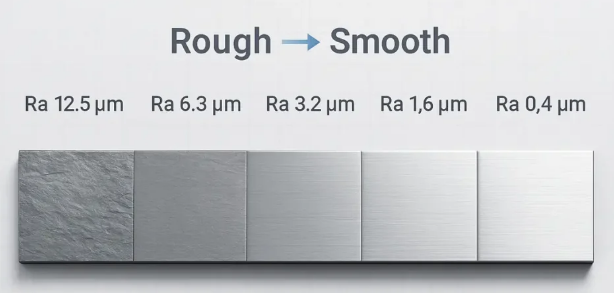
Issue: Vibration, built-up edge, or improper parameters can leave rough, torn, or work-hardened surfaces on critical sealing or aesthetic features.
Solution:
● Use a larger tool nose radius (0.8–1.2 mm) for finishing passes.
● Leave a finish allowance of 0.3–0.5 mm, then cut with high feed and low depth.
● Apply a light, constant coolant mist to prevent thermal shock.
Below is an example of a stainless steel surface finish .
Issue: Stainless steel expands significantly with heat. During machining, dimensions can shift as the part warms up, causing out-of-tolerance custom parts.
Solution:
● Allow parts to thermally stabilize before final passes.
● Use climb milling for better heat evacuation.
● Plan for multiple roughing passes with a final finishing pass after a cooling dwell.
For more information on thermal management in CNC machining, check this authoritative: Azom Materials's Thermal Properties of Stainless Steel .
Machining stainless steel requires careful tool selection, parameter tuning, and thermal management. By addressing work hardening, chip control, tool wear, surface finish, and thermal expansion, you can produce high-quality custom parts efficiently. For complex or high-volume projects, leveraging the expertise of a dedicated partner like Dongguan Start Point Precision Technology Co., Ltd. ensures you get reliable, precise components every time.
Add: Building 3No.277 Zhen'an Middle Road, Chang'an Town,Dongguan,Guangdong, China
Tel:+86-769-82855591
Copyright © 2019 All Rights Reserved Dongguan Start Precision Technology Co., Ltd. Tel: +86-769-82855591
Add: No. 277 Zhen'an Middle Road, Chang'an Town, Dongguan, Guangdong, China



 中文版
中文版 English