Stainless Steel Turned Parts with 17-4PH Hardening
Date:2026-08-13Article editor:Starting Point PrecisionViews:312In the demanding world of precision engineering, selecting the right material and process for your components is paramount. Stainless Steel Turned Parts are critical in applications requiring high strength, excellent corrosion resistance, and dimensional stability. Among the various grades available, 17-4PH stands out as a precipitation-hardening stainless steel that offers an exceptional combination of these properties, making it a top choice for industries like aerospace, medical, and defense. For a detailed material data sheet, you can refer to the MatWeb entry for 17-4PH which provides comprehensive physical and mechanical properties.
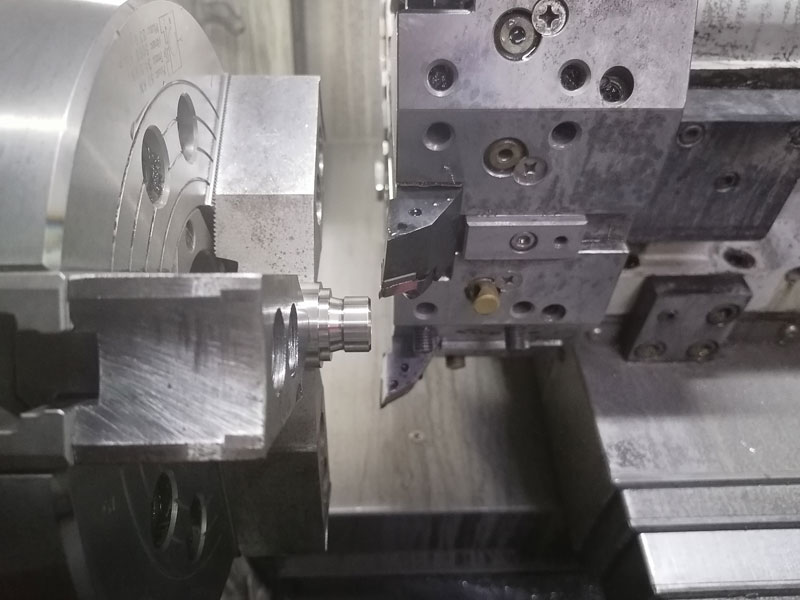
Precision CNC turning of high-strength stainless steel components
This guide explores the intricacies of manufacturing Stainless Steel Turned Parts from 17-4PH, detailing the benefits of the material, its machining challenges, and the critical hardening process that unlocks its full potential.
17-4PH (UNS S17400) is a martensitic, chromium-nickel-copper precipitation-hardening stainless steel. Its popularity stems from its ability to achieve incredibly high strength and hardness after a simple, low-temperature heat treatment, all while maintaining excellent corrosion resistance comparable to Grade 304. The fundamental metallurgy is well-documented by ASM International, which highlights its use in critical structural components.
Below is a comparison of key properties in different conditions:
| Property | Condition A (Solution Annealed) | Condition H900 (Aged) |
| Tensile Strength (MPa) | ~1100 | ~1310 |
| Yield Strength (MPa) | ~1000 | ~1170 |
| Hardness (HRC) | ~28 | ~40 |
| Corrosion Resistance | Excellent | Excellent |
| Machinability | Good | More Difficult |
The "H900" designation refers to the age-hardening treatment, which involves heating the parts to 900°F (482°C) for one hour. This process significantly boosts the mechanical properties, as outlined in standard heat treatment practices.
Creating Stainless Steel Turned Parts from 17-4PH presents unique challenges. In its annealed state (Condition A), the material is relatively machinable. However, the presence of hard carbides and its tendency to work-harden can lead to rapid tool wear. For best practices on tool selection and cutting parameters, the Sandvik Coromant knowledge center offers excellent guidance on machining stainless steels.
● Tooling: For turning operations, it is recommended to use premium carbide inserts with a positive rake geometry to reduce cutting forces. An appropriate coating, such as TiAlN (Titanium Aluminum Nitride), is essential for managing heat.
● Speeds and Feeds: Conservative cutting speeds are advised to prevent work hardening. Using consistent feeds and avoiding dwell time on the workpiece are crucial practices.
● Coolant: High-pressure coolant is vital to evacuate chips effectively, cool the cutting zone, and prevent chip welding on the tool.
The true value of these components is realized through a two-step process:
1. Precision Turning: The parts are initially machined to a size slightly larger than the final dimensions.
2. Post-Machining Hardening: The parts are then subjected to the precipitation-hardening (aging) heat treatment. This process results in a slight dimensional and volumetric change, which must be accounted for in the initial design.
This sequence allows for easier machining before hardening and ensures the final component achieves its high strength specifications. More technical details on precipitation hardening can be found on Wikipedia's 17-4 PH page.
For components used in safety-critical applications, rigorous quality control is non-negotiable. Top-tier manufacturers employ advanced inspection equipment to ensure every dimension is within tolerance.
One such partner dedicated to these standards is Dongguan Start Precision Technology Co., Ltd.. They specialize in precision mechanical parts for the aerospace, medical, and automotive industries. By combining a highly experienced technical team with world-renowned manufacturing and inspection equipment, they ensure the highest product quality and precision for components like CNC turned parts (explore their full capabilities). Their commitment to quality ensures that your components meet the most demanding specifications.
A prominent medical device manufacturer required a series of small, complex bone fixation screws. These parts demanded the extreme strength of 17-4PH in the H900 condition, with threads that had to be flawless to ensure patient safety. By partnering with a manufacturer that understood the nuances of machining this alloy, the project was a success. The parts were machined, hardened, and delivered with a surface finish that exceeded expectations, proving that even the most challenging materials can be mastered with the right expertise.
Stainless Steel Turned Parts made from 17-4PH offer an unbeatable combination of strength, hardness, and corrosion resistance. While the material poses machining challenges, working with an experienced precision parts manufacturer ensures you can leverage its superior properties for your most demanding applications. The key is to understand the material, the tooling, and the critical heat treatment process involved.
Explore our precision machining solutions to see how we can bring your complex designs to life.
For reliable, high-quality turned parts, the right manufacturing partner is your greatest asset. Contact us to discuss your manufacturing needs and let our team of experts help you turn your concepts into high-performance realities.
1. What is the main advantage of using 17-4PH stainless steel for turned parts?
The main advantage is its ability to achieve very high strength and hardness through a single aging heat treatment, while still retaining excellent corrosion resistance. This makes it a cost-effective alternative to more expensive high-strength materials.
2. Is 17-4PH stainless steel difficult to machine?
In its annealed state (Condition A), it has good machinability. However, it can be challenging due to its tendency to work-harden. Using sharp tooling, correct speeds and feeds, and high-pressure coolant is essential for successful machining.
3. Does the hardening process affect the dimensions of the part?
Yes, the precipitation-hardening process causes slight dimensional changes. This is a critical factor that a skilled manufacturer must account for in the initial CNC programming and tooling design to ensure the final part meets all tolerances.
4. What industries commonly use these hardened turned parts?
Due to their high strength and corrosion resistance, 17-4PH turned parts are widely used in the aerospace, medical (e.g., surgical instruments and implants), oil and gas, and defense industries.
Add: Building 3No.277 Zhen'an Middle Road, Chang'an Town,Dongguan,Guangdong, China
Tel:+86-769-82855591
Copyright © 2019 All Rights Reserved Dongguan Start Precision Technology Co., Ltd. Tel: +86-769-82855591
Add: No. 277 Zhen'an Middle Road, Chang'an Town, Dongguan, Guangdong, China



 中文版
中文版 English