Humanoid Robot Parts Made via CNC Machining
Date:2026-10-22Article editor:Starting Point PrecisionViews:27Humanoid robot parts demand exceptional precision, repeatability, and material integrity. Every joint housing, actuator bracket, and structural frame must fit within microns to ensure smooth motion and long service life. CNC machining is the backbone of producing these components, offering the accuracy and surface finish that casting or molding cannot match. From five-axis milling of complex curvatures to turning of cylindrical shafts, CNC processes convert raw alloys into reliable robot hardware.
Key Humanoid Robot Parts Produced by CNC
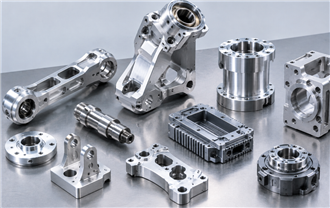
● Joint housings and bearing seats – require tight bore tolerances and perpendicularity
● Actuator mounts and gearbox adapters – need flatness and hole alignment
● Structural frames and links – lightweight ribs and pockets machined from aluminum or titanium
● Sensor brackets and camera mounts – thin walls and precise mounting surfaces
● Hand and finger components – small features, slots, and pivot holes
These parts often combine curved surfaces, oblique holes, and hollowed-out sections. Five-axis CNC machining handles such geometries in a single setup, reducing error stacking. According to ISO 10218 safety requirements for industrial robots, mechanical integrity directly affects risk assessment—making machining quality non-negotiable.
CNC Processes and Equipment for Humanoid Robot Parts
A typical workflow includes 5-axis milling, CNC turning, wire EDM, and surface grinding. For complex curved surfaces and nonconforming shapes, five-axis machining centers are essential. The table below lists representative equipment used for humanoid robot part production, drawn from a precision equipment list that includes high-end models from DMG, Mazak, Haas, and Sodick.
| Process | Equipment (Brand / Model) | Typical Use for Robot Parts |
| Five-axis machining | DMG HSC 75 linear | Complex curved surfaces, oblique holes, hollowed structures |
| Vertical machining | DMG DMC 835V, Mazak VCN-510C, Haas VF3 | Frames, brackets, mounting plates |
| Horizontal machining | Haas EC400 | Multi-face joint housings |
| CNC turning | DMG CTX beta 800, Takzawa NEX-108 | Shafts, pins, cylindrical adapters |
| Slow wire cutting | Seibu M50B, Sodick ALN400Gs | Fine slots, hardened inserts |
| EDM | Makino EDGE3, Sodick AD30Ls | Deep ribs, sharp corners |
| Grinding | MICCO 350, Glory GU32-60NC | Bearing seats, sealing surfaces |
Tolerances within ±0.01 mm are achievable according to 3D CAD drawings. For material behavior and machinability data, resources such as ScienceDirect’s CNC machining topic provide useful references on tool wear and surface integrity.
Quality Control and Practical Considerations
Humanoid robot parts often use aluminum 7075, titanium Ti-6Al-4V, copper alloys, and engineering plastics. Each material demands specific speeds, feeds, and cooling strategies. In-process inspection with CMM and optical comparators verifies critical dimensions. For a complete overview of machining capabilities and equipment, visit Start Precision’s homepage. The shop’s five-axis and turning centers are configured for small-to-medium batches of precision robot components.
Contact us to discuss your manufacturing needs.
Frequently Asked Questions
Q1: What tolerances can CNC machining hold for humanoid robot parts?
A: Typical precision machining achieves ±0.01 mm on critical features, depending on material and geometry.
Q2: Which materials are best for humanoid robot joints?
A: Aluminum 7075 for lightweight frames, titanium for high-strength joints, and copper alloys for thermal management.
Q3: How are complex curved surfaces on robot parts machined?
A: Five-axis machining centers (e.g., DMG HSC 75 linear) allow single-setup machining of curved surfaces, oblique holes, and hollow sections.
Q4: What inspection methods ensure part quality?
A: CMM, optical comparators, and surface roughness testers verify dimensions and finishes against CAD models.
Add: Building 3No.277 Zhen'an Middle Road, Chang'an Town,Dongguan,Guangdong, China
Tel:+86-769-82855591
Copyright © 2019 All Rights Reserved Dongguan Start Precision Technology Co., Ltd. Tel: +86-769-82855591
Add: No. 277 Zhen'an Middle Road, Chang'an Town, Dongguan, Guangdong, China



 中文版
 English