Wire EDM in China: High-Speed vs Low-Speed
Date:2026-06-13Article editor:Starting Point PrecisionViews:449Wire Electrical Discharge Machining (Wire EDM) has become a cornerstone of precision manufacturing in China. As industries demand higher accuracy and faster turnaround, understanding the trade-offs between high-speed wire EDM and low-speed wire EDM is critical. This article breaks down their differences, applications, and how to choose the right solution for your workshop.
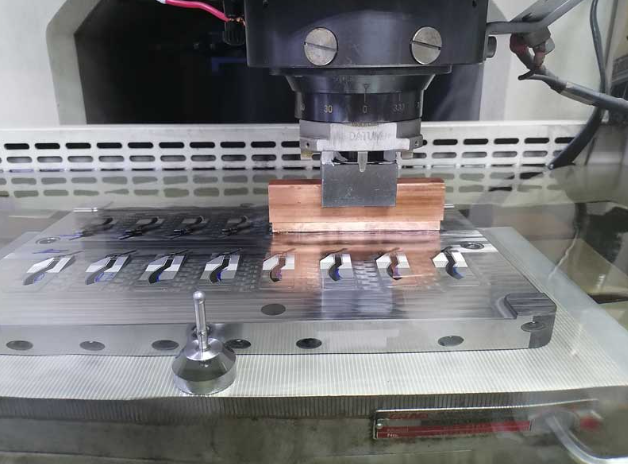
High-speed wire EDM (also called fast wire cutting) uses a molybdenum wire that moves repeatedly at speeds of 8–12 m/s. The wire is inexpensive and can be reused multiple times, making it popular for domestic Chinese machine tools. It offers decent cutting efficiency (60–100 mm²/min) but lower surface finish (Ra 1.0–2.5 μm). Typical applications include die and mold roughing, stamping parts, and general tooling where ultra-high precision is not mandatory.
Learn more about fundamental EDM principles.
Low-speed wire EDM (slow wire cutting) uses a brass or coated wire that passes through the workpiece only once at 0.5–15 m/s. This single-pass method eliminates wire wear fluctuations, achieving superior accuracy (±0.002 mm) and surface finish (Ra 0.1–0.4 μm). Machines from Japanese or European brands dominate this category, though Chinese manufacturers are rapidly improving. Low-speed systems are essential for aerospace components, medical devices, and high-end injection molds.
View global EDM market trends and statistics.
| Feature | High-Speed Wire EDM | Low-Speed Wire EDM |
| Cutting speed | 60–120 mm²/min | 200–350 mm²/min (first cut) |
| Tolerance | ±0.01–0.02 mm | ±0.002–0.005 mm |
| Wire cost | Very low (reusable Mo wire) | Higher (single-use brass) |
| Machine price (China) | $8,000–25,000 | $30,000–120,000 |
Chinese factories often use high-speed machines for budget-sensitive production, while low-speed machines are adopted for export-grade precision parts.
● Choose high-speed wire EDM if: You cut thick workpieces (up to 1000mm), need low operating costs, and surface finish below Ra 1.6 μm is acceptable.
● Choose low-speed wire EDM if: You work with tight tolerances (<0.005 mm), hard materials like carbide, or require automated threading for complex cavities.
Many Chinese job shops start with high-speed machines and later add low-speed capacity for high-value orders. Hybrid approaches (using high-speed for roughing and low-speed for finishing) are also common.
The choice between high-speed and low-speed wire EDM in China depends on your accuracy requirements and budget. High-speed excels in low-cost material removal, while low-speed delivers unmatched precision for critical components. Evaluate your typical part geometry, surface finish needs, and wire consumption before purchasing.
Q1: Can high-speed wire EDM cut carbide tools?
Yes, but slower and with more wire breakage risks than low-speed machines. Use specialized molybdenum wire and lower discharge energy.
Q2: Is low-speed wire EDM worth the higher cost in China?
For export molds, medical parts, or aerospace components – absolutely. The repeatability and lack of recast layer issues justify the investment.
Q3: How do I verify a wire EDM machine’s performance from a Chinese supplier?
Request a test cut with your own material. Measure surface roughness and corner radius. Ask for CE or ISO certificates.
Q4: What’s the typical power consumption difference?
Low-speed machines consume 20–30% more power due to higher-frequency generators and dielectric cooling systems.
Q5: Can I upgrade a high-speed machine to low-speed?
Not directly – the wire drive mechanism, tensioning system, and power supply are fundamentally different. It’s better to buy a dedicated low-speed unit.
Add: Building 3No.277 Zhen'an Middle Road, Chang'an Town,Dongguan,Guangdong, China
Tel:+86-769-82855591
Copyright © 2019 All Rights Reserved Dongguan Start Precision Technology Co., Ltd. Tel: +86-769-82855591
Add: No. 277 Zhen'an Middle Road, Chang'an Town, Dongguan, Guangdong, China



 中文版
中文版 English