Automated Deburring Solutions for Low Volume Precision Machining
Date:2026-03-09Article editor:Starting Point PrecisionViews:537In Low Volume Precision Machining, the focus is often on CNC programming, fixture design, and tight tolerances. However, one critical step is frequently overlooked: deburring.
Removing sharp edges and burrs is essential for part functionality, safety, and aesthetics. In high-volume production, manufacturers invest in expensive, dedicated deburring machines. But for low volume runs—typically ranging from 50 to 1,000 parts—the challenge is different. You need flexibility, quick changeover, and cost-effectiveness.
This article explores automated deburring solutions that fit the unique demands of low volume precision machining.
The Challenge of Deburring in Small Batches
Manual deburring with hand tools or files is common in small shops. While it requires low upfront investment, it introduces variability. Fatigue can lead to inconsistent edge break sizes or even damaged parts.
Automation in this space must be adaptable. A solution designed for one family of parts must quickly adjust to the next job without lengthy reprogramming or tooling changes.
Solution 1: Robotic Deburring Cells
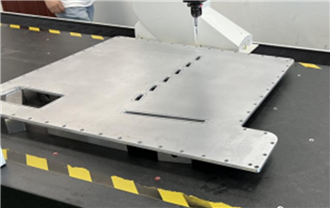
The most flexible solution for low volume work is the collaborative robot, or cobot.
How it works: A robot arm equipped with a force-controlled spindle or compliant tool follows the part contour. It can be programmed by "teaching" points or using offline software.
Advantages: Ideal for complex geometries and mixed batches. The same robot can handle different parts by simply switching programs.
Precision Aspect: Modern force sensors allow the robot to maintain consistent contact pressure, ensuring uniform edge break quality across every part, regardless of minor casting variations.
Solution 2: Thermal and Electrochemical Methods
For parts with intersecting holes or complex internal passages where burs are inaccessible, mechanical methods fail.
Thermal Energy Deburring (TED): Parts are placed in a sealed chamber filled with a combustible gas. A spark ignites the gas, creating a heat wave that burns off burs and thin flashes without affecting the solid part geometry.
Electrochemical Deburring (ECD): Uses an electrolytic cell to selectively dissolve burrs. Current passes through a tool (cathode) positioned near the burr area, removing metal ions.
These methods are particularly valuable in precision industries like aerospace and medical devices, where a hidden burr breaking loose inside a hydraulic system or implant could cause catastrophic failure.
Solution 3: Automated Edge Breaking with CNC
Sometimes, the best deburring solution is to prevent the burr or handle it during the machining cycle itself.
CNC Brushing: Programmed toolpaths with abrasive nylon or wire brushes can deburr edges while the part is still on the machine. This ensures perfect geometric alignment.
Back Chamfering Tools: Specialized tools can create consistent chamfers on the back of holes without refixturing the part.
Advantage: This approach requires zero additional floor space and eliminates extra handling. The trade-off is increased spindle time, which must be justified against the cost of a separate secondary operation.
Solution 4: Mass Finishing for Simpler Parts
For less complex parts made in batches of several hundred, mass finishing equipment can be surprisingly effective.
Centrifugal Disc or Vibratory Bowls: Parts are placed in a media (ceramic, plastic, or steel shapes) with compound. The vibration or centrifugal action causes the media to rub against the parts, wearing down sharp edges.
Considerations: This is a "batch" process. It is excellent for breaking sharp corners but offers less control over specific edge break dimensions compared to robotic methods.
Choosing the Right Strategy
To select the best automated deburring solution for your low volume shop, consider:
Part Complexity: Simple flat parts may only need a vibratory bowl. Complex 5-axis parts likely require robotic or CNC-based solutions.
Material: Hard materials like Inconel may need aggressive robotic cutting; soft aluminum may respond well to thermal deburring.
Accessibility: If you cannot see the burr, you likely need thermal, electrochemical, or CNC brushing.
Conclusion
Automated Deburring of Sharp Edges is no longer reserved for high-volume production. With the advent of flexible robotics and advanced technologies like thermal energy methods, low volume precision machinists can achieve consistent, high-quality results without the overhead of dedicated automation. Integrating these solutions reduces manual labor, improves safety, and ensures every part meets the stringent requirements of modern precision engineering.
Add: Building 3No.277 Zhen'an Middle Road, Chang'an Town,Dongguan,Guangdong, China
Tel:+86-769-82855591
Copyright © 2019 All Rights Reserved Dongguan Start Precision Technology Co., Ltd. Tel: +86-769-82855591
Add: No. 277 Zhen'an Middle Road, Chang'an Town, Dongguan, Guangdong, China



 中文版
中文版 English