Precision Machining of Small Propellers | Low Volume CNC Services
Date:2026-03-09Article editor:Starting Point PrecisionViews:517Small propellers are critical components in various industries, from unmanned aerial vehicles (UAVs) and drones to marine sensors and medical devices. Unlike mass-produced plastic blades, precision-engineered metal or high-performance polymer propellers require exacting tolerances and superior surface finishes.
Low Volume CNC Services offer the ideal manufacturing solution for these applications, providing the flexibility to iterate designs without the commitment to high-volume tooling.
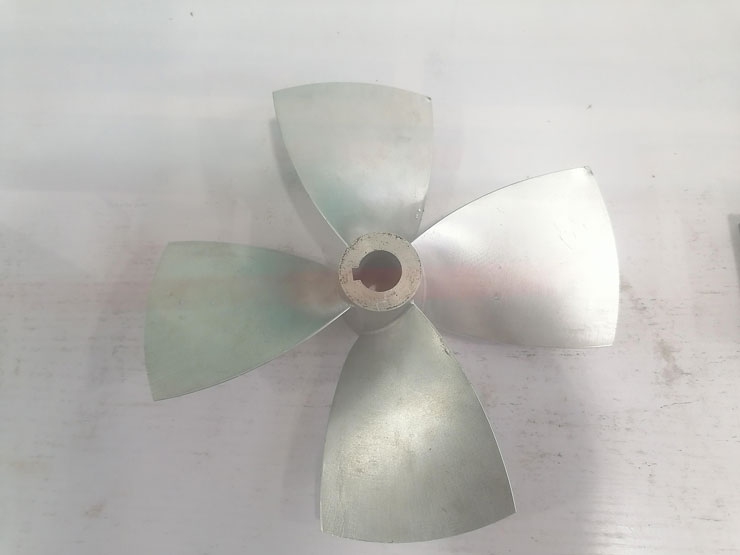
The Complexity of Small Propeller Geometry
A propeller may look simple, but its functionality depends on complex aerodynamic or hydrodynamic forces. Key features include:
Twisted Blades: The angle of attack changes from the hub to the tip.
Thin Cross-Sections: Leading and trailing edges must be sharp yet durable.
Balance: Even microscopic imbalances can cause vibration and failure.
Machining these features requires advanced strategies that differ significantly from standard prismatic part production.
Why Low Volume CNC Fits the Niche
For prototyping, custom racing drones, or specialized marine equipment, production volumes rarely reach the thousands. Injection molding or casting is prohibitively expensive due to mold costs.
Low Volume CNC Machining bridges this gap perfectly. It allows engineers to:
Test Iterations: Modify blade pitch or airfoil shape between batches without scrapping expensive tooling.
Select Materials: Use high-strength aluminum (7075-T6), titanium, or engineering plastics like PEEK and Delrin.
Achieve Precision: Hold tolerances within microns to ensure each blade in the set is identical, maintaining dynamic balance.
Multi-Axis Machining Strategies
Manufacturing small propellers efficiently requires advanced CNC equipment. While 3-axis machines can rough out the shape, they struggle with the undercuts and variable angles.
5-axis CNC machining is the preferred method. By tilting the tool or workpiece, the cutter maintains optimal contact with the helical surface. This results in:
Faster cycle times due to continuous machining.
Better surface finish by avoiding stepovers on complex curves.
Reduced hand finishing requirements.
Material Selection for Performance
Choosing high-quality materials enhances the performance of the propeller.In low volume runs, material cost is less of a barrier than in mass production, allowing for premium choices.
Aluminum Alloys (6061-T6, 7075-T6): Excellent strength-to-weight ratio for UAVs and air sampling drones.
Stainless Steel: Used in marine environments where corrosion resistance is paramount.
Engineering Plastics (PEEK, Acetal): Ideal for medical devices or applications requiring electrical insulation and chemical resistance.
The Importance of Surface Finish and Balancing
Machining marks on a propeller blade create drag and turbulence. In low volume CNC production, programmers use high-speed machining techniques with small stepovers and specially designed finishing toolpaths.
After machining, each propeller often undergoes:
Surface Polishing: To achieve the required smoothness (typically under Ra 0.8 µm for aerospace).
Dynamic Balancing: The propeller is spun at operational speeds, and sensors detect vibration. Minute amounts of material are removed from the heavy blade until balance is achieved.
Cost-Effective Production Runs
One concern with CNC machining for propellers is cost per part. However, for runs of 10 to 500 pieces, it remains the most economical path. Strategies to optimize cost include:
Near-Net Forging: Using near-net shaped blanks to reduce machining time and material waste.
Fixture Reusability: Designing modular holding solutions that accommodate different propeller sizes.
CAM Optimization: Simulating toolpaths to minimize air cutting and reduce cycle time.
Applications Across Industries
Aerospace & Defense: The enabler of stealth flight, the assurance of precision strike, and the protector of payloads in complex environments.
Marine Technology: Sensors for oceanographic research.
Medical: Impellers for ventricular assist devices.
Automotive: Cooling fans for electric vehicle components.
Conclusion
The demand for high-performance, custom small propellers is growing. Low Volume CNC Services provide the technical capability to produce these complex parts with the precision required for modern applications. By leveraging multi-axis machining and rigorous quality control, manufacturers can deliver propellers that meet the exact specifications of engineers and designers without the constraints of mass production.
Add: Building 3No.277 Zhen'an Middle Road, Chang'an Town,Dongguan,Guangdong, China
Tel:+86-769-82855591
Copyright © 2019 All Rights Reserved Dongguan Start Precision Technology Co., Ltd. Tel: +86-769-82855591
Add: No. 277 Zhen'an Middle Road, Chang'an Town, Dongguan, Guangdong, China



 中文版
中文版 English