Aluminum CNC Turning Parts with Anodized Finishes
Date:2026-08-08Article editor:Starting Point PrecisionViews:176In precision manufacturing, the combination of CNC turning and anodized finishes has become the gold standard for producing high-performance aluminum components. From aerospace fittings to medical device housings, Aluminum CNC Turning Parts require surface treatments that enhance both functionality and longevity. This guide explores the critical aspects of anodizing these precision-machined components, with a focus on process control and quality assurance.
Sulfuric acid anodizing remains the most widely used electrochemical treatment for Aluminum CNC Turning Parts. The process involves four essential stages:
| Stage | Parameter | Purpose |
| Pre-treatment | Alkaline cleaning + acid etching | Remove oils and natural oxide layer |
| Anodizing | 15-20% H₂SO₄, 18-22°C, 12-18 V | Form porous aluminum oxide layer |
| Coloring (optional) | Organic or inorganic dyes | Achieve desired aesthetics |
| Sealing | Hot water or nickel acetate | Close pores for corrosion resistance |
During anodizing, the CNC-turned aluminum part becomes the anode in an electrolytic cell, creating a controlled oxide layer. This layer is integral to the base metal—not a coating—ensuring it won't peel or flake, even under demanding conditions. For detailed specifications, refer to the MIL-A-8625 standard for anodizing.
Thickness is the most critical variable affecting performance. For Aluminum CNC Turning Parts, three thickness classes are common:
● Class I (5-10 μm): Light-duty applications, decorative finishes
● Class II (10-15 μm): General industrial components with moderate wear
● Class III (15-25 μm): Heavy-duty, high-wear environments
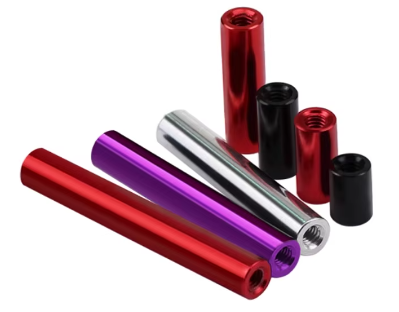
Color selection depends on dye type and anodizing duration. Clear (natural) anodizing preserves the aluminum's metallic appearance, while black, gold, and red dyes are popular for branding and identification. Deeper colors require thicker oxide layers to absorb sufficient dye particles, but thickness beyond 25 μm can reduce fatigue strength for certain alloys.
Sealing is the step that transforms a porous anodic layer into a protective barrier. Two methods dominate:
1. Hot water sealing (96-100°C, 15-30 min): Hydrates the oxide to close pores
2. Nickel acetate sealing (80-85°C, 15-20 min): Provides enhanced corrosion protection
Properly sealed Aluminum CNC Turning Parts routinely achieve 336+ hours of neutral salt spray (NSS) testing per ASTM B117, with some formulations exceeding 500 hours.
Even minor defects can compromise the performance of Aluminum CNC Turning Parts. Common issues and their mitigation include:
● Etch marks or dullness: Caused by improper pre-cleaning. Use ultrasonication for complex geometries.
● Burning or powdering: Due to excessive current density. Reduce voltage or increase solution agitation.
● Color inconsistency: Results from uneven temperature distribution. Maintain bath temperature within ±1°C.
● White spots (pitting): Chloride contamination in rinse water. Monitor deionized water quality daily.
Implementing statistical process control (SPC) for bath chemistry and temperature can reduce defect rates by over 60%. For turnkey solutions in precision CNC turning and anodizing, explore the capabilities at Start Precision's CNC machining services.
A major aerospace supplier required 5,000 pieces of aluminum 7075-T6 CNC turned bushings with clear anodize (Class II, 12 μm thickness). The parts needed 336-hour salt spray resistance with no visible corrosion. By optimizing the sealing step with nickel acetate at 82°C for 18 minutes, the manufacturer achieved consistent 400-hour performance. Subsequent dye stain tests showed zero dye penetration, confirming complete pore sealing. This success led to a repeat order of 20,000 units annually.
Mastering the anodizing process for Aluminum CNC Turning Parts requires attention to every detail—from sulfuric acid bath parameters to sealing methods and testing protocols. By understanding film thickness options, implementing robust defect prevention, and validating performance through salt spray testing, manufacturers can produce components that meet the highest industry standards.
Contact us to discuss your manufacturing requirements and how we can help optimize your anodized CNC turned parts.
Q1: What is the difference between anodized and plain Aluminum CNC Turning Parts?
Anodized parts have a controlled oxide layer that provides superior wear resistance, corrosion protection, and dye acceptance compared to bare aluminum. The anodic layer is chemically bonded to the substrate.
Q2: Can all aluminum alloys be anodized effectively?
No. Wrought alloys like 6061 and 7075 anodize well, while high-silicon alloys (e.g., 4032) or copper-rich alloys like 2024 may produce darker or non-uniform finishes. Always consult your material supplier.
Q3: How long does the sulfuric acid anodizing process take?
Typical cycle times range from 45 to 90 minutes, including pre-treatment, anodizing (20-40 minutes), dyeing (5-15 minutes), and sealing (15-30 minutes). Total throughput depends on batch size and automation.
Q4: Does thicker anodizing affect the dimensional accuracy of CNC turned parts?
Yes. The oxide layer grows approximately 50% outward from the original surface and 50% inward, effectively increasing the part's outside diameter by about 50% of the total thickness. For tight tolerances, account for a 10-15 μm build-up during design.
Q5: How can I verify the sealing quality of my anodized parts?
The dye stain test (ASTM F2834) is the most common method. Apply a drop of dye solution, wait 5 minutes, and rinse. Any dye penetration indicates incomplete sealing, necessitating re-sealing or rejection.
Add: Building 3No.277 Zhen'an Middle Road, Chang'an Town,Dongguan,Guangdong, China
Tel:+86-769-82855591
Copyright © 2019 All Rights Reserved Dongguan Start Precision Technology Co., Ltd. Tel: +86-769-82855591
Add: No. 277 Zhen'an Middle Road, Chang'an Town, Dongguan, Guangdong, China



 中文版
中文版 English