Precision Liquid Cold Plate Machining Services
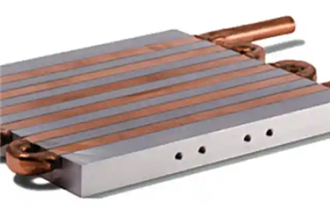
Date:2026-09-12Article editor:Starting Point PrecisionViews:87Liquid cooling systems increasingly depend on components that can move heat away from high-power devices without compromising installation space or mechanical reliability. A liquid cold plate is one such component: coolant travels through engineered passages while heat enters the plate from the mounted device. The machining quality of those passages and contact surfaces directly affects how the finished component performs.
For this reason, Liquid Cold Plate Machining is not simply a matter of cutting channels into an aluminum or copper block. The manufacturing process must connect the cooling design with dimensional control, cleanliness, sealing, inspection, and repeatable production.
We begin with the customer's 2D drawing, 3D model, material specification, tolerances, and quantity. Instead of immediately programming the CNC machine, our engineers first review the design for machining accessibility and potential production risks.
Critical features are identified before machining:
● Cooling-channel dimensions and locations
● Required wall thickness
● Mounting-hole positions
● Inlet and outlet ports
● Sealing surfaces
● Flatness and dimensional tolerances
● Areas requiring special inspection
This stage helps determine the machining sequence and prevents avoidable problems later in production.
The selected material is verified against the project requirements before entering production. Aluminum is frequently considered when low weight and thermal conductivity are important, while copper can be selected when higher thermal conductivity is required.
Material choice should also consider coolant compatibility and the complete cooling-system design. ASHRAE notes that liquid-cooling systems have specific requirements involving flow, pressure drop, cleanliness, and material compatibility.
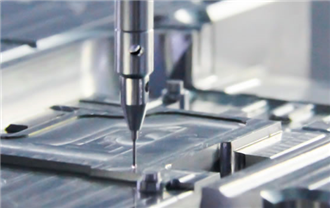
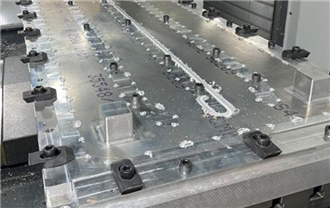
The workpiece is securely positioned before rough machining removes unnecessary material. We then use controlled CNC milling operations to produce the designed cooling passages.
The machining sequence is planned around tool access and feature relationships. For complicated channel layouts, maintaining a stable reference throughout different operations is especially important because small positional errors can affect subsequent ports, covers, or mounting features.
After roughing, critical surfaces and channels are finish-machined. Particular attention is given to:
| Feature | Manufacturing Focus |
| Cooling channels | Geometry and dimensional consistency |
| Contact surface | Flatness and surface condition |
| Ports | Position and connection accuracy |
| Mounting holes | Pitch and positional accuracy |
| Sealing area | Surface integrity and cleanliness |
The objective is not simply to achieve attractive machining marks. Each surface is produced according to its functional role.
Cold plates contain passages that are difficult to inspect after assembly. We therefore treat chip removal and deburring as important manufacturing operations rather than cosmetic finishing.
After machining, residual chips and loose material are removed, and the part is cleaned before final inspection. This is particularly important for narrow coolant passages because particles can restrict flow.
ASHRAE also highlights the relationship between small liquid-cooling flow paths, filtration, and particulate control.
Our quality process is based on measurable requirements from the customer's drawing.
Depending on the project, inspection may include:
● Dimensional verification
● Flatness measurement
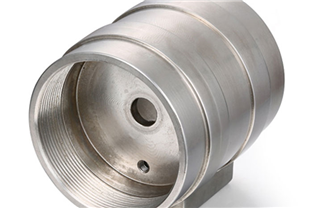
● Thread and port inspection
● Surface-finish verification
● Visual inspection of coolant passages
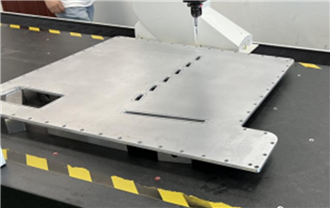
● CMM inspection for critical dimensions
● Leak or pressure testing when specified
Inspection requirements are determined before production so that critical characteristics are controlled throughout the manufacturing process rather than discovered only at the end.
Liquid Cold Plate Machining can be adapted for electronics cooling, power electronics, energy equipment, industrial control systems, and other applications where heat must be transferred through a compact liquid-cooled structure.
Cooling-channel geometry should be developed together with the thermal and hydraulic requirements. Smaller passages may provide more contact area but can also increase flow resistance, making the relationship between thermal performance and pressure drop an important design consideration.
For CNC machining capability and precision manufacturing services, you can visit the Start Precision homepage.
Technical reference: ASHRAE liquid cooling cold plate guidance
Consider a custom aluminum cold plate containing internal cooling channels, multiple mounting holes, and threaded coolant ports.
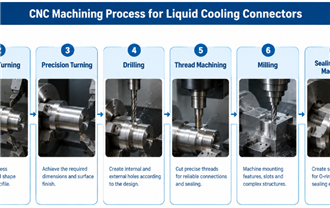
Our production route would be:

This approach creates a traceable connection between the customer's design intent and the finished cold plate.
High-quality Liquid Cold Plate Machining depends on the entire manufacturing chain—not one CNC operation. Design review, machining strategy, channel accuracy, surface control, cleaning, inspection, and testing must work together.
By focusing on how each manufacturing step affects the final cooling component, precision CNC machining can provide a practical path from prototype parts to repeat production.
Contact us to discuss your manufacturing requirements and develop a precision machining solution for your liquid cooling components.
1. What materials can be used for liquid cold plate machining?
Aluminum and copper are common choices. The final selection depends on thermal requirements, weight, coolant compatibility, corrosion considerations, and cost.
2. What information is needed to manufacture a custom cold plate?
A 3D CAD file, 2D drawing, material specification, quantity, tolerance requirements, surface treatment, and testing requirements are helpful.
3. How do you control the accuracy of cooling channels?
The machining datum, tool path, cutting sequence, tooling, and inspection method are planned according to the channel geometry and required tolerances.
4. Can you manufacture prototype and production quantities?
Yes. The CNC process can be adapted for prototype development, low-volume production, and repeat manufacturing.
5. Why is cleaning important after machining a cold plate?
Residual chips or burrs inside coolant passages can interfere with flow and potentially contaminate the cooling system. Thorough cleaning is therefore part of the manufacturing process.
6. Can cold plates be leak tested?
Yes. Leak or pressure testing can be incorporated when it is specified by the application or engineering requirements.
Add: Building 3No.277 Zhen'an Middle Road, Chang'an Town,Dongguan,Guangdong, China
Tel:+86-769-82855591
Copyright © 2019 All Rights Reserved Dongguan Start Precision Technology Co., Ltd. Tel: +86-769-82855591
Add: No. 277 Zhen'an Middle Road, Chang'an Town, Dongguan, Guangdong, China



 中文版
中文版 English