CNC Turning Machining – Hard Turning vs Cylindrical Grinding
Date:2026-07-02Article editor:Starting Point PrecisionViews:354In modern manufacturing, CNC turning machining remains the backbone of cylindrical part production. When finishing hardened steel (above 45 HRC), engineers face a classic dilemma: hard turning or cylindrical grinding? Both deliver high precision, but their economic and technical trade-offs decide the winner. This article breaks down the battle, backed by real shop-floor data, to help you choose wisely.
Hard turning is a single-point cutting process using CBN (cubic boron nitride) or ceramic inserts on CNC lathes to machine workpieces with hardness up to 70 HRC. It removes material via shear deformation, generating chips and heat. Modern rigid lathes and advanced tool coatings make hard turning a viable finish operation, often replacing grinding for components like gear shafts, bearing races, and hydraulic pistons. For detailed CBN insert grades and application data, refer to Sandvik Coromant’s hard turning guide, which offers real-world parameter recommendations.
Cylindrical grinding uses an abrasive wheel rotating at high speed to remove microscopic layers via friction and fracture. It’s the traditional choice for ultra-tight tolerances (±0.002 mm) and mirror-like surface finishes (Ra < 0.2 µm). Grinding excels on brittle materials, thin-walled parts, and long shafts where deflection would ruin turning accuracy. Common applications include turbine rotors, precision spindles, and mold cores.
| Factor | Hard Turning | Cylindrical Grinding |
| Tolerance | ±0.005–0.010 mm (with advanced lathes) | ±0.001–0.002 mm |
| Surface Finish (Ra) | 0.2–0.8 µm | 0.05–0.2 µm |
| Cycle Time | 2–5× faster (single setup) | Slower, multiple passes |
| Tool Cost | High (CBN inserts ~$50–$150 each) | Moderate (wheels dressable) |
| Machine Cost | Lower (CNC lathe vs. grinder) | Higher (specialized grinder) |
| Heat Impact | Generates heat; may cause white layer | Minimal heat; better metallurgical integrity |
| Flexibility | Can turn profiles, grooves, and shoulders in one setup | Limited to cylindrical surfaces |
■ Choose Hard Turning if:
◆ Part hardness ≤ 60 HRC
◆ Tolerance ≥ ±0.005 mm
◆ You need multi-feature machining (turning, grooving, threading) in one chucking
◆ High production volume (>1000 parts/month)
◆ Floor space is limited (lathes are smaller than grinders)
■ Choose Cylindrical Grinding if:
◆ Tolerance ≤ ±0.002 mm or roundness < 0.002 mm
◆ Surface finish Ra < 0.2 µm required
◆ Material is very hard (>60 HRC) or brittle (ceramics, carbides)
◆ Part has thin walls or long unsupported sections (to avoid deflection)
◆ You need to correct heat-treatment distortion after hardening
For a batch of 500 hardened steel rollers (55 HRC, Ø40×100 mm):
◆ Hard turning: Machine rate $60/hr, cycle 2 min → labor/machine cost $2.00; insert cost $1.50/part → total $3.50/part.
◆ Grinding: Machine rate $90/hr, cycle 6 min → cost $9.00; wheel dressing amortized $0.80 → total $9.80/part.
Hard turning saves 64% here. But if reject rate from turning is 5% (vs. 0.5% for grinding), the effective cost rises to $3.68 vs. $9.85 – still grinding is 2.7× more expensive.
Many shops adopt a hybrid strategy: rough and semi-finish by hard turning, then a light grind (0.05–0.10 mm stock) for final tolerance and surface. This balances speed and quality. For instance, EMAG and INDEX offer combined turning-grinding centers that perform both operations in one setup, reducing handling errors.
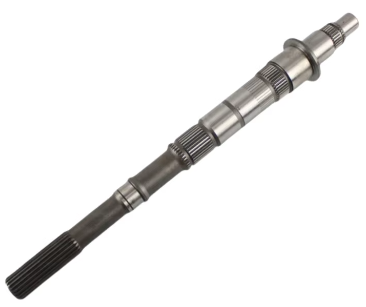
A tier-1 auto supplier produced a 45 HRC output shaft (length 300 mm, diameter 50 mm). Initially, they used cylindrical grinding after pre-turning, achieving ±0.003 mm roundness and Ra 0.15 µm. Cycle time: 4.2 minutes per part. They switched to hard turning on a DOOSAN Lynx 2100 with CBN inserts, maintaining ±0.008 mm and Ra 0.4 µm – acceptable for the application. Cycle time dropped to 1.1 minutes, saving 72% machining time. Tool life averaged 80 parts per edge. Annual cost reduction: $47,000, despite higher insert prices. The lesson? Hard turning wins when tolerances are relaxed and volume is high.
However, for a aerospace fuel pump spindle (62 HRC, ±0.002 mm requirement, Ra 0.1 µm), grinding remained irreplaceable. The heat from turning would distort the thin wall, and the required finish was impossible with CBN alone.
No universal winner exists – hard turning offers speed, flexibility, and lower operating costs, while cylindrical grinding delivers unmatched precision and surface integrity. The decision hinges on tolerance requirements, batch size, material hardness, and part geometry. With modern machine tools closing the accuracy gap, hard turning is steadily eating into grinding’s territory, but grinding remains the gold standard for the most demanding applications. Evaluate your process capability, run cost simulations, and consider a hybrid workflow to get the best of both worlds.
Q1: Can hard turning achieve the same surface finish as grinding?
A: Not typically. Grinding can achieve Ra 0.05–0.1 µm, while hard turning usually stops at 0.2 µm with CBN. With wiper inserts and optimized parameters, some shops reach 0.15 µm, but grinding is still superior for mirror finishes.
Q2: What hardness limit is practical for hard turning?
A: Up to 65–68 HRC is feasible with CBN tools. Above that, tool wear accelerates exponentially, making grinding more economical.
Q3: Is cylindrical grinding always more accurate than hard turning?
A: Yes, grinding can hold ±0.001 mm consistently, whereas hard turning on a standard CNC lathe holds ±0.005 mm. Only ultra-precision lathes (e.g., hydrostatic bearings) approach grinding-level accuracy.
Q4: How do I decide which process to use for my job?
A: Start with the drawing’s tolerance and surface roughness. If they exceed hard turning’s capability, choose grinding. Then compare cycle times and tooling costs per part – a simple ROI spreadsheet will clarify the choice.
Q5: Can I use the same CNC lathe for hard turning and soft turning?
A: Yes, but you need rigid tooling, high-pressure coolant, and vibration-damping setups. Changing between soft and hard materials requires insert changes and parameter adjustments; some shops dedicate a lathe solely to hard turning to avoid contamination.

Add: Building 3No.277 Zhen'an Middle Road, Chang'an Town,Dongguan,Guangdong, China
Tel:+86-769-82855591
Copyright © 2019 All Rights Reserved Dongguan Start Precision Technology Co., Ltd. Tel: +86-769-82855591
Add: No. 277 Zhen'an Middle Road, Chang'an Town, Dongguan, Guangdong, China



 中文版
中文版 English