Steel Turned Parts for Carbon vs Alloy Steel
Date:2026-07-20Article editor:Starting Point PrecisionViews:269Selecting the right steel grade for turned components directly impacts product lifecycle, cost, and performance. While both 1045 (medium carbon) and 4140 (chromium-molybdenum alloy) are workhorses in CNC turning, their distinct metallurgical behaviors demand careful evaluation. This article dissects their mechanical divergence, fatigue resistance, processability, and real-world deployment, backed by shop-floor parameters.
The core difference lies in tensile strength and yield point. 1045 carbon steel, with 0.45% carbon, offers a tensile strength of ~585 MPa and yield of ~505 MPa (as-rolled). Its hardness hovers around 170–210 HB. In contrast, 4140 alloy steel (0.40% C, Cr-Mo) delivers a tensile strength of ~655 MPa in annealed state, soaring to over 950 MPa after heat treatment. Yield strength scales from 415 MPa to 800+ MPa.
| Parameter | 1045 Carbon Steel | 4140 Alloy Steel |
| Tensile Strength (MPa) | 585 (as-rolled) | 655 (annealed) / 950+ (QT) |
| Yield Strength (MPa) | 505 | 415 (annealed) / 800+ (QT) |
| Hardness (HB) | 170–210 | 200–235 (annealed) / 280–350 (QT) |
| Elongation (%) | 16–18 | 18–22 (annealed) / 10–12 (QT) |
| Impact Toughness (J, Charpy V) | ~20 @ RT | ~50 @ RT (QT) |
Table 1: Typical mechanical comparison (based on ASTM A29/AISI standards)
While 1045 provides adequate strength for light-duty shafts, 4140’s alloying elements (Cr, Mo) enhance hardenability, enabling through-hardening in thicker sections—a critical advantage for heavy-load spindles.
In cyclic loading applications, fatigue strength differentiates them sharply. 1045 exhibits an endurance limit of ~250 MPa (10⁷ cycles). 4140, when quenched and tempered (QT) to 30 HRC, achieves an endurance limit of ~420 MPa—nearly 68% higher. Moreover, 4140’s fracture toughness (K_IC) is superior due to its refined grain structure and tempered martensite, reducing crack propagation risk under impact or vibration.
For instance, an automotive transmission input shaft experienced premature failure with 1045 after 150,000 cycles. Switching to 4140 (QT) extended fatigue life beyond 500,000 cycles, as documented in a SAE technical paper. The trade-off? 4140’s higher strength demands more rigid tooling and slower speeds.
● 1045 Carbon Steel – Ideal for low-stress, high-volume parts: hydraulic piston rods, agricultural machinery pins, and general-purpose bushings. Its lower cost and good weldability suit non-critical automotive brackets.
● 4140 Alloy Steel – Preferred for high-strength, safety-critical components: aircraft landing gear pins, heavy-duty gear shafts, oilfield drill collars, and press rams. Its resistance to stress corrosion cracking also benefits marine environments.
When your design requires combined torsion and bending (e.g., crane sheave axles), 4140’s superior yield-to-tensile ratio ensures a safer failure mode.
Machinability ratings (based on AISI 1212 = 100) are 65 for 1045 and 55 for 4140 (annealed). 4140’s higher hardness accelerates tool wear, especially with carbide inserts. Recommended turning parameters for a typical CNC lathe:
| Parameter | 1045 | 4140 (annealed) |
| Cutting Speed (m/min) | 180–220 | 120–160 |
| Feed (mm/rev) | 0.20–0.30 | 0.15–0.25 |
| Depth of Cut (mm) | 2.0–4.0 | 1.5–3.0 |
| Insert Grade | P25 (coated) | P35 (ceramic/titanium nitride) |
For 4140 in hardened condition (>30 HRC), use CBN tools and reduce speed by 30%.
Chip control is trickier with 4140—its toughness produces long, stringy chips. Employ high-pressure coolant (>70 bar) and chip breakers to avoid bird-nesting. 1045, on the other hand, generates manageable helical chips, enabling faster cycle times.
A manufacturer producing 1000 mm long piston rods initially used 1045 for cost reasons. Field returns due to surface galling and bending exceeded 8% annually. After analyzing load spectra, they switched to 4140 (QT 28–32 HRC) with induction-hardened surface. Not only did the yield strength increase by 60%, but the chrome-moly layer also improved wear resistance. Within six months, failure rates dropped to 1.2%, offsetting the higher material cost. This case illustrates that total cost of ownership often favors alloy steel in dynamic applications.
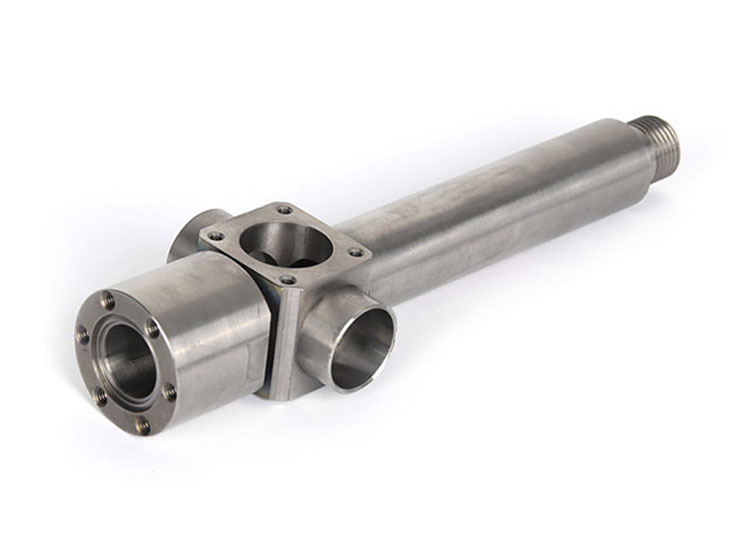
For such precision turning requirements, Start Precision offers customized CNC machining with real-time process monitoring. Our turning capabilities encompass both 1045 and 4140, with in-house heat treatment and non-destructive testing to guarantee fatigue performance.
Choosing between 1045 and 4140 is not a simple cost equation. For static, low-cycle parts under 500 MPa stress, 1045 delivers economical efficiency. For components subjected to high torsion, impact, or over 400 MPa cyclic loads, 4140’s superior fatigue and toughness justify its premium. Always factor in machinability—4140 requires experienced programmers and robust tooling, while 1045 suits high-throughput production.
Remember: Material selection should align with your specific safety factors and environmental conditions. Consult your machining partner early to optimize both design and process.
Contact us to discuss your manufacturing requirements—we are ready to provide metallurgical and process engineering support for your next turned parts project.
Q1: Can 1045 be heat-treated to match 4140’s strength?
Not practically. 1045 hardens only to a shallow depth (~5 mm) and cannot achieve 4140’s core toughness due to lower alloy content.
Q2: Which grade is easier to weld?
1045 has better weldability (preheat 150–200°C). 4140 requires strict preheating (250–350°C) and post-weld stress relief to avoid cracking.
Q3: How does cost compare per kilogram?
Typically, 4140 costs 40–60% more than 1045 in raw bar stock, but the gap narrows when considering heat treatment and surface finishing.
Q4: Are there eco-friendly alternatives?
Both are recyclable. Some suppliers offer low-lead 4140 variants for environmental compliance (e.g., RoHS).
Add: Building 3No.277 Zhen'an Middle Road, Chang'an Town,Dongguan,Guangdong, China
Tel:+86-769-82855591
Copyright © 2019 All Rights Reserved Dongguan Start Precision Technology Co., Ltd. Tel: +86-769-82855591
Add: No. 277 Zhen'an Middle Road, Chang'an Town, Dongguan, Guangdong, China



 中文版
中文版 English