CNC turning precision parts machining: Custom auto shaft mechanical parts
Date:2026-05-18Article editor:Starting Point PrecisionViews:4301. Introduction to CNC Turning for Automotive Shafts
CNC turning precision parts machining is the most reliable method for producing custom auto shaft mechanical parts with high repeatability and tight tolerances. Automotive shafts such as transmission input shafts, propeller shafts, and axle shafts require cylindrical accuracy that only modern CNC lathes can provide. With capabilities including live tooling, Y-axis, and sub-spindle, complex features like grooves, threads, and splines are machined in a single setup, reducing both lead time and geometric errors.
The choice of raw material directly impacts the strength, wear resistance, and cost of CNC turned auto shafts. Typical grades include medium-carbon steel (1045, 4140), stainless steel (303, 304, 17-4 PH), and light alloys like aluminum 6061-T6 and titanium Grade 5. For high-torque drive shafts, 4140 alloy steel with induction hardening is preferred, while corrosion-resistant shafts use 316 stainless steel. External reference on automotive steel grades: ASTM A29 standard.
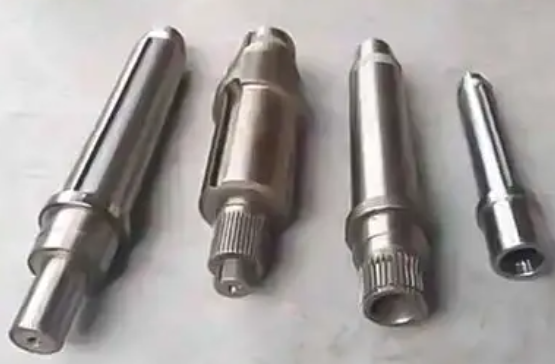
Precision CNC turning holds extremely tight tolerances on custom auto shaft mechanical parts, typically ±0.005 mm on critical diameters. For a typical engine balance shaft, CNC turning achieves concentricity between bearing journals within 0.008 mm and surface finish Ra ≤ 0.8 µm without additional grinding. Live tooling enables cross holes, keyways, and hex flats to be machined while the shaft remains clamped, eliminating secondary fixturing errors. Image of a finished CNC turned auto shaft:
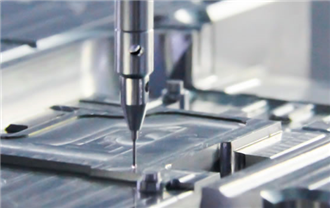
Closed-loop process monitoring during CNC turning ensures that every custom auto shaft meets design specifications. Modern CNC lathes integrate touch probes that measure critical diameters immediately after cutting and automatically adjust tool offsets to compensate for wear. Statistical process control (SPC) tracks parameters such as roundness, straightness, and perpendicularity. For production runs of 5,000+ shafts, this reduces defect rates below 0.3%.
Secondary operations after CNC turning significantly improve the mechanical properties and service life of custom auto shaft mechanical parts. These include centerless grinding for ultra-precise bearing surfaces, induction or carburizing heat treatment for surface hardness (HRC 55–60), and black oxide or zinc-nickel plating for corrosion resistance. Rotating shafts such as propeller shafts also require dynamic balancing per ISO 1940 G6.3 grade. External standard on balancing: ISO 1940-1:2003.
CNC turning precision parts machining offers fast turnaround from single prototypes to high-volume production of custom auto shafts. For prototype quantities (1–10 pieces), lead time is typically 3–5 business days using soft jaws and standard tooling. Production orders of 100–1,000 shafts require 10–15 working days, with unit prices ranging from 6–22 depending on material, tolerances, and secondary treatments. Request a quote for your shaft design.
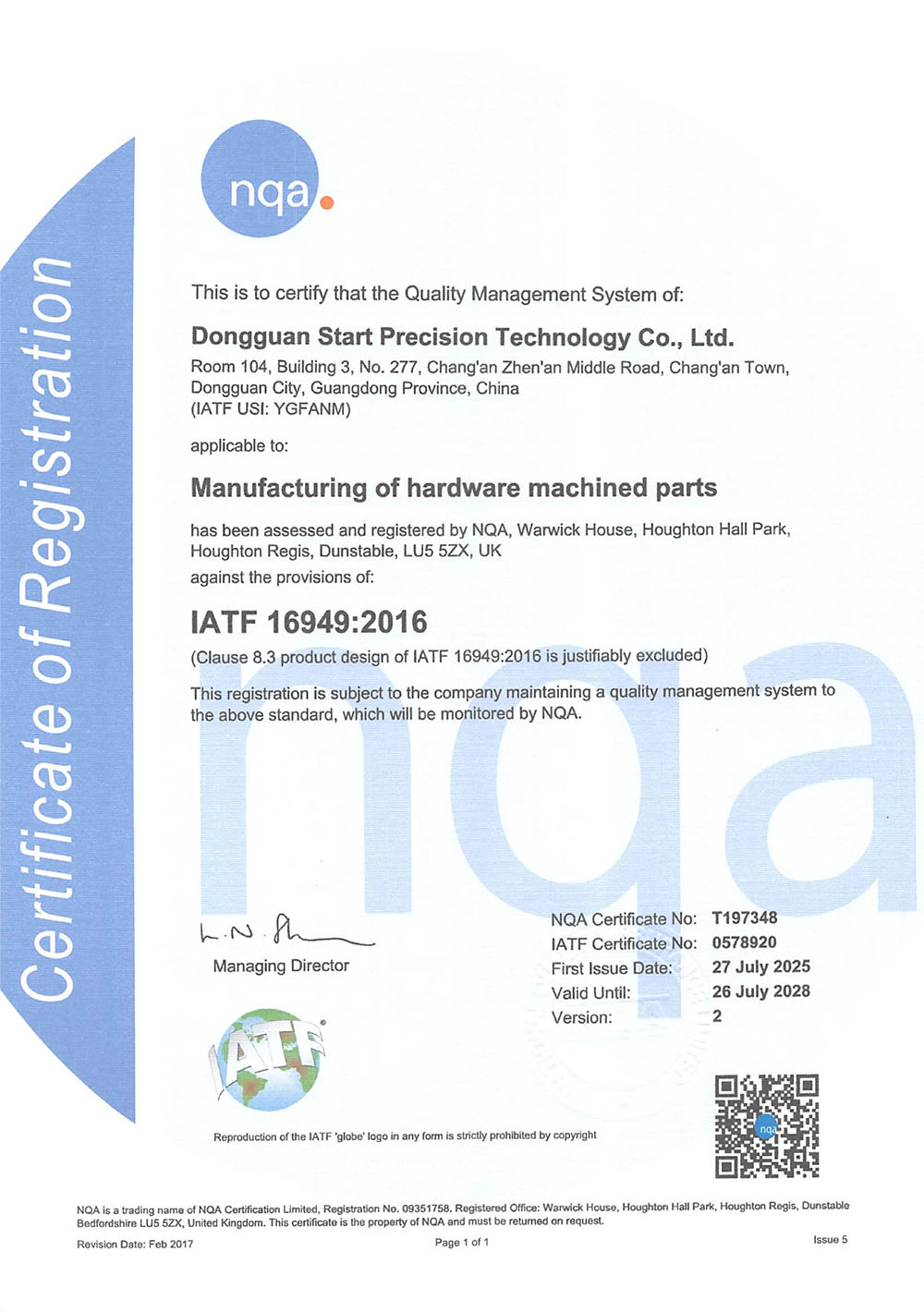
Working with an IATF 16949 certified CNC turning shop guarantees that custom auto shaft mechanical parts meet strict automotive quality standards. IATF 16949 emphasizes defect prevention, reduction of variation, and supply chain management. Many buyers also require compliance with ISO 9001:2015 and PPAP (Production Part Approval Process) Level 3 documentation.
Q1. What is the maximum length and diameter for CNC turning of auto shafts?
Most CNC lathes handle diameters from 2 mm to 300 mm and lengths up to 1,500 mm. For longer shafts (e.g., truck propeller shafts up to 3,000 mm), specialized long-bed lathes with steady rests are available.
Q2. Which tolerances are standard for custom auto shaft mechanical parts?
Typical diametrical tolerances: ±0.005 mm to ±0.010 mm. Concentricity between bearing journals: ≤0.01 mm. Straightness per 300 mm length: ≤0.02 mm. Tighter tolerances (±0.002 mm) can be achieved with post-turning grinding.
Q3. Can you machine splines and keyways using CNC turning alone?
Yes, if the CNC lathe has live milling capability. Splines and keyways can be milled with form cutters or single-point tools in the same clamping. For non-live-tool lathes, these features require a separate milling operation.
Q4. What file formats are needed for a quotation?
3D CAD files in STEP (.stp), IGES (.igs), or Parasolid (.x_t) are preferred. A 2D drawing in PDF with GD&T per ASME Y14.5 helps clarify tolerances. Please also specify material grade, quantity, and any heat treatment or coating required.
Q5. What is the typical lead time for 500 custom auto shafts?
For 500 shafts made of 4140 steel with basic turning, grooving, and threading, lead time is 10–12 working days after material arrival. Adding heat treatment (carburizing) and grinding extends lead time by 5–7 days.
Add: Building 3No.277 Zhen'an Middle Road, Chang'an Town,Dongguan,Guangdong, China
Tel:+86-769-82855591
Copyright © 2019 All Rights Reserved Dongguan Start Precision Technology Co., Ltd. Tel: +86-769-82855591
Add: No. 277 Zhen'an Middle Road, Chang'an Town, Dongguan, Guangdong, China



 中文版
中文版 English