Contract Machining Services with Seamless Transfer from Other Shops
Date:2026-08-28Article editor:Starting Point PrecisionViews:91Moving production between machining shops is often viewed as a last resort—fraught with qualification delays, first-article rejections, and interrupted deliveries. Yet, with the right Contract Machining Services, this transition can become a strategic advantage rather than a liability. The key lies in a structured, engineering-led handover that preserves your existing process intelligence while leveraging advanced equipment capabilities.
Migrating precision parts to a new machining partner exposes you to three critical failure points:
● Process Drift: Your CNC programs were fine-tuned for specific machine dynamics. Running the same code on different equipment can introduce chatter, dimensional deviation, or surface finish degradation—turning first-article inspection into a costly troubleshooting loop.
● Supply Gap: If the new line isn't validated before the old supplier ships its last order, your inventory runs dry. Production stoppages during supplier transitions are a leading cause of unplanned downtime, with significant revenue impact per hour lost.
● Qualification Bottleneck: Re-running PPAP, re-submitting certifications, and re-validating first articles for every component consumes weeks of engineering effort. Incomplete documentation can stretch this timeline into months, delaying your product launches.
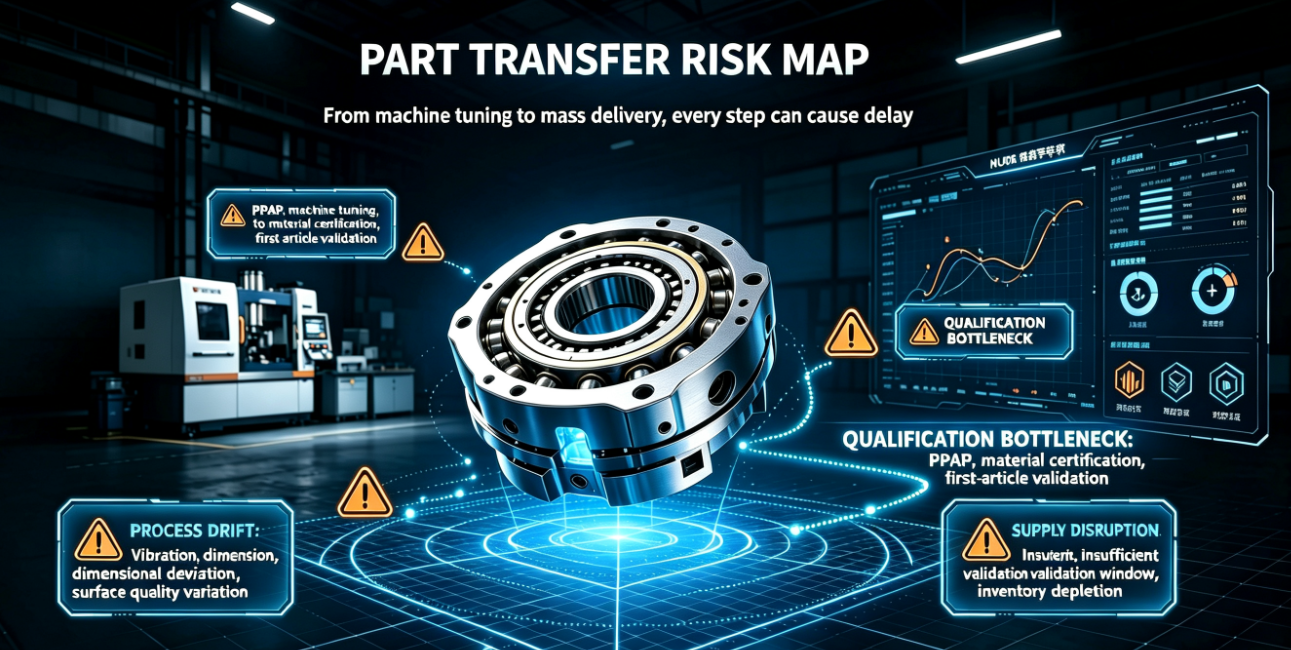
These risks are manageable—but only with a methodical, engineering-driven approach. The solution lies in a partner who treats your existing process knowledge as an asset, not an obstacle. This is the foundation of our Contract Machining Services.
When you engage our Contract Machining Services for a transfer, we initiate a three-phase protocol designed to eliminate the typical friction points.
1. Absorption of Existing Processes and Program Files
We do not start from a blank sheet. Our engineering team conducts a comprehensive intake that includes:
● Existing CNC programs (G-code, CAM files) for your specific parts.
● Current setup sheets, tooling lists, and inspection plans.
● Historical SPC data to benchmark capability indices (Cpk).
● Material certifications and heat treatment specifications.
This information is mapped against our Precision equipment list to identify the optimal machine assignment. For instance, your existing 3-axis milling program might be reassigned to a 5-axis machining center to reduce setups, but we run it in a "simulation mode" first to validate geometry against your original intent.
| Transfer Phase | Our Action | Client Benefit |
| Process Intake | Full digital archiving of programs, tool data, and inspection criteria | Preserves your intellectual capital and tribal knowledge |
| Trial Run | Production of validation samples using your exact programs | Immediate identification of equipment-specific offsets |
| Supply Bridge | Retaining of safety stock during parallel production | Zero day of delivery interruption |
2. Rapid Trial Production & Validation
We compress the traditional PPAP timeline through two tactics:
● Digital Twin Simulation: We run your programs through our simulation software to detect potential collisions or tool path inefficiencies before cutting metal.
● Same-Inspection Standards: Using CMM and optical comparators, we inspect trial parts to the same print characteristics and sampling plan you used previously. Our goal is to achieve "first-pass yield" within the first trial batch, not after multiple iterations.
3. Uninterrupted Supply During the Transfer
The greatest fear is a supply gap. To mitigate this, we coordinate with your logistics to implement a cross-shipping schedule:
● We begin building a buffer stock of finished parts two weeks prior to the official transfer date.
● We synchronize our shipping schedule with your existing supplier's final shipments to ensure your inventory level never drops below the reorder point.
Example: A medical device manufacturer needed to transfer 47 high-mix, low-volume surgical instrument components from a closing shop. The parts required tight tolerances on stainless steel and complex 5-axis contours. By taking over the existing G-code and tooling lists, our engineers on the precision equipment list identified that a Mazak 5-axis could consolidate two operations into one. We produced 3 sample parts per SKU in the first trial, with 44 out of 47 passing CMM inspection on the first attempt. We shipped the first 1,000-piece order ahead of the planned transfer date, ensuring the client’s surgical line faced zero downtime. The three components that required adjustment were corrected through toolpath parameter refinements within 48 hours.
How we implement this philosophy is rooted in our operational DNA:
● We do not assume our machines are better; we prove it. We run your existing program as-is to establish a baseline.
● We embrace your document hierarchy. We do not force our own template on you. Instead, we map your process control documents to our internal systems, creating a cross-reference that simplifies audits for your quality team.
● We validate through part replication, not just theory. Our trial runs simulate your actual production volume to confirm that thermal stability and tool wear patterns remain consistent.
A seamless transfer is not about starting over; it is about a respectful, data-driven handover of your manufacturing legacy. Our Contract Machining Services are designed to protect your supply chain, preserve your engineering investment, and accelerate time-to-market for your products—all while leveraging our advanced precision equipment for potential process improvements.
For authoritative insights into supply chain risk management in manufacturing, you can refer to industry standards from the Association for Manufacturing Excellence or Modern Machine Shop, which regularly discuss supplier transition best practices.
Contact us to discuss your manufacturing needs. We are ready to review your existing programs, engineering documents, and transfer timeline to build a continuity plan that works for your business.
1. How long does a typical transfer of machining services take?
The timeline varies based on part complexity and volume. For most medium-complexity parts with complete documentation, our trial production completes within 2-4 weeks, with safety stock production commencing in parallel to ensure supply continuity.
2. What if my existing programs are written for a specific machine controller (e.g., Fanuc, Siemens) that you do not have?
We can post-process your programs to our equipment's controllers. More importantly, we review the CAM strategy and tool paths to ensure the machining philosophy is preserved, not just the code.
3. Do you handle parts with outdated or incomplete documentation?
Yes. We have reverse-engineering capabilities. We can scan the finished part or use existing inspection data to re-create tool paths, though this may extend the validation timeline.
4. Who absorbs the cost of trial parts and potential scrap during the transfer?
We share this risk. Our pricing model includes a "transfer package" that covers the cost of trial runs for a defined number of SKUs, mitigating the financial risk for your company during the qualification phase.


Add: Building 3No.277 Zhen'an Middle Road, Chang'an Town,Dongguan,Guangdong, China
Tel:+86-769-82855591
Copyright © 2019 All Rights Reserved Dongguan Start Precision Technology Co., Ltd. Tel: +86-769-82855591
Add: No. 277 Zhen'an Middle Road, Chang'an Town, Dongguan, Guangdong, China



 中文版
中文版 English