Custom CNC Milling Parts: Mastering Complex Profile Machining
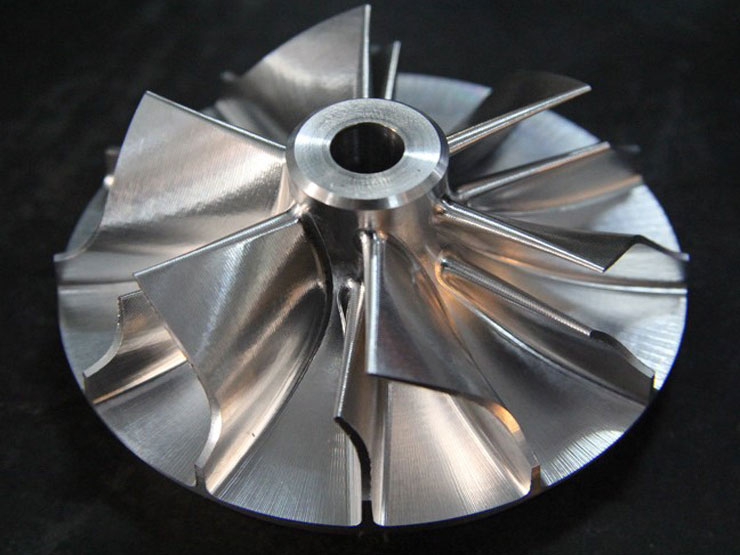
Date:2026-06-20Article editor:Starting Point PrecisionViews:313The demand for custom CNC milling parts has shifted dramatically. Gone are the days when prismatic blocks and simple holes defined CNC work. Today’s engineers design complex profile machining features—sculpted aerodynamic surfaces, deep ribbed pockets, and organic lattice structures—that push standard 3-axis machines to their limits. Successfully manufacturing these components requires a holistic approach that blends advanced machinery, intelligent programming, and real-time metrology. Without these capabilities, parts like turbine blisks or orthopedic knee implants simply cannot achieve the required surface integrity and dimensional accuracy.
1. 5-Axis Simultaneous Kinematics
While 3+2 axis positioning offers some flexibility, true complex profile machining relies on full 5-axis simultaneous motion. This allows the cutting tool to maintain a constant relationship with the part’s curved surface, minimizing tool marks and maximizing tool life. For instance, swarf milling—where the side of a cylindrical cutter follows a ruled surface—can machine an entire airfoil flank in one continuous pass.
Software is the brain behind the operation. Modern CAM packages (NX, Mastercam, and Hypermill) offer specialized modules for complex profile machining. Adaptive clearing algorithms maintain a constant chip load even as the tool engages varying widths of material, while scallop-height-controlled finishing paths ensure uniform surface roughness across freeform surfaces. Before committing to expensive materials, we strongly recommend reviewing our material-specific cutting parameters to match toolpath strategies with hardness and tensile strength.
Furthermore, machine simulation—a non-negotiable step for 5-axis work—detects collisions between the toolholder, spindle, and fixture. This digital twin approach saves countless hours of manual prove-outs and is thoroughly detailed in industry best practices published by the Society of Manufacturing Engineers, which emphasizes the importance of kinematic simulation for zero-defect production.
The physical cutting environment must be meticulously orchestrated. For custom CNC milling parts with slender, deep profiles, long-reach variable-helix end mills reduce harmonic chatter. For finishing expansive curved surfaces, barrel-shaped or lollipop cutters increase contact area, boosting productivity by up to 40%. Coating technologies like AlTiN or DLC are equally critical; they act as thermal barriers when machining superalloys like Inconel.
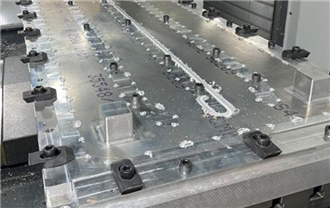
Workholding often becomes the bottleneck. Modular vises, vacuum pods, or custom-machined soft jaws must provide rigid clamping without obstructing the toolpath. Many specialist shops now employ zero-point clamping systems that allow parts to be moved between operations without losing spatial reference—a game-changer for parts requiring multiple orientations. For a visual breakdown of these clamping setups, see this complex profile.
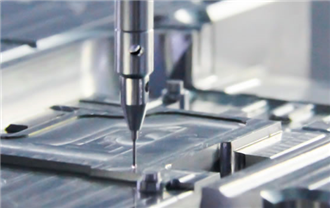
Achieving geometric tolerances of ±0.005″ on freeform surfaces is impossible with post-process inspection alone. In-process spindle probes measure critical datums while the part is still fixtured, allowing macros to automatically compensate for thermal growth or tool wear. For comprehensive verification, non-contact structured-light scanners capture millions of data points and generate color-coded deviation maps against the original CAD model. This closed-loop feedback is increasingly standard, as highlighted by recent CIMdata research on digital quality , which correlates in-process scanning with reduced scrap rates in high-mix, low-volume production.
Not every job shop possesses the infrastructure for complex profile machining. When sourcing custom CNC milling parts, buyers should audit three critical areas: the machine spindle speed and torque curve, the post-processor’s verification history for their specific control (e.g., Heidenhain or Siemens), and the programmer’s experience with similar organic geometries. A competent partner will also offer Design for Manufacturing (DFM) feedback—suggesting subtle changes like variable fillet radii that reduce machining time without sacrificing structural integrity.
As product designs become lighter, stronger, and more aerodynamically efficient, complex profile machining is no longer a niche specialty—it is a core competency. By harmonizing 5-axis kinematics, adaptive CAM logic, rigid workholding, and smart inspection routines, manufacturers can consistently produce custom CNC milling parts that meet the strictest functional requirements. Investing time in upfront simulation and selecting the right technical partner transforms complex CAD surfaces into reliable, high-performance physical components.
Q1: Why is 5-axis machining preferred over 3-axis for complex profiles?
A: 3-axis machining often requires multiple setups and leaves visible cusp marks on steep walls. 5-axis simultaneous machining allows the tool to tilt and follow the surface normal, which reduces setups, eliminates re-fixturing errors, and produces superior surface finishes on undercuts and deep cavities in a single clamping.
Q2: How do you manage tool deflection when machining deep, narrow slots?
A: Tool deflection is controlled through a combination of strategies: using stubby or tapered-neck end mills for maximum rigidity, applying high-speed machining (HSM) toolpaths that direct cutting forces axially rather than radially, and adjusting feeds/speeds based on real-time spindle load monitoring.
Q3: Can the same 5-axis strategies work for both aluminum and hardened tool steels?
A: Yes, but parameters must be scaled. Aluminum allows high surface speeds (800–1200 SFM) and lighter radial engagement, while hardened steels (>45 HRC) require lower speeds, higher rigidity, and often ceramic or cubic boron nitride (CBN) tooling. The CAM strategy—such as trochoidal milling—remains valid but with adjusted step-over values.
Q4: What CAD format is best for quoting a complex profile part?
A: STEP AP203 or AP214 (.stp) is the industry standard because it preserves solid geometry and tolerances without losing surface definition. Including a native file (e.g., SolidWorks .sldprt) alongside a detailed 2D PDF with critical datums and surface roughness requirements (Ra/Rz) is highly recommended for accurate quoting.
Q5: How long does the programming phase typically take for a complex 5-axis part?
A: Programming time can range from 4 hours for a simple contoured bracket to 40+ hours for a multi-bladed impeller. This includes CAD cleanup, toolpath calculation, machine simulation, and post-processor fine-tuning. Most specialists provide a DFM review and a detailed timeline, often including a first-article inspection report before starting full-scale production.
Add: Building 3No.277 Zhen'an Middle Road, Chang'an Town,Dongguan,Guangdong, China
Tel:+86-769-82855591
Copyright © 2019 All Rights Reserved Dongguan Start Precision Technology Co., Ltd. Tel: +86-769-82855591
Add: No. 277 Zhen'an Middle Road, Chang'an Town, Dongguan, Guangdong, China



 中文版
中文版 English