Carbon Steel CNC Machined Parts with Volume Tier Pricing Saves More
Date:2026-09-02Article editor:Starting Point PrecisionViews:20In precision manufacturing, cost efficiency depends on material choice, machining strategy, order quantity, and supplier partnership. Carbon steel grades like 1045, AISI 4140, and 1215 offer an excellent balance of machinability and mechanical strength, making them the standard choice for shafts, gears, and hydraulic components across automotive and heavy machinery sectors. However, the real cost advantage emerges when you pair Carbon Steel CNC Machined Parts with a volume tier pricing model. This approach reduces per-unit costs by amortizing fixed expenses across larger batches.
The American Machine Tool Distributors' Association emphasizes that predictable material behavior and consistent chip formation make carbon steel ideal for high-efficiency CNC operations. Yet per-part pricing fluctuates significantly based on setup time, tool wear, and material handling—costs that diminish as order volume increases. At Start precision, we structure our tiered pricing to capture these efficiencies and pass them directly to our clients.
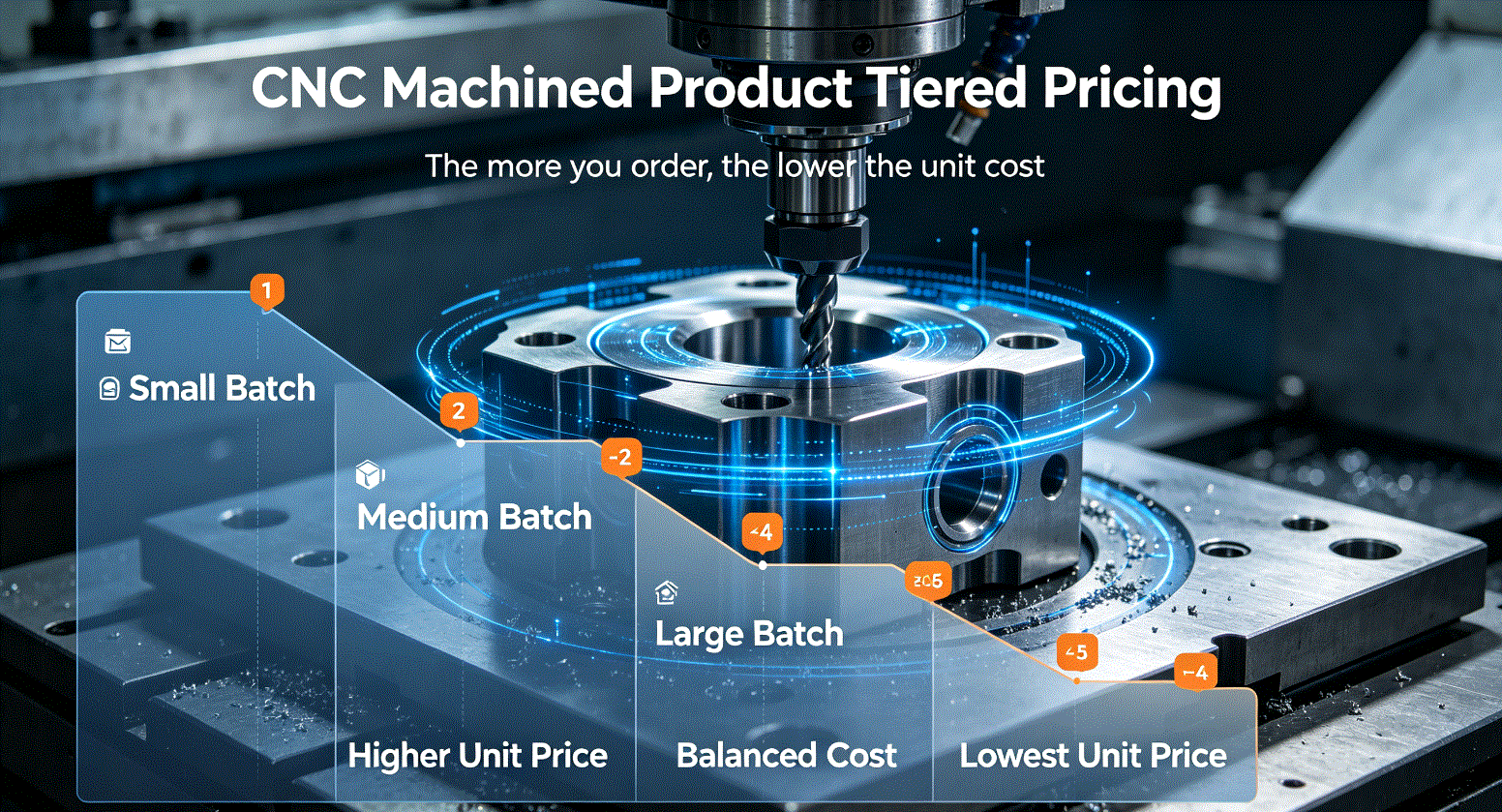
Volume tier pricing is a strategic model where unit cost decreases as order quantities cross defined thresholds. For Carbon Steel CNC Machined Parts, this directly addresses fixed production costs:
| Order Quantity Range | Relative Cost (Index) | Setup Allocation | Efficiency Gain | Savings vs. Prototype |
| Prototype (1–20) | 1.00 (baseline) | Very High | Standard | – |
| Small Batch (21–100) | 0.82 | High | Optimized | ~18% |
| Medium Batch (101–500) | 0.67 | Medium | High | ~33% |
| Large Batch (501–2000) | 0.55 | Low | Very High | ~45% |
| Mass Production (2000+) | 0.46 | Negligible | Maximum | ~54% |
Actual dollar amounts depend on part complexity, tolerances, secondary operations, and material grade. Figures above are comparative indices.
Moving from prototype to mass production can cut the per-part cost coefficient by over 54% through setup amortization and continuous machining cycles. For annual volumes of 5,000 units, this typically yields five-figure savings—even for moderately complex components. These economies of scale are well-documented in Research on manufacturing cost structures, confirming that machining costs decline non-linearly with batch size when suppliers maintain operational discipline.
We engineer savings through three core practices:
1. Setup Standardization – Modular fixturing and pre-set tooling reduce changeover time from 45 to under 12 minutes between repeat orders, lowering fixed-cost burdens. Our tooling strategies follow recommendations from Sandvik Coromant to optimize insert grades and cutting data for carbon steel's specific wear characteristics.
2. Tool Path Optimization – Our CAM programmers apply adaptive clearing and trochoidal milling specifically for carbon steel grades, extending tool life by 30% and reducing cost per cutting edge. All processes adhere to ASME machining standards for surface finish and dimensional accuracy.
3. Material Blank Consolidation – For high-volume runs, we precut raw bars to exact lengths, reducing material waste below 3%. Mill-direct ordering for committed schedules further lowers material overhead and stabilizes pricing.
Higher tiers mean more than lower prices—they reflect a production system that grows more efficient with every additional piece.
A Midwest manufacturer needed 2,500 AISI 1144 valve spools per quarter. Their existing supplier offered a flat rate with no volume differentiation. We proposed a tiered structure:
● First 500 pcs – baseline tier
● Next 1,000 pcs – 18% reduction
● Remaining 1,000 pcs – 27% reduction
The client saved over $8,200 per quarter and reduced lead time by 6 days through continuous lights-out machining. This example demonstrates the tangible difference between passive quoting and active cost engineering.
Volume tier pricing for Carbon Steel CNC Machined Parts is a financial and operational lever. When executed with disciplined setup management, intelligent tooling, and material foresight, it delivers compounding savings over a product's lifecycle. The key is partnering with a machine shop that treats each tier as a distinct manufacturing campaign, not just a price break.
At Startprecision, every quote for carbon steel components includes tiered analysis based on your annual forecast, not just a single purchase order.
Contact us to discuss your manufacturing requirements and discover how our tier pricing structure can turn your high-volume carbon steel project into a long-term cost advantage.
Q1: What is the minimum order quantity for volume tier pricing?
A: Tiered pricing starts at 20 pieces, with significant savings typically beginning at the 100-piece threshold.
Q2: Does tier pricing apply to all carbon steel grades like 4140 or 8620?
A: Yes. The tier structure applies to all carbon steel alloys, with tooling and feeds adjusted per grade.
Q3: How are engineering changes handled during a production run?
A: We implement a "frozen period" per batch. If changes occur, we requote remaining pieces at the original or a new tier—whichever benefits you more.
Q4: Are there hidden tooling or programming fees?
A: No. Tooling and programming are embedded in tier pricing for standard parts. Separate NRE fees only apply to complex geometries or custom form tools.
Q5: Can multiple part numbers be combined for tier pricing?
A: Yes. We offer "family tiering"—combining quantities of parts sharing the same material and similar machining cycles to unlock higher savings.



Add: Building 3No.277 Zhen'an Middle Road, Chang'an Town,Dongguan,Guangdong, China
Tel:+86-769-82855591
Copyright © 2019 All Rights Reserved Dongguan Start Precision Technology Co., Ltd. Tel: +86-769-82855591
Add: No. 277 Zhen'an Middle Road, Chang'an Town, Dongguan, Guangdong, China



 中文版
中文版 English