EDM Machining Metal Parts: Your Complete Industrial Machining Service Guide
Date:2026-05-13Article editor:Starting Point PrecisionViews:416When you need high-precision metal components with complex geometries, EDM machining metal parts is the go-to industrial machining service. This article covers the process, applications, when to choose EDM over turning/milling, cost comparisons, and how to select a reliable supplier.
What is EDM Machining for Metal Parts?
Electrical Discharge Machining (EDM) is a non‑contact thermal process that erodes metal using controlled electrical sparks. It is ideal for hardened steels, titanium, carbides, and superalloys. Unlike CNC milling, EDM produces burr‑free edges and intricate internal features. Learn the basics from Wikipedia: EDM Technology.
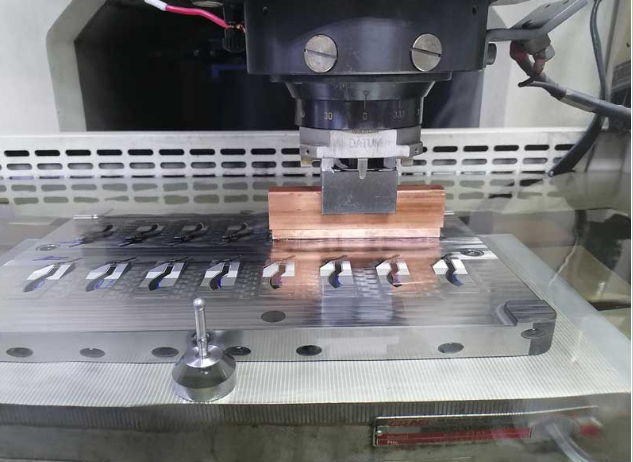
Wire EDM cutting a Copper parts
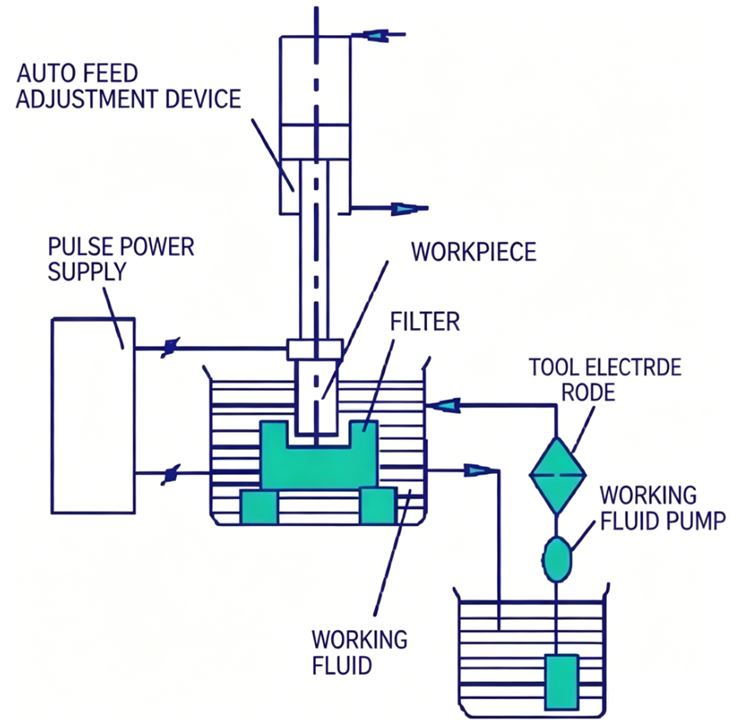
The principle is simple: a series of rapid electrical discharges between an electrode (tool) and the conductive metal workpiece vaporizes tiny amounts of material. The parts are submerged in dielectric fluid (deionized water or oil), which flushes away debris and cools the zone. Because there is no direct contact, there is no mechanical stress – perfect for fragile or thin‑wall metal parts. Two common methods:
◆ Wire EDM – uses a thin moving wire to cut through thick metal plates.
◆ Sinker EDM – uses a shaped electrode to create cavities, moulds, and blind holes.
While turning and milling are efficient for many geometries, several situations demand EDM instead of conventional machining:
◆ Extremely hard materials (>55 HRC, e.g., hardened tool steel, carbide, Stellite). Traditional cutters wear rapidly or fail. EDM erodes any conductive metal regardless of hardness.
◆ Deep, narrow slots or thin walls – Milling tools deflect or break; EDM’s non‑contact process avoids tool pressure.
◆ Sharp internal corners – Milling leaves a radius (tool diameter limitation). Sinker EDM produces near‑perfect 90° internal corners.
◆ Small holes (<0.5 mm) with high depth‑to‑diameter ratio – Drilling is impossible; small‑hole EDM excels.
◆ Fragile or pre‑hardened parts where mechanical cutting could induce residual stress or distortion.
◆ Complex 3D cavities (moulds, dies) with undercuts or ribs – EDM can burn shapes that no rotating tool can reach.
An industrial machining service based on EDM excels in producing:
◆ Hardened tool steel parts (e.g., punches, dies, injection mould cores).
◆ Aerospace metal components – turbine blades, fuel system parts made of Inconel or Waspaloy.
◆ Medical implants and surgical tools – stainless steel, titanium, and cobalt‑chrome alloys.
◆ Automotive precision parts – gear segments, fuel injector nozzles, and transmission components.
◆ Micro‑machined metal parts – holes as small as 0.05 mm, thin slots, and sharp internal corners.
When evaluating EDM vs. conventional machining, the total job cost depends on volume, material hardness, and feature complexity. Key points:
◆ Low‑volume, high‑complexity parts: EDM often has lower total cost because it requires no custom‑ground form tools and generates less scrap.
◆ High‑volume, simple shapes in soft materials: Conventional milling/turning is cheaper and faster (lower $/part).
◆ Medium‑volume hardened steel dies: EDM is cost‑effective – a single electrode can burn many cavities, while milling would need several expensive carbide cutters and longer cycle times.
◆ Micro‑features: EDM’s per‑part cost may be higher than CNC micro‑milling, but achievable tolerances and aspect ratios are superior.
In general, EDM hourly rates ($40‑$120) are higher than milling ($30‑$80), but the total job cost can be lower when factoring in tooling, fixturing, and secondary finishing.
When outsourcing EDM machining metal parts, consider these factors:
◆ Machine fleet & capacity: Does the shop offer multiple EDM types (wire, sinker, hole‑drill)? Max workpiece dimensions?
◆ Material expertise: Can they machine your specific alloy (e.g., D2 steel, carbide, titanium)?
◆ Quality certifications: ISO 9001:2015, AS9100D (aerospace), or ISO 13485 (medical).
◆ Tolerance and finish capabilities: Ask for a surface finish Ra ≤ 0.2 µm if needed.
◆ Turnaround & customer support: Do they offer design for manufacturability (DFM) feedback?
1. No mechanical stress or tool deflection – protects thin walls and delicate features.
2.Can machine any conductive metal, regardless of hardness (up to 70 HRC).
3.Excellent surface finish, often eliminating secondary polishing.
4.High repeatability for complex 2D and 3D shapes.
EDM machining metal parts is a versatile, high‑precision industrial machining service for challenging materials and geometries. By understanding when EDM outperforms turning/milling and how its total cost compares, you can make smarter sourcing decisions. Always request a test cut for critical tolerances and verify the supplier’s quality system.
Need a quote? Contact our EDM service team .
Add: Building 3No.277 Zhen'an Middle Road, Chang'an Town,Dongguan,Guangdong, China
Tel:+86-769-82855591
Copyright © 2019 All Rights Reserved Dongguan Start Precision Technology Co., Ltd. Tel: +86-769-82855591
Add: No. 277 Zhen'an Middle Road, Chang'an Town, Dongguan, Guangdong, China



 中文版
中文版 English