CNC Turned Component Machining Technology: High‑Speed Chip Removal
Date:2026-05-06Article editor:Starting Point PrecisionViews:586In CNC turning of precision components, high‑speed chip removal is critical for surface finish, tool life, and operator safety. When turning materials like steel, titanium, or aluminum at speeds above 300 m/min, chips are generated rapidly. If not evacuated instantly, they can tangle around the workpiece, scratch the finished surface, or even damage the turret.This article explains the proven technologies behind high‑speed chip removal and how to apply them to your CNC turned components.
Why High‑Speed Chip Removal Is Essential
At high cutting speeds, conventional chip breaking fails for two reasons: heat and momentum. Long, stringy chips become hot and ductile, resisting breakage. Without forced evacuation, these chips create a “bird’s nest” inside the machine, leading to:
● Built‑up edge (BUE) on the insert
● Poor surface roughness (Ra values increase by 30–50%)
● Automated cell downtime due to manual cleaning
High‑speed chip removal solves all three problems by mechanically or hydraulically breaking chips into small, safe fragments.
Modern carbide inserts are designed with precision-ground chip breakers that curl and fracture chips at specific feed‑speed combinations. For high‑speed finishing of turned components, a “shallow groove + steep wall” design works best. You can see a typical example in the follow image .
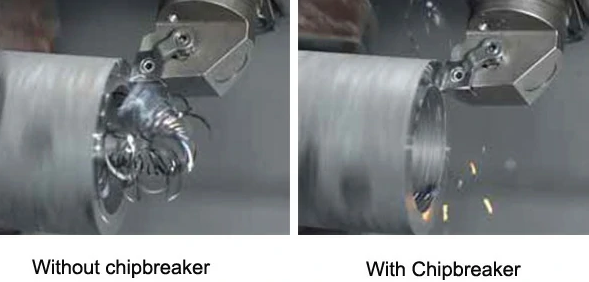
Choosing the right chip breaker reduces cutting force and improves chip flow direction.
Directing coolant at 70–350 bar through the tool or spindle creates a hydraulic jet that strikes the chip’s underside, forcing it to curl, break, and flush away. Many studies have proven that HPC can double tool life in stainless steel machining. For a detailed technical overview, refer to the SME guide on high-pressure coolant.
When retrofitting an older lathe, start with at least 20 bar through‑tool coolant – it still dramatically improves chip removal.
Even with optimal hardware, programmed chip breaking helps. Use G74 or G75 pecking cycles for deep‑hole turning or grooving. For custom applications, a short dwell every few millimeters in Z‑axis feed also breaks long chips. Example:
G01 Z-15.0 F0.18; G04 X0.05; G01 Z-30.0 F0.18;
This brief pause changes chip thickness and induces fracture.
● Increase feed rate to 0.15–0.25 mm/rev – higher feed breaks chips more reliably.
● Monitor chip color: straw‑brown is ideal; blue means excess heat.
● Use a chip conveyor with a crusher to handle high‑speed chip volumes.
1. Can I achieve high‑speed chip removal without through‑tool coolant?
Yes, but with limitations. Use a flood coolant nozzle aimed directly at the cutting zone combined with a sharp positive‑rake insert. For difficult materials like Inconel, through‑tool coolant is highly recommended.
2. What chip shape indicates perfect removal?
Small “C” or “6” shaped chips, 5–15 mm long. They fall straight into the pan and do not recirculate.
3. Does high‑speed chip removal affect surface finish positively?
Absolutely. By eliminating re‑cutting of chips, the machined surface stays free of scratches and dents. Many users report a 20–30% improvement in Ra values.
4. How do I select the best insert for high‑speed chip removal?
Look for inserts with a medium to aggressive chip breaker (MF or MP class) and a sharp edge hone. Refer to the ISO 3685:2022 standard for tool life testing for comparative testing methods.
By integrating these high‑speed chip removal technologies, your CNC turned component production becomes faster, safer, and more consistent. Start with the right chip breaker and coolant strategy – your tools and parts will show the difference immediately.

Add: Building 3No.277 Zhen'an Middle Road, Chang'an Town,Dongguan,Guangdong, China
Tel:+86-769-82855591
Copyright © 2019 All Rights Reserved Dongguan Start Precision Technology Co., Ltd. Tel: +86-769-82855591
Add: No. 277 Zhen'an Middle Road, Chang'an Town, Dongguan, Guangdong, China



 中文版
中文版 English