Liquid Cooling Connector Machining with Tight Tolerances
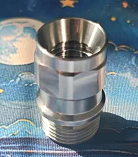
Date:2026-09-11Article editor:Starting Point PrecisionViews:99Liquid cooling systems depend on connectors that maintain stable coolant flow while preventing leakage under pressure and repeated thermal cycling. For this reason, Liquid Cooling Connector Machining requires more than standard CNC cutting. Critical threads, bores, O-ring grooves, sealing faces, and internal flow passages must be manufactured with controlled tolerances and clean surfaces.
Why Tight Tolerances Matter
A small dimensional deviation can affect connector assembly, sealing compression, or coolant flow. Tight-tolerance machining is especially important for:
● O-ring grooves: Accurate diameter, width, depth, and corner radius.
● Threaded interfaces: Consistent pitch and profile for reliable mating.
● Sealing faces: Controlled flatness and surface roughness.
● Internal passages: Accurate geometry with minimal burrs.
● Concentric features: Proper alignment between the bore, thread, and sealing surface.
For demanding applications, tolerance requirements should always be defined according to the actual connector design rather than applying one universal tolerance to every feature.
Equipment & Machining Parameters
| Parameter | Typical Manufacturing Consideration |
| Equipment | CNC turning, CNC milling, 5-axis machining |
| Dimensional capability | Up to ±0.002 mm according to part requirements |
| Materials | Stainless steel, aluminum, copper alloys, titanium |
| Critical features | Threads, bores, O-ring grooves, sealing faces |
| Inspection | CMM, gauges, dimensional inspection |
| Surface treatment | Passivation, anodizing, polishing or coating |
| Quality control | First-article and in-process inspection |
Start Precision states that its precision machining capability can reach ±0.01 mm based on customer 3D/CAD drawings and supports CNC milling, turning, grinding, wire cutting, and EDM processes.
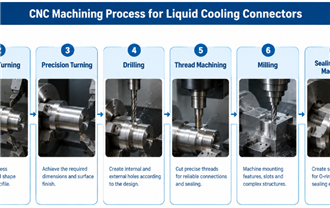
Professional Liquid Cooling Connector Machining Process
A controlled manufacturing workflow helps reduce leakage and dimensional variation.
1. Engineering & DFM Review
Review the CAD model, material, tolerance zones, thread specifications, coolant requirements, and sealing structure before production.
2. CNC Turning
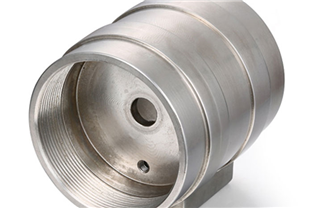
The connector body, external diameter, internal bore, shoulders, and threaded sections can be precision-machined with stable tool control.
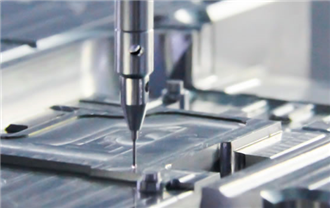
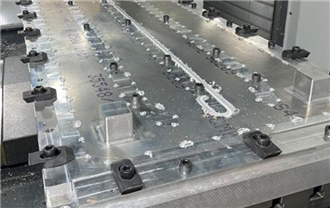
3. CNC Milling & Multi-Axis Machining
Side ports, cross holes, flats, complex profiles, and asymmetric features are produced according to the drawing.
4. O-Ring Groove Machining
Dedicated tooling and controlled cutting parameters help achieve consistent groove geometry without damaging thin walls.
5. Deburring & Cleaning
Internal burrs are carefully removed because loose particles can interfere with coolant circulation or downstream components.
6. Inspection & Validation
Critical dimensions can be verified using precision gauges and CMM inspection. Surface finish and sealing interfaces should also be checked before shipment.
For additional guidance on CNC surface finish requirements, see this related CNC machining surface finish guide.
Materials for Precision Cooling Connectors
Material selection depends on coolant chemistry, pressure, temperature, corrosion resistance, weight, and cost.
● 316L stainless steel: Suitable where corrosion resistance and durability are priorities.
● Aluminum alloys: Useful for lightweight thermal-management assemblies.
● Copper alloys: Suitable for applications requiring high thermal conductivity.
● Engineering alloys: Selected according to mechanical and chemical requirements.
Material compatibility should be evaluated together with coolant formulation and the complete cooling-loop design.
Quality Control for Leak-Resistant Connections
A professional Liquid Cooling Connector Machining process should focus on the complete functional chain:
Dimensional accuracy → Surface quality → Clean internal passages → Correct assembly → Pressure/leak validation
Inspection documentation can include dimensional reports, material certificates, surface-finish records, and other project-specific quality documents.
Project Example
Consider a custom connector for a high-density electronics cooling system. The component includes an internal coolant passage, threaded connection, and precision O-ring groove.
The manufacturing strategy can combine CNC turning for the cylindrical body with milling or multi-axis machining for side ports. After machining, the connector is deburred and thoroughly cleaned. Critical groove dimensions, thread accuracy, concentricity, and sealing surfaces are inspected before pressure or leak testing.
This process creates a repeatable production route that can support prototype validation and subsequent batch manufacturing.
Conclusion
Tight-tolerance Liquid Cooling Connector Machining plays an important role in reliable thermal-management systems. Accurate threads, sealing grooves, internal passages, and clean surfaces help reduce leakage risks and improve assembly consistency. With appropriate CNC processes, inspection methods, and material selection, precision cooling connectors can be manufactured for data centers, power electronics, EV thermal systems, and industrial equipment.
For professional manufacturing support, contact us to discuss your manufacturing requirements, drawings, tolerance specifications, and production objectives.
Add: Building 3No.277 Zhen'an Middle Road, Chang'an Town,Dongguan,Guangdong, China
Tel:+86-769-82855591
Copyright © 2019 All Rights Reserved Dongguan Start Precision Technology Co., Ltd. Tel: +86-769-82855591
Add: No. 277 Zhen'an Middle Road, Chang'an Town, Dongguan, Guangdong, China



 中文版
中文版 English