Aluminum CNC Turning Parts for Cost Savings
Date:2026-07-22Article editor:Starting Point PrecisionViews:223In modern manufacturing, the drive to lower per‑part costs without sacrificing quality is relentless. For high‑volume aluminum components, CNC turning offers a direct path to savings—but only when the process is engineered for maximum efficiency. This article explores four core levers—material utilization, multi‑spindle cycle time, batch stability, and a real‑world hydraulic valve spool case—that transform aluminum turning from a simple operation into a strategic cost center.
Aluminum’s machinability is a gift, but raw material often represents 40‑60% of total part cost. Optimizing stock diameter, nesting multiple parts from a single bar, and employing chip‑breaking geometries reduce scrap significantly. At our facility, we use bar feeders with remnant retraction to minimize end‑piece waste, achieving >92% material yield for typical 6061‑T6 components. By simulating toolpaths in CAM software, we also reduce air‑cutting time, ensuring each aluminum billet delivers maximum usable parts. This approach directly supports cost savings, as every kilogram of aluminum saved drops directly to the bottom line.
Single‑spindle lathes are productive, but multi‑tasking turning centers with Y‑axis and live tooling slash cycle times by performing turning, milling, and drilling simultaneously. For example, our DMG CTX beta 800 (max. spindle speed 5,000 rpm, 8 axes) can complete a complex aluminum fitting in 18 seconds—compared to 52 seconds on a conventional 2‑axis lathe. For mid‑volume batches, the TAKZASAWA NEX‑108 (6,000 rpm, 10‑inch chuck) offers rapid turret indexing and thermal‑stable structure, achieving 22‑second cycles for valve‑type components. The table below summarizes key parameters of our primary CNC turning equipment, sourced from our Precision equipment list:
| Equipment Brand/Model | Max. Spindle Speed | Bar Capacity (mm) | Typical Cycle (Alum. Valve Core) |
| DMG CTX beta 800 | 5,000 rpm | 65 | 18.0 sec |
| TAKZASAWA NEX‑108 | 6,000 rpm | 51 | 22.5 sec |
| China CK6136 | 2,800 rpm | 36 | 35.0 sec (economy option) |
Actual cycle times vary with part geometry; all machines equipped with high‑pressure coolant (70 bar) for aluminum chip evacuation.
By deploying these machines in a flexible manufacturing cell, we overlap spindle idle times with part unloading, further reducing non‑cutting time. This multi‑machine approach lowers labor and overhead per piece, directly contributing to cost savings for high‑mix production.
In lots of 50,000+ pieces, even 0.01 mm deviation can cause rework or scrap, eroding savings. Our process employs statistical process control (SPC) with in‑process gauging (using Mitutoyo bore gauges and Zeiss CMMs), adjusting tool offsets every 50 parts. Combined with thermal compensation on the spindle and coolant temperature control (±1°C), we hold Cpk > 1.67 for critical diameters. For aluminum’s low modulus of elasticity, we apply chip breakers and polished PCD inserts to prevent built‑up edge, ensuring surface finish Ra ≤ 0.8 µm. This stability ensures that the first part and the 100,000th part are identical—eliminating sorting costs and customer returns.
Our workshop implements ISO 9001:2015 and AS9100D quality systems, with regular internal audits and machine calibration records available for review. The combination of rigorous process control and modern equipment like the DMG CTX beta 800 guarantees predictable output, which is the bedrock of long‑term cost reduction.
To guarantee this performance, we rely on our certified management systems. Our shop floor features vertical machining centers (HAAS VF3, Mazak VCN‑510C) for secondary ops, but the core turning is handled by the DMG and TAKZASAWA machines. We maintain tool life databases that predict insert changes—preventing unplanned downtime. All batches undergo FAI per ASME Y14.5.
A leading fluid‑power OEM approached us to reduce the cost of a hydraulic valve spool (6061‑T6, OD 16 mm, length 78 mm, with three precision lands and cross‑holes). Originally produced on single‑spindle lathes with secondary milling, the cycle was 94 seconds and material yield was 78%. By transferring the job to a DMG CTX beta 800 with live tooling and subspindle, we:
● Consolidated operations (turning, drilling, milling, and deburring) into one 18‑second cycle.
● Optimized bar stock from 19 mm to 18.2 mm diameter, saving 7.5% material per part.
● Implemented a pull‑out cycle to reduce remnant length from 120 mm to 40 mm.
Result: Per‑part cost dropped by 44%, and annual savings exceeded $46,000 for a 100,000‑piece order. The spool’s roundness (≤3 µm) and land width (tolerance ±5 µm) passed all functional tests, and the customer approved the first‑article inspection within one week.
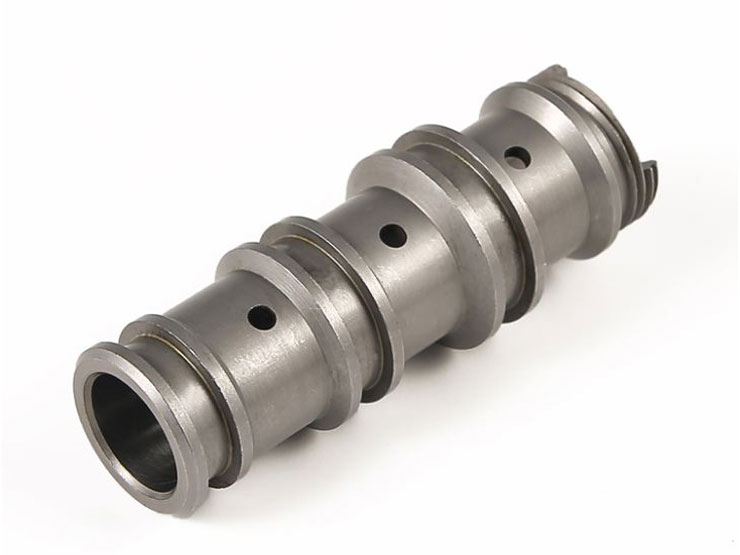
The hydraulic spool example proves that aluminum CNC turning parts are not merely about cutting metal—they are about systematically eliminating waste in material, time, and variability. By combining advanced turning centers (DMG, TAKZASAWA), intelligent toolpaths, and rigorous stability controls, we deliver parts that are consistently cheaper and better, with full traceability.
For your next high‑volume aluminum project, consider these principles as a roadmap. Contact us to discuss your manufacturing needs—we will analyze your drawings, propose cycle time simulations, and share a cost‑benefit analysis before the first chip falls. Visit our homepage to learn more about our full range of precision machining services.
Q1: What aluminum alloys are best for CNC turning cost savings?
A: 6061‑T6 and 7075‑T6 are most common due to excellent machinability and strength. For free‑cutting, consider 2011 or 6262 for even faster cycles, though they may have lower corrosion resistance.
Q2: How do you handle tight tolerances (±0.01 mm) in high‑volume runs on DMG CTX beta 800?
A: We combine in‑process air‑gauging with automatic tool compensation. The DMG’s thermal‑symmetric spindle and our coolant control keep drift within 2 µm over an 8‑hour shift. CMM checks every 50th part.
Q3: Can the TAKZASAWA NEX‑108 machine complex geometries with cross‑holes or flats?
A: Yes. It features a Y‑axis and live tooling for milling/drilling. For back‑working, we use the subspindle option. Complex spools with cross‑holes are regularly produced on this machine.
Q4: What is the minimum batch size for economic use of these turning centers?
A: Typically 3,000+ pieces justify setup and tooling costs for the DMG/TAKZASAWA. For smaller batches, we recommend our CK6136 economy lathes, which offer competitive rates with quick changeover (under 15 minutes).
Add: Building 3No.277 Zhen'an Middle Road, Chang'an Town,Dongguan,Guangdong, China
Tel:+86-769-82855591
Copyright © 2019 All Rights Reserved Dongguan Start Precision Technology Co., Ltd. Tel: +86-769-82855591
Add: No. 277 Zhen'an Middle Road, Chang'an Town, Dongguan, Guangdong, China



 中文版
中文版 English