Stainless Steel Turned Parts with Laser Marking
Date:2026-08-22Article editor:Starting Point PrecisionViews:105In modern manufacturing, the journey from raw material to finished component is a story of precision. However, for critical industries like medical devices, aerospace, and automotive, the story doesn't end with the cut. The final, crucial chapter is often written by a laser. This is where stainless steel turned parts meet the permanent, precise world of laser marking, creating components that are not only dimensionally perfect but also eternally identifiable.
Stainless steel is the material of choice for its strength and corrosion resistance. Yet, these very properties make it difficult to mark. Traditional methods like ink printing or adhesive labels fail in harsh environments due to wear, chemicals, or high temperatures. Laser marking offers a solution by physically altering the surface at a microscopic level. For a deeper technical dive, you can refer to the widely recognized Wikipedia article on laser engraving, which explains the underlying physics.
For manufacturers of high-precision components, integrating laser marking is not an afterthought; it's a critical step in the value chain, ensuring:
● Traceability: 2D Data Matrix codes, serial numbers, and batch codes allow parts to be tracked from production to end-of-life.
● Brand Integrity: Logos and specifications remain legible for the product's entire lifespan.
● Regulatory Compliance: Industries like medical and aerospace demand permanent marking for safety and quality control.
The process is more than just pointing a beam. It's a science that interacts with the part's metallurgy and geometry. The following table outlines the primary methods and their characteristics:
| Method | Mechanism | Appearance | Key Advantage | Best For |
| Annealing/Marking | Controlled heating below melting point to create a thin oxide layer. | Dark, oxidation mark (black/grey). | Smooth surface, doesn't compromise corrosion resistance. | Highly polished surfaces, medical parts. |
| Engraving/Etching | Beam ablates the material to create a shallow cavity. | Contrasting, textured surface. | Very durable and resistant to wear. | Parts requiring high contrast and readability. |
| Coloring | Precise heat control to produce a spectrum of colors. | Colorful, decorative marks. | Aesthetic appeal and functionality. | Branding, user interfaces, consumer goods. |
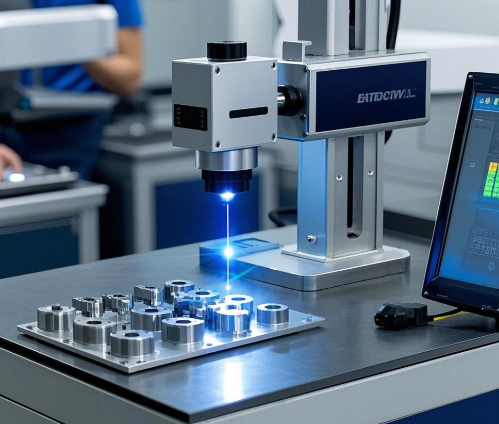
Creating a perfect turned part is one challenge. Marking it without inducing stress, distortion, or compromising its integrity is another. A manufacturer with integrated capabilities is essential, especially when the machining tolerance is as tight as ±0.01mm – a standard that demands exceptional machine rigidity and process control.
This is precisely where the expertise of companies like Dongguan Start Precision Technology Co., Ltd. becomes invaluable. With advanced CNC turning and milling equipment, they are able to machine parts to tolerances within ±0.01mm while maintaining strict geometrical consistency. Their in-depth understanding of material properties allows them to apply secondary processes like laser marking effectively, ensuring the part's quality is maintained from the first cut to the final mark. Learn more about their comprehensive approach to precision manufacturing at https://www.startprecision.com.
The Challenge: A leading automotive supplier needed a series of stainless steel turned parts – specifically, fuel injector nozzles – each requiring a permanent, highly legible 2D barcode for end‑of‑line traceability. The nozzles had critical sealing surfaces with a specified flatness tolerance of ±0.01mm. Any thermal distortion or incorrect marking depth would risk scrap and costly rework. Additionally, the marks had to withstand 1,000 hours of salt‑spray testing and extreme temperature cycling.
The Solution: The manufacturer employed a nanosecond fiber laser with a galvanometer scanner. The process was carefully engineered to:
1. Minimize Heat Input: Short‑pulse settings (20 ns) and high scanning speeds were used to create high‑contrast dark annealing marks without raising the bulk temperature, thus preserving the ±0.01mm flatness on the sealing face.
2. Optimized Focal Position: An autofocus system compensated for minor part‑to‑part variations, ensuring consistent mark depth across all nozzles.
3. Inline Verification: An integrated vision system read each marked code instantly, with a 99.99% first‑pass readability rate.
The Result: Over 50,000 nozzles were processed with zero thermal‑related rejects. The marks passed all durability tests, and the traceability system enabled the client to pinpoint a specific batch of parts that later required a design update – saving an estimated $120,000 in potential recall costs. This demonstrates how the synergy between ultra‑precise turning and advanced laser marking delivers both quality and operational intelligence.
Stainless steel turned parts are the unsung heroes of countless mechanical assemblies. By adding laser marking, these components gain a new dimension of utility, becoming fully traceable, brandable, and ready for the most demanding applications. It is a powerful combination of form and function, ensuring that quality is both built in and permanently visible.
For manufacturers who demand the highest standards in both precision machining and secondary processing, partnering with a facility that masters both technologies is the key to success. From the initial CNC turning to the final laser mark, every step is a commitment to excellence.
Contact us to discuss your manufacturing needs, and let's engineer a precise solution for your next project.
Q1: Will laser marking compromise the corrosion resistance of my stainless steel turned parts?
If done correctly using an annealing process, the mark is an oxide layer that is actually more corrosion‑resistant than the base material. Engraving can expose the material but typically doesn't reduce resistance significantly, especially if the part is passivated afterward.
Q2: What is the difference between laser marking and laser engraving for turned parts?
Laser marking refers to a surface change (like oxidation), creating a mark without removing much material. Laser engraving physically removes material, creating a cavity. Engraving is typically more durable but can affect part geometry if not controlled precisely.
Q3: Can you maintain a ±0.01mm tolerance on a turned part after laser marking?
Yes, as long as the laser process is carefully optimized. Annealing marking, which doesn't ablate material, introduces negligible dimensional change. For engraving, you must account for the removal depth and ensure it remains within the overall tolerance budget.
Q4: What types of stainless steel are best suited for laser marking?
Most grades, including 304, 316, and 17‑4 PH, respond well. The marking contrast and speed may vary with alloy composition, but a skilled manufacturer can adjust parameters accordingly.


Add: Building 3No.277 Zhen'an Middle Road, Chang'an Town,Dongguan,Guangdong, China
Tel:+86-769-82855591
Copyright © 2019 All Rights Reserved Dongguan Start Precision Technology Co., Ltd. Tel: +86-769-82855591
Add: No. 277 Zhen'an Middle Road, Chang'an Town, Dongguan, Guangdong, China



 中文版
中文版 English