CNC Turning Components with Live Tooling
Date:2026-08-03Article editor:Starting Point PrecisionViews:20In modern precision manufacturing, the demand for complex, multi‑featured parts produced in a single setup has skyrocketed. CNC Turning Components are no longer limited to simple cylindrical geometries. With the integration of live tooling—which enables milling, drilling, and tapping operations without removing the workpiece from the spindle—manufacturers can achieve unprecedented efficiency and accuracy. This article explores the core technologies behind this capability, focusing on BMT tooling systems, axial/radial milling strategies, and the critical reduction of setup errors.
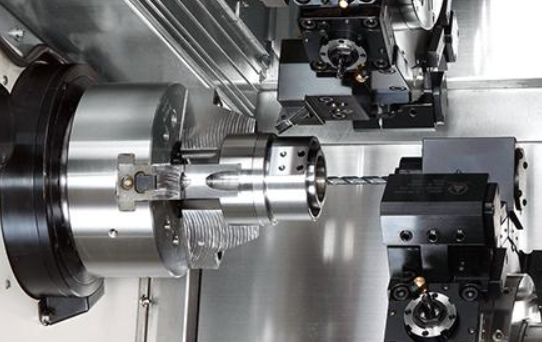
At the heart of many advanced CNC turning centers lies the BMT (Base Mounted Tooling) interface. Unlike traditional VDI (Verein Deutscher Ingenieure) tool holders, BMT systems are clamped directly to the turret’s mounting surface using a robust base and a central bolt. This design provides superior rigidity and repeatability, which are essential for heavy milling cuts and high‑precision drilling. According to industry machining guidelines , BMT holders consistently outperform VDI in torque‑heavy applications.
| Feature | BMT Tool Holder | Traditional VDI Holder |
| Mounting Method | Base‑mounted with central bolt | Shank inserted into a bore |
| Rigidity | Excellent (direct contact) | Good (less surface contact) |
| Torque Capacity | Higher, suitable for heavy milling | Lower, best for light turning |
| Repeatability | ±0.002mm or better | ±0.005mm |
| Common Application | Heavy milling, drilling, tapping | Light turning, boring |
For high‑volume production of precision CNC Turning Components, BMT holders are the preferred choice. They ensure that live tools—such as end mills and drill bits—remain stable under varying cutting loads, directly improving tool life and surface finish.
Live tooling on a CNC lathe can perform two primary types of milling operations, defined by the tool’s orientation relative to the spindle axis (Z‑axis).
● Axial Milling (Face Milling): The tool’s rotational axis is parallel to the workpiece spindle (Z‑axis). This is typically used for creating flat surfaces, slots, or hexagonal features on the face of the part. It’s ideal for machining the ends of shafts or creating counterbores.
● Radial Milling (Cross Milling): The tool’s rotational axis is perpendicular (at 90 degrees) to the workpiece spindle. This setup is used for milling flat surfaces, keyways, or grooves along the outer diameter (OD) of the part.
The flexibility to switch between axial and radial milling, often within the same program, is what makes live tooling so powerful. A complex component, such as a hydraulic fitting, might require a radial milled hexagon on its OD and an axial drilled hole on its face—all completed in one cycle.
One of the most significant time‑saving advantages of live tooling is the ability to perform drilling and tapping in a single operation. On a traditional lathe, a part would need to be moved to a separate milling or drilling machine for these secondary operations.
With a live tooling system:
1. Centering: A center drill creates a precise starting point on the face or OD.
2. Drilling: A drill bit (held in a live tool holder) creates the pilot hole to the required depth.
3. Tapping: A tap is then used to cut internal threads.
This process is guided by the CNC’s C‑axis (spindle rotation) interpolation, which locks the spindle’s rotational position to coordinate with the live tool’s movements. For example, a standard M8 threaded hole can be drilled and tapped in less than 20 seconds, complete with a chamfer for thread entry. For detailed technical data on live tooling performance, you can refer to resources from industrial monitor direct.
The sequential nature of moving a part between a lathe and a milling machine introduces a major risk: clamping errors. Every time a workpiece is unloaded and re‑clamped, even the most advanced fixtures can introduce a slight deviation from the original datum.
By completing all turning, milling, drilling, and tapping processes in a single chucking, the part’s reference point (datum) remains constant. This directly translates to:
● Tighter Tolerances: Achieve true positional tolerances of ±0.005mm on cross‑drilled holes relative to turned diameters.
● Better Concentricity: Milled flats and drilled holes maintain perfect concentricity with the turned diameter, crucial for rotating components.
● Eliminated Fixture Costs: Secondary operation fixtures are completely unnecessary, saving on both tooling and setup time.
● Reduced Lead Time: Parts move from raw material to finished component in a single cycle, drastically shortening production timelines.
Consider a manufacturer producing a 6061‑T6 aluminum pump housing. The part requires: an outer diameter (OD) turn, a face grooving, a radial milled flat for a wrench, and an axial drilled and tapped hole for a sensor. By using a CNC lathe with live tooling: The cycle time is reduced from 45 minutes (across two machines) to just 12 minutes. The scrappage rate from misalignment in re‑fixturing drops from 3% to virtually zero, and the total cost per part is cut by 40%.
The integration of live tooling into CNC turning centers has redefined what is possible for CNC Turning Components. By leveraging the rigidity of BMT holders, the versatility of axial and radial milling, and the efficiency of in‑cycle drilling/tapping, manufacturers can achieve a level of precision and throughput that was unattainable just a decade ago. The elimination of setup errors not only improves quality but also makes production significantly more cost‑effective.
Ready to take your manufacturing to the next level? Start Precision, with its advanced facility equipped with 5‑axis machining and high‑precision turning centers, exemplifies the technical capability required to produce such complex components. For more information on their equipment, visit their precision equipment overview or explore their full range of services on their official website .
If you are looking to optimize your production with advanced CNC turning solutions or need a reliable partner for complex, high‑precision parts, we invite you to contact us to discuss your manufacturing needs. Our team of experienced engineers is ready to provide you with a professional and effective solution.
Q1: Can a live tooling lathe perform heavy milling like a dedicated VMC?
A: While live tooling is powerful, it is generally not designed for heavy, high‑volume material removal. Its strength lies in performing secondary operations (milling, drilling, tapping) on a turned part in one setup. For roughing large blocks, a Vertical Machining Center (VMC) is still preferred.
Q2: What is the main difference between BMT and VDI tooling?
A: BMT (Base Mounted Tooling) is clamped to the turret’s surface, offering higher rigidity, better torque transmission, and superior repeatability. VDI (Verein Deutscher Ingenieure) tooling uses a shank that inserts into a bore, which is more common but less rigid for heavy milling applications.
Q3: How is the C‑axis coordinated with live tooling?
A: The C‑axis is the controlled rotation of the main spindle. When live tooling is activated, the CNC controller locks the C‑axis at precise angles (e.g., 45°, 90°) to ensure the milling or drilling operation is performed at the correct position on the part’s circumference.
Q4: What are the most common materials used for CNC turned components with live tooling?
A: Common materials include aluminum alloys (like 6061‑T6), stainless steels (303, 304), carbon steels (12L14, 4140), and engineering plastics. The choice depends on the application, such as aerospace, automotive, or medical devices.
Add: Building 3No.277 Zhen'an Middle Road, Chang'an Town,Dongguan,Guangdong, China
Tel:+86-769-82855591
Copyright © 2019 All Rights Reserved Dongguan Start Precision Technology Co., Ltd. Tel: +86-769-82855591
Add: No. 277 Zhen'an Middle Road, Chang'an Town, Dongguan, Guangdong, China



 中文版
中文版 English