Precision Turning for Custom Metal Parts: 3 Critical Factors Affecting Surface Finish
Date:2026-06-06Article editor:Starting Point PrecisionViews:454Achieving a superior surface finish in precision turning is essential for custom metal parts machining. It directly impacts part functionality, wear resistance, and aesthetic quality. However, three key factors often determine success or failure. Understanding these variables helps manufacturers optimize CNC lathe operations and reduce secondary polishing costs.
The most influential group of factors involves cutting parameters – specifically cutting speed (Vc), feed rate (f), and depth of cut (ap).
◆ Feed rate leaves helical marks on the turned surface. Lower feeds generally produce finer finishes, but excessively low feeds can cause rubbing and built-up edge (BUE).
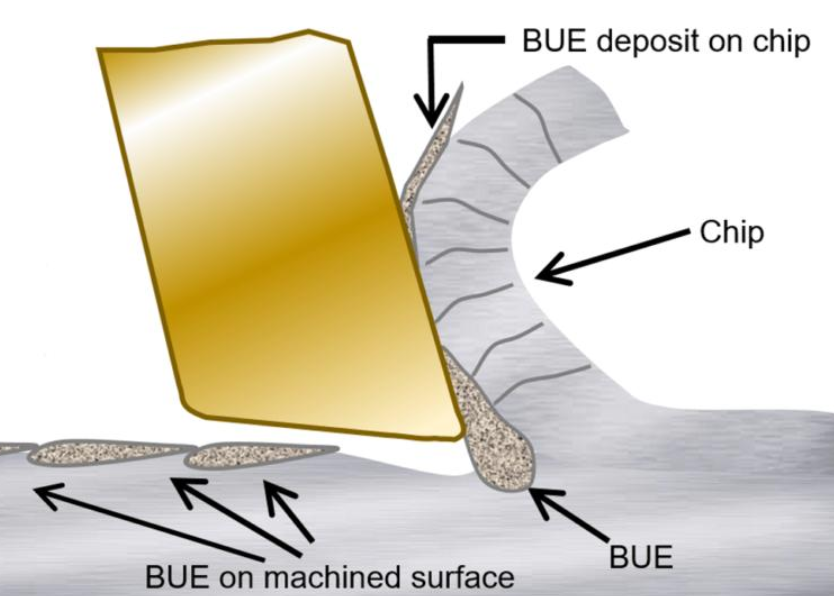
◆ Cutting speed affects chip formation and heat generation. Optimal speeds reduce BUE and improve surface integrity.
◆ Depth of cut influences vibration; shallow cuts may cause chatter, while deeper cuts can dampen harmonics.
Pro tip: Use recommended parameter charts for your material. For detailed external guidance, refer to Sandvik Coromant Turning Guidelines.
Tool condition and geometry directly transfer to the workpiece.
◆ Nose radius – larger radii (≥0.8 mm) improve finish but increase radial forces.
◆ Rake angle – positive rake reduces cutting forces and built-up edge.
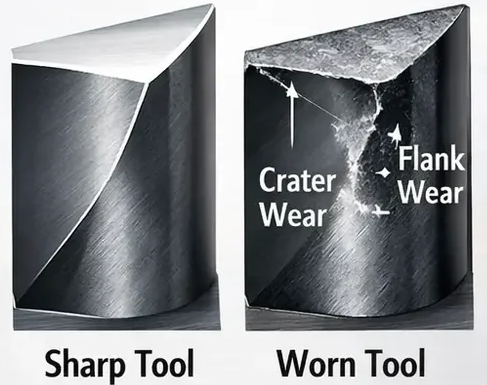
◆ Wear – flank wear increases friction and degrades finish rapidly. A worn tool creates a rough, torn surface.
Regular tool inspection and using coated carbide inserts (e.g., TiAlN, AlCrN) for custom metal parts can maintain consistent surface quality. For more on tool wear management, visit Kennametal Tool Wear Guide. A visual comparison is available here: Compare sharp vs. worn tool surface finishes.
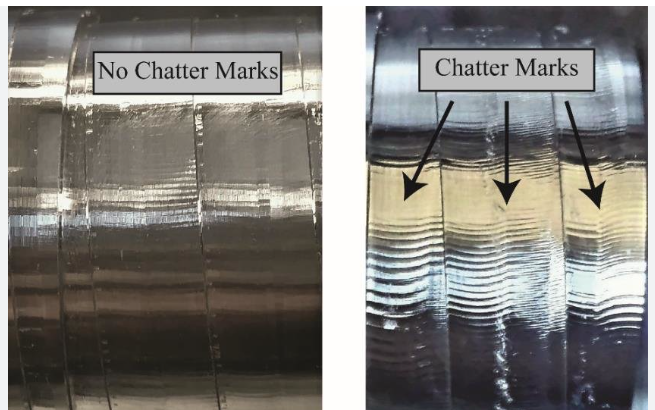
Even with perfect parameters and tools, lack of stiffness causes chatter marks.
◆ Machine condition – worn spindle bearings or guideways introduce vibration.
◆ Workpiece overhang – length-to-diameter ratio >3 requires a tailstock or steady rest.
◆ Fixturing – improper clamping leads to micro-movements, leaving wavy patterns.
Use balanced holders, reduce overhang, and apply damping techniques for slender parts. Active vibration control systems (e.g., passive dynamic absorbers) are advanced solutions for ultra-precision turning. View example defects here: Chatter pattern vs. ideal surface finish.
For custom metal parts machining, controlling these three factors – cutting parameters, tool geometry/wear, and rigidity/vibration – ensures predictable surface finish in precision turning. Always start with a stable setup, choose the right insert, and verify parameters with test cuts.
Q1: What is the typical Ra value achievable in precision turning?
A: For conventional CNC turning, Ra 0.4–1.6 µm is common. With wiper inserts and optimized parameters, Ra 0.1–0.2 µm is possible on rigid machines.
Q2: Can I improve surface finish by reducing cutting speed only?
A: Not always. Very low speeds can promote built-up edge (BUE) on ductile metals. You may need to increase speed or change insert geometry.
Q3: How often should I change turning inserts for consistent finish?
A: Inspect every 50–200 parts depending on material (e.g., stainless vs. aluminum). Replace when flank wear reaches 0.15–0.3 mm or when surface roughness exceeds spec.
Q4: Does coolant help surface finish in precision turning?
A: Yes – proper coolant reduces heat, flushes chips, and minimizes BUE. Use high-pressure coolant (300–1000 psi) for difficult materials like Inconel or titanium.
Q5: What is the best tool nose radius for a fine finish on small custom parts?
A: For diameters under 10 mm, use R0.2–R0.4 mm to avoid excessive radial forces. For larger parts, R0.8–R1.2 mm provides better finish.
Add: Building 3No.277 Zhen'an Middle Road, Chang'an Town,Dongguan,Guangdong, China
Tel:+86-769-82855591
Copyright © 2019 All Rights Reserved Dongguan Start Precision Technology Co., Ltd. Tel: +86-769-82855591
Add: No. 277 Zhen'an Middle Road, Chang'an Town, Dongguan, Guangdong, China



 中文版
中文版 English