Rapid Prototyping Supplier: Industrial Component Prototype Machining
Date:2026-05-23Article editor:Starting Point PrecisionViews:367When developing industrial machinery, hydraulic systems, or automotive parts, a functional prototype is not a luxury—it's a necessity. A professional rapid prototyping supplier specializing in industrial component prototype machining converts CAD files into metal or plastic testable parts within days. Unlike consumer-grade prototypes, industrial prototypes must withstand real loads, temperatures, and corrosion. This requires a supplier that masters both speed and engineering rigor.
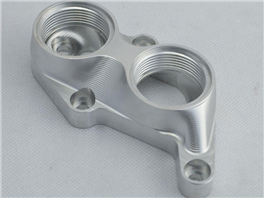
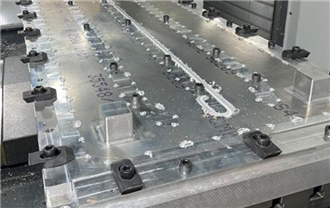
CNC milling machine cutting an aluminum industrial prototype component
Core Machining Technologies for Industrial Prototypes
Industrial prototyping relies on three proven methods.
◆ CNC machining delivers isotropic strength and tight tolerances for functional testing of brackets, shafts, and housings.
◆ 3D printing (SLA, SLS, DMLS) enables rapid geometry validation for complex cooling channels or lightweight lattices.
◆ Hybrid additive-subtractive processes combine both for near-net shape prototypes in materials like Inconel or PEEK.
An experienced supplier also offers secondary operations—threading, anodizing, heat treatment—so the prototype mirrors final production parts. This is where selecting the right partner becomes critical. How should engineers evaluate a rapid prototyping supplier for complex industrial components?
The answer lies in three measurable criteria:
◆ In-house material certification (e.g., ASTM/ISO traceability),
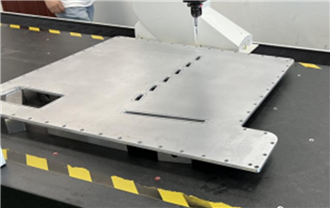
◆ Quality inspection equipment (CMM, optical scanners)
◆ Design feedback—do they provide DFM analysis before machining?
A supplier that simply "takes orders" often produces parts that pass visual checks but fail real-world assembly.
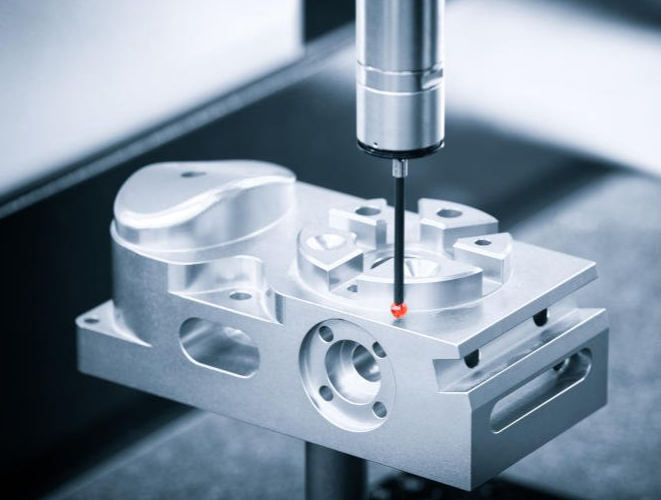
CMM probe measuring a machined industrial prototype
Industrial applications demand engineering-grade materials: aluminum 6061-T6, 7075, stainless 316L, brass, titanium, PEEK, Ultem, Nylon 12, and glass-filled composites. Ask your rapid prototyping supplier for material data sheets and batch certificates. Many suppliers source from global mills; verify with MatWeb material property database before machining critical components.
Beyond materials, consider lead time dynamics. A reliable supplier offers multiple service tiers: 3‑day "rapid" for design validation, 7‑day for functional testing, and 15‑day for high‑finish pre‑production parts. Some also provide first-article inspection reports with every prototype—this non-negotiable for regulated industries like medical devices or aerospace. External studies show that integrated rapid prototyping reduces product launch delays by nearly 40%,learn from Study on rapid prototyping ROI.
The best rapid prototyping suppliers bridge seamlessly into bridge tooling or short-run production. They maintain the same CNC programs, workholding fixtures, and inspection protocols. This continuity ensures that a validated prototype leads directly to production-ready parts without re-engineering. For complex industrial components such as pump housings, valve bodies, or robotic arm joints, this approach eliminates months of lead time.
Ready to move your industrial component from concept to metal? Discuss your prototype requirements with our engineering team. Include your 3D step file and tolerance notes for a same‑day feasibility review.
Add: Building 3No.277 Zhen'an Middle Road, Chang'an Town,Dongguan,Guangdong, China
Tel:+86-769-82855591
Copyright © 2019 All Rights Reserved Dongguan Start Precision Technology Co., Ltd. Tel: +86-769-82855591
Add: No. 277 Zhen'an Middle Road, Chang'an Town, Dongguan, Guangdong, China



 中文版
中文版 English