Custom Low Volume Precision Parts Machining: High Tolerance Solutions for Critical Applications
Date:2026-02-23Article editor:Starting Point PrecisionViews:453In today’s fast-paced industrial landscape, the demand for custom low volume precision parts machining has surged. From aerospace prototypes to medical implants and niche automotive components, engineers require components that meet exacting specifications without the lead times and costs of mass production. Achieving high tolerance in these small batches is not just a goal—it’s a necessity. This article explores the processes, benefits, and best practices behind manufacturing custom low-volume parts with exceptional accuracy, and how modern machining technologies make it possible.
Understanding High Tolerance in Precision Machining
High tolerance refers to the allowable limit of variation in a part’s physical dimension. In precision machining, tolerances can be as tight as ±0.0005 inches (±0.0127 mm) or even stricter. Such precision ensures that parts fit and function perfectly within complex assemblies, reducing wear and improving reliability. For low-volume production—typically ranging from one to a few hundred units—maintaining these tolerances requires advanced equipment, skilled machinists, and rigorous quality control. Unlike high-volume runs that rely on dedicated tooling, custom low volume precision parts machining leverages flexible CNC (Computer Numerical Control) processes to deliver accuracy without the need for expensive molds or fixtures.
Why Choose Low Volume Production?
Opting for low volume machining offers several strategic advantages:
Speed to Market: Rapid prototyping and short runs allow for quick design iterations and faster product launches.
Cost Efficiency: No tooling amortization means lower upfront investment, ideal for startups and R&D projects.
Customization: Each part can be tailored to specific requirements, enabling unique geometries and material choices.
Inventory Control: Produce only what you need, minimizing storage and obsolescence risks.
These benefits make low volume production the preferred choice for industries where precision and adaptability are paramount.
Advanced Machining Technologies
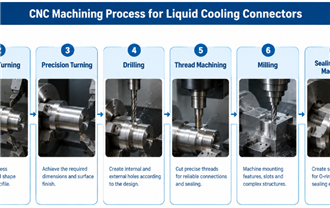
Modern CNC machining centers are the backbone of custom low volume precision parts machining. Multi-axis mills and lathes, EDM (Electrical Discharge Machining), and Swiss-type machines can produce complex features with micron-level accuracy. For instance, our state-of-the-art facility employs 5-axis CNC machines that reduce setup times and enhance surface finishes. Additionally, in-process probing and adaptive machining ensure consistent quality across every batch, even when tolerances are extremely tight.
Material Selection and External Resources
The choice of material significantly impacts machinability, performance, and cost. Common materials include aluminum, stainless steel, titanium, engineering plastics (like PEEK), and exotic alloys. To verify material properties, designers often refer to official databases such as MatWeb or ASTM standards . These resources provide critical data on hardness, tensile strength, and thermal stability, helping engineers select the optimal material for their application.
Quality Assurance and Metrology
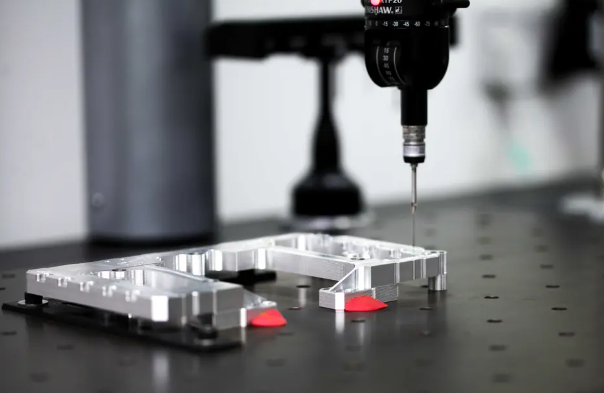
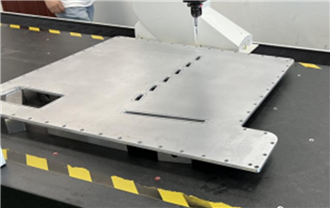
Achieving high tolerance is impossible without rigorous inspection. Coordinate Measuring Machines (CMM), optical comparators, and surface roughness testers are used to validate every dimension. Our quality management system follows ISO 9001 protocols to ensure traceability and repeatability. A typical inspection process includes first-article inspection (FAI) and in-process checks, with detailed reports provided to customers. The image below shows a CMM in action, verifying critical features on a machined part.
Applications Across Industries
Custom low volume precision parts machining serves a wide array of sectors:
Aerospace: Lightweight brackets, engine components, and sensor housings with tight tolerances.
Medical: Surgical instruments, implants, and custom orthopedic devices.
Robotics: Gears, joints, and end-effectors requiring high strength and accuracy.
Energy: Prototypes for turbine blades and downhole tools.
Each application demands not only precision but also compliance with industry standards. For example, medical parts often require biocompatible materials and surface finishes that minimize friction .
The Future of Low Volume Manufacturing
As Industry 4.0 advances, digital twins, AI-driven process optimization, and automated tendering are transforming low-volume production. These technologies further reduce lead times and enhance quality. To explore how we can support your next project, visit our contact page or request a quote today.
Add: Building 3No.277 Zhen'an Middle Road, Chang'an Town,Dongguan,Guangdong, China
Tel:+86-769-82855591
Copyright © 2019 All Rights Reserved Dongguan Start Precision Technology Co., Ltd. Tel: +86-769-82855591
Add: No. 277 Zhen'an Middle Road, Chang'an Town, Dongguan, Guangdong, China



 中文版
中文版 English