Lightweight Structural Parts for Drone Frames: Precision CNC Manufacturing for Flight-Ready Assemblies
Date:2026-10-20Article editor:Starting Point PrecisionViews:27
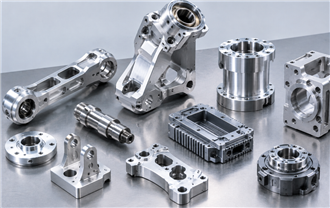
Lightweight Structural Parts are the backbone of modern drone frames. They determine payload capacity, flight time, vibration behavior, and crash resistance. Whether the frame uses carbon-fiber plates, aluminum arms, titanium joints, or magnesium housings, every gram and every tolerance matters. CNC machining gives engineers the freedom to optimize ribs, pockets, lightening holes, and interfaces without expensive tooling—especially for low-to-mid volume drone programs.
Design Priorities for Drone Frame Structures
A flight-ready frame balances stiffness, weight, fatigue life, and manufacturability. Our project checklist for drone structural parts includes:
● Material selection – 7075-T6 aluminum for arms, Ti-6Al-4V for high-load joints, magnesium for housings, and composite-compatible inserts
● Topology and pocketing – thin-wall milling with controlled deflection
● Interface control – motor mounts, battery rails, gimbal brackets, and landing gear
● Vibration damping – tuned stiffness and damping features
● Corrosion and finish – anodizing, chromate conversion, bead blasting, or passivation
|
Material |
Typical Use |
Key Advantage |
Machining Consideration |
|
7075-T6 aluminum |
Arms, plates |
High strength-to-weight |
Distortion control |
|
Ti-6Al-4V |
Joints, fasteners |
Fatigue resistance |
Tool wear, heat |
|
Magnesium AZ31 |
Housings |
Very low density |
Chip safety, corrosion |
|
Carbon-fiber composite |
Plates, booms |
Stiffness |
Delamination-free drilling |
For regulatory and operational context, see FAA UAS guidance.
How We Machine Lightweight Structural Parts
At Start Precision, we approach drone frame parts as precision assemblies—not isolated cuts. Our workflow:
1. DFM review – wall thickness, hole breakout, fixturing, and tolerance stack-up
2. CAM programming – adaptive clearing and high-speed toolpaths for thin ribs
3. Multi-axis machining – 5-axis contouring for complex arm and bracket geometry
4. EDM and grinding – fine slots, sharp corners, and flatness-critical interfaces
5. Inspection – CMM, surface finish, and dimensional reports
6. Finishing – anodizing, passivation, laser marking, and assembly support
Equipment Selected for Drone Frame Parts
Our precision equipment list includes multi-axis mills, turning centers, EDM, and grinding equipment suitable for lightweight structural parts.
| Equipment | Brand / Model | Role in Drone Frame Parts |
| Five-axis machining center | DMG HSC 75 linear | Complex arm and bracket contours |
| Vertical machining center | DMG DMC 835V | Plates, pockets, motor mounts |
| Vertical machining center | Mazak VCN-510C | High-speed aluminum milling |
| Vertical machining center | HAAS VF3 | Flexible low-volume runs |
| Horizontal machining center | HAAS EC400 | Multi-face housings |
| CNC turning center | DMG CTX beta 800 | Precision bushings and shafts |
| CNC turning center | TAKZAWA NEX-108 | Small connectors and pins |
| Slow wire EDM | Seibu M50B | Fine slots and sharp corners |
| Sinker EDM | Sodick AD30Ls | Deep cavities and details |
| Surface grinder | MICCO 350 | Flatness-critical interfaces |
Example: 120 Drone Arm Brackets
A UAV developer needed 120 aluminum arm brackets with a 32% weight reduction target, ±0.02 mm interface tolerance, and anodized finish. We reviewed the CAD, redesigned rib spacing, programmed the DMG HSC 75 linear for 5-axis contouring, and used CMM checks on every batch. The parts achieved the weight target, passed fit checks, and shipped in 10 working days. This is how Lightweight Structural Parts become flight-ready hardware—through design, machining, and inspection working together.
Conclusion
Lightweight drone frames demand more than removing material. They require controlled stiffness, reliable interfaces, and repeatable finishing. Our team supports low-to-mid volume programs with DFM feedback, multi-axis machining, EDM, grinding, and inspection under one roof.
Contact us to discuss your manufacturing needs.
FAQ
Q1: What materials are best for lightweight drone frame parts?
7075-T6 aluminum, Ti-6Al-4V, magnesium, and composite-compatible inserts are common. The choice depends on stiffness, fatigue, cost, and finish requirements.
Q2: Can you machine thin walls without distortion?
Yes. We use adaptive toolpaths, controlled fixturing, stress-relieved stock, and in-process inspection to manage thin-wall deflection.
Q3: What tolerances can you hold on drone structural parts?
We routinely hold ±0.02 mm on critical interfaces and tighter on selected features after DFM review.
Q4: Do you support low-volume drone frame production?
Yes. We handle prototype quantities through low-to-mid volume runs, with no heavy tooling investment.
Q5: Can you provide finishing and assembly support?
Yes. We offer anodizing, passivation, bead blasting, laser marking, and fit-check support for frame assemblies.


Add: Building 3No.277 Zhen'an Middle Road, Chang'an Town,Dongguan,Guangdong, China
Tel:+86-769-82855591
Copyright © 2019 All Rights Reserved Dongguan Start Precision Technology Co., Ltd. Tel: +86-769-82855591
Add: No. 277 Zhen'an Middle Road, Chang'an Town, Dongguan, Guangdong, China



 中文版
 English