
Brass CNC Machining for Terminals: Precision Manufacturing for Reliable Electrical Connections
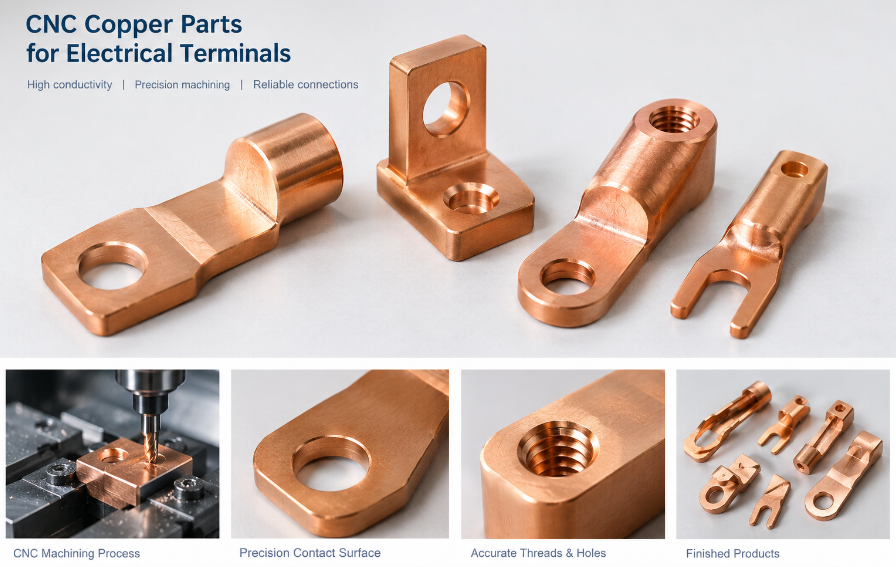
Date:2026-11-21Article editor:Starting Point PrecisionViews:88Brass CNC machining is an effective manufacturing solution for producing high-quality electrical terminals with accurate dimensions and consistent performance. Brass is widely selected for terminal components because of its good electrical conductivity, corrosion resistance, and excellent machinability. From small connector pins to customized terminal blocks, precision-machined brass components help ensure stable electrical contact and dependable mechanical connections in various industrial applications.
1. Why Choose Brass for Electrical Terminals?
Brass is a copper-zinc alloy that offers a combination of physical and mechanical properties suitable for electrical connection components. Its manufacturing advantages make it a popular choice for customized terminal production.
Key benefits include:
● Good electrical conductivity: Supports efficient electrical transmission in various connector applications.
● Excellent machinability: Allows manufacturers to produce complex shapes, accurate holes, and precise threads.
● Corrosion resistance: Helps protect components against environmental exposure and oxidation.
● Mechanical strength: Provides sufficient structural stability for many electrical connection applications.
● Consistent surface quality: Supports accurate contact dimensions and reliable component assembly.
These properties make brass a practical material for terminals used in automotive electronics, industrial equipment, and electrical distribution systems.
2. Common Brass Materials for CNC Machined Terminals
Choosing the appropriate brass alloy is important for achieving the required balance between conductivity, machinability, strength, and service life.
| Brass Grade | Main Characteristics | Typical Applications |
| C36000 | Excellent machinability | Threaded terminals and connector pins |
| C26000 | Good ductility and formability | Electrical connectors |
| C28000 | Good strength and machinability | Industrial terminal hardware |
| Lead-free brass | Reduced lead content | Applications with lead-content restrictions |
C36000 is frequently selected for precision-machined components because of its excellent machining characteristics. C26000 may be more suitable when greater ductility is required.
The final material choice should consider the component's operating environment, electrical requirements, and applicable industry regulations.
For more material specifications, visit the Copper Development Association's C36000 material database.
3. Important Quality Requirements for Brass Terminals
The quality of a brass terminal directly influences its electrical connection performance, assembly compatibility, and long-term reliability.
Manufacturers should pay particular attention to the following quality factors:
| Quality Factor | Key Requirement |
| Dimensional accuracy | Meet specified drawing tolerances |
| Contact surface | Maintain appropriate surface finish |
| Thread precision | Ensure accurate dimensions and assembly compatibility |
| Edge quality | Prevent sharp edges and unwanted burrs |
| Material consistency | Verify alloy grade and material composition |
| Surface protection | Apply suitable plating when required |
For electrical terminals, even small dimensional variations can affect contact pressure and assembly performance. Therefore, inspection procedures should be established according to the component's functional requirements.
Depending on the application, manufacturers may also need to evaluate electrical resistance, mechanical stability, and temperature performance. Relevant connector testing information can be found in this TE Connectivity technical specification.
4. Precision Manufacturing Equipment and Production Capabilities
Reliable brass terminal production requires appropriate manufacturing equipment, technical expertise, and effective quality management.
Start Precision provides precision CNC machining and turning capabilities for customized metal components. According to its published precision equipment list, the company's manufacturing equipment includes:
● Germany DMG HSC 75 Linear five-axis machining center
● Germany DMG CTX beta 800 CNC turning center
● Japan TAKZAWA NEX-108 CNC turning centers
● Japan Mazak VCN-510C vertical machining centers
● United States HAAS VF3 vertical machining centers
These machines support different precision manufacturing requirements and provide production flexibility for customized components.
With suitable equipment and engineering support, manufacturers can address different component geometries, dimensional requirements, and production quantities.
Explore the precision machining equipment and manufacturing capabilities at Start Precision.
5. Applications of CNC Machined Brass Terminals
Brass terminals are widely used in electrical systems where stable connections, dimensional consistency, and mechanical reliability are important.
Typical applications include:
● Automotive industry: Electrical connector pins, wiring terminals, and connection components.
● Industrial automation: Control panel terminals, electrical connectors, and terminal hardware.
● Power distribution: Electrical connection parts and conductive terminal components.
● Consumer electronics: Compact connectors and customized electrical contacts.
● Battery systems: Connection terminals and conductive components.
● Electrical equipment: Switch components, terminal blocks, and connector assemblies.
Custom brass CNC machining also allows manufacturers to accommodate different thread specifications, mounting structures, dimensions, and component designs.
6. How to Choose a Reliable Brass CNC Machining Manufacturer
Selecting an experienced manufacturing partner is essential for maintaining product consistency and controlling production costs.
Before choosing a supplier, consider these important factors:
1. Material knowledge: The manufacturer should understand different brass grades and their properties.
2. Equipment capabilities: Check whether its CNC equipment can meet your component requirements.
3. Quality inspection: Confirm that dimensional measurement and material verification procedures are available.
4. Customization experience: Look for experience manufacturing components according to customer drawings.
5. Production capacity: Evaluate whether the supplier can support prototype orders and repeat production.
A qualified supplier should also communicate clearly about material selection, manufacturing feasibility, quality expectations, and delivery schedules.
Conclusion
Brass CNC machining for terminals combines the advantages of brass materials with precision manufacturing to produce dependable electrical connection components. Appropriate material selection, dimensional control, surface quality, and professional inspection all contribute to consistent product performance.
Start Precision offers precision CNC machining services for customized metal components.
Contact us to discuss your manufacturing requirements. Share your technical drawings, material specifications, and project expectations with our team to explore a suitable precision manufacturing solution.
Frequently Asked Questions (FAQ)
Q1: Why is brass commonly used for electrical terminals?
Brass offers good electrical conductivity, excellent machinability, corrosion resistance, and mechanical strength. These properties make it suitable for manufacturing various electrical connection components.
Q2: Which brass grade is best for CNC machined terminals?
C36000 is commonly used for precision-machined terminals because of its excellent machinability. C26000 is another option when greater ductility is needed. The appropriate grade depends on the application's requirements.
Q3: Can brass CNC machining produce customized electrical terminals?
Yes. CNC machining can manufacture customized terminal pins, threaded connectors, terminal posts, and other electrical components according to customer drawings and technical specifications.
Q4: What surface treatments are available for brass terminals?
Common options include nickel plating and tin plating. The appropriate treatment depends on corrosion resistance requirements, electrical contact performance, and the intended operating environment.
Q5: How is the quality of brass terminals controlled?
Quality control typically includes material verification, dimensional inspection, thread measurement, surface inspection, and functional testing according to product specifications.
Q6: Does Start Precision accept customized brass machining projects?
Start Precision provides precision CNC machining services for customized metal components. Customers can submit technical drawings and project requirements for manufacturing evaluation.






Add: Building 3No.277 Zhen'an Middle Road, Chang'an Town,Dongguan,Guangdong, China
Tel:+86-769-82855591
Copyright © 2019 All Rights Reserved Dongguan Start Precision Technology Co., Ltd. Tel: +86-769-82855591
Add: No. 277 Zhen'an Middle Road, Chang'an Town, Dongguan, Guangdong, China



 中文版
 English
