
Custom Robotic Components for OEM Projects
Date:2026-11-20Article editor:Starting Point PrecisionViews:114Humanoid robots require more than advanced software and intelligent control systems. Their mobility, stability, and dexterity depend on precisely engineered hardware. Custom Robotic Components play a critical role in developing reliable humanoid robots, from lightweight skeletal structures and joint housings to actuator brackets and transmission components. For OEM projects, selecting the right manufacturing partner helps transform complex engineering designs into functional, production-ready parts.
1. Key Custom Components for Humanoid Robot OEM Projects
Unlike conventional industrial robotic arms, humanoid robots must reproduce human-like movements through coordinated joints, limbs, hands, and body structures. Each component must balance weight, mechanical strength, dimensional accuracy, and durability.
| Component | Main Function | Manufacturing Requirements |
| Joint housings | Support shoulder, elbow, hip, and knee joints | Precision CNC milling, tight tolerances |
| Actuator housings | Protect motors and transmission systems | CNC turning, milling, surface finishing |
| Skeletal connectors | Connect the torso, arms, and legs | Lightweight structures, accurate positioning |
| Gearbox components | Transfer torque and control movement | Precision turning, grinding |
| Hand mechanism parts | Support finger movement and gripping | Small-feature machining, dimensional accuracy |
| Sensor mounting brackets | Maintain sensor positioning | Precision milling, stable mounting surfaces |
These components directly influence movement accuracy, structural stability, and long-term operating performance.
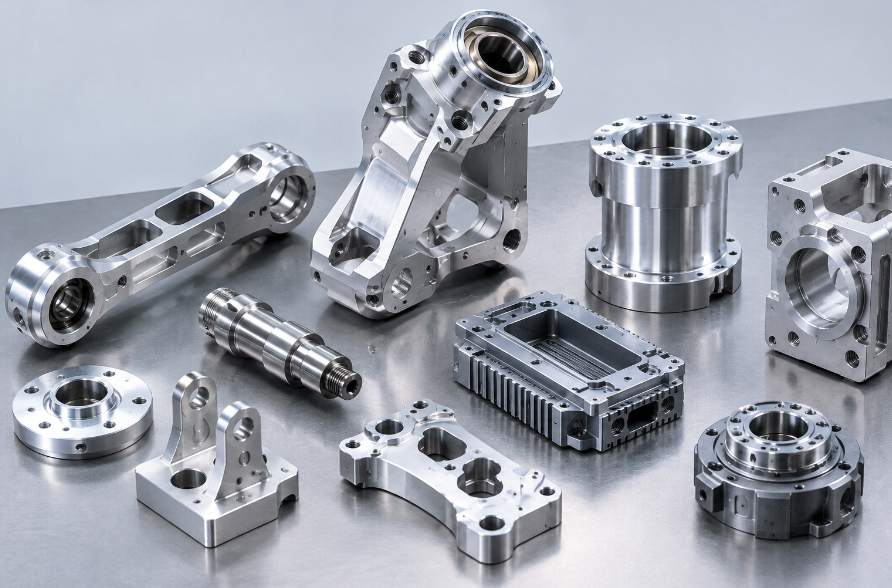
2. Advanced Manufacturing Processes for Custom Robotic Components
Different humanoid robot components require different machining strategies. The manufacturing process should be selected according to component geometry, material, tolerance, and production volume.
| Manufacturing Process | Technical Characteristics | Typical Humanoid Robot Applications |
| Five-Axis CNC Machining | Machines complex geometries and multiple angled surfaces in fewer setups, improving positioning accuracy | Shoulder joint housings, hip joint structures, complex skeletal connectors |
| CNC Milling | Produces precise flat surfaces, pockets, slots, and mounting holes | Actuator brackets, structural frames, motor mounting plates |
| CNC Turning | Delivers accurate cylindrical dimensions and concentric features | Drive shafts, bearing seats, rotating joint components |
| Precision Grinding | Improves surface finish, dimensional accuracy, and geometric consistency | Precision shafts, bearing contact surfaces, mating components |
| Slow Wire EDM | Processes intricate profiles, narrow slots, and complex contours with high precision | Precision mechanical inserts, customized structural parts |
| Surface Treatment | Improves corrosion resistance, surface hardness, and wear performance through suitable finishing processes | Aluminum joint housings, metal brackets, exposed structural components |
Combining these manufacturing processes helps OEM developers achieve the required balance of mechanical strength, lightweight design, dimensional accuracy, and component durability.
3. Manufacturing Equipment Supporting OEM Projects
A capable manufacturing facility needs different machines to accommodate complex geometries and varying production requirements.
The following equipment is listed on the manufacturer's precision equipment page:
| Equipment | Brand and Model | Typical Application |
| Five-axis machining center | DMG HSC 75 linear | Complex joint housings |
| Vertical machining center | DMG DMC 835V | Structural components |
| Vertical machining center | Mazak VCN-510C | Precision brackets |
| Vertical machining center | HAAS VF3 | General CNC milling |
| Horizontal machining center | HAAS EC400 | Multi-face machining |
| CNC turning center | DMG CTX beta 800 | Shafts and cylindrical parts |
| Slow wire cutting | Sodick ALN400Gs | Complex profiles |
| Discharge spark machine | MAKINO EDGE3 | Detailed EDM features |
| Flat profile grinding machine | MICCO 350 | Precision surface finishing |
Combining these processes provides manufacturing flexibility for different humanoid robot component designs.
4. OEM Manufacturing Workflow: From Design to Production
A structured workflow helps reduce engineering risks and maintain consistent part quality throughout the manufacturing process.
Step 1 — Engineering Review
Analyze 2D drawings, 3D CAD models, material specifications, tolerances, and functional requirements.
Step 2 — Process Planning
Select machining methods, cutting tools, workholding solutions, and appropriate inspection standards.
Step 3 — Prototype Machining
Produce initial components for dimensional verification, assembly testing, and engineering evaluation.
Step 4 — Quality Inspection
Check critical dimensions, hole positions, flatness, concentricity, and surface finish using suitable measuring equipment.
Step 5 — Production and Delivery
Optimize machining parameters, establish repeatable processes, and maintain quality consistency across production batches.
Early communication between OEM engineers and manufacturers is particularly important when optimizing component weight, machining costs, and assembly accuracy.
5. Choosing a Reliable Custom Robotic Components Manufacturer
When evaluating a manufacturing partner, humanoid robot OEMs should consider:
Engineering capability: Experience interpreting complex CAD drawings and precision requirements.
Equipment capacity: Access to five-axis CNC machining, milling, turning, grinding, and EDM.
Material flexibility: Experience machining aluminum alloys, stainless steel, titanium alloys, and other engineering metals.
Quality control: Defined inspection procedures and dimensional verification.
Production flexibility: Support for prototypes, small batches, and repeat production.
A supplier with integrated machining capabilities can help simplify sourcing and improve communication throughout product development.
6. Precision Manufacturing Support for Humanoid Robotics
Custom Robotic Components require a combination of engineering understanding, advanced machining equipment, and reliable quality control. From actuator housings and joint connectors to structural frames and precision shafts, every component contributes to the overall performance of a humanoid robot.
Dongguan Start Precision Technology provides precision CNC milling, turning, five-axis machining, grinding, and wire EDM services for custom mechanical parts. Explore our manufacturing capabilities and precision machining solutions.
Contact us to discuss your manufacturing requirements. Share your drawings, CAD files, material specifications, and project requirements to explore a suitable manufacturing solution for your humanoid robot OEM project.
Frequently Asked Questions (FAQ)
Q1: What are Custom Robotic Components for humanoid robots?
They are specially manufactured mechanical parts, including joint housings, actuator brackets, structural connectors, shafts, gearbox components, and robotic hand mechanisms.
Q2: Which materials are suitable for humanoid robot components?
Aluminum alloys are commonly considered for lightweight structures. Stainless steel provides strength and corrosion resistance, while titanium alloys may be suitable for applications requiring high strength-to-weight ratios.
Q3: Can CNC machining support prototype and low-volume OEM projects?
Yes. CNC machining is suitable for custom prototypes, engineering validation, small batches, and repeat production without requiring dedicated injection molds or extensive tooling investment.
Q4: Why is five-axis CNC machining important for humanoid robot parts?
It can machine complex surfaces, angled holes, and multiple faces with fewer setups, helping improve geometric consistency and reduce repositioning errors.
Q5: What information should OEM customers provide when requesting a quotation?
Customers should provide 2D engineering drawings, 3D CAD files, material requirements, surface treatment specifications, critical tolerances, estimated quantities, and delivery expectations.
Q6: Can one manufacturer handle different types of humanoid robot components?
A manufacturer with CNC milling, turning, five-axis machining, grinding, and EDM capabilities can support a broader range of custom mechanical components under one manufacturing supply chain.






Add: Building 3No.277 Zhen'an Middle Road, Chang'an Town,Dongguan,Guangdong, China
Tel:+86-769-82855591
Copyright © 2019 All Rights Reserved Dongguan Start Precision Technology Co., Ltd. Tel: +86-769-82855591
Add: No. 277 Zhen'an Middle Road, Chang'an Town, Dongguan, Guangdong, China



 中文版
 English
