CNC Turning Precision Parts Machining: The Essential Guide to Heat Treatment Parts
Date:2026-05-21Article editor:Starting Point PrecisionViews:365In modern manufacturing, CNC turning precision parts machining plays a vital role in producing high-accuracy components. However, many of these parts require enhanced mechanical properties to withstand extreme conditions. This is where heat treatment parts become essential. Heat treatment modifies the microstructure of metals, improving hardness, strength, and wear resistance – all critical for precision-turned components used in aerospace, automotive, and medical industries.
This guide explains how CNC turning integrates with heat treatment processes, why it matters for precision parts, and best practices to achieve optimal results.
Raw materials like steel, aluminum, and titanium alloys often lack the required hardness or durability after initial machining. Heat treatment parts undergo controlled heating and cooling cycles to:
◆ Increase surface hardness (e.g., for shafts and bearings)
◆ Relieve internal stresses caused by CNC turning operations
◆ Improve fatigue resistance and dimensional stability
◆ Enhance machinability for subsequent finishing passes
Without proper heat treatment, precision parts may deform under load, wear prematurely, or fail in service. Therefore, integrating heat treatment into the CNC turning workflow is not optional – it is a strategic necessity.
A common question in CNC turning precision parts machining is whether to perform heat treatment before or after turning. Both approaches have merits:
◆ Pre-heat treatment turning (soft turning): Faster and cheaper, but final dimensions may change after heat treatment due to distortion.
◆ Post-heat treatment turning (hard turning): Uses specialized CNC lathes with ceramic or CBN tools to achieve final tolerances on hardened materials (up to 70 HRC). This eliminates distortion risks.
For high-precision components, manufacturers often combine both: rough turning before heat treatment, then finish turning after heat treatment. This ensures geometric accuracy while benefiting from improved material properties.
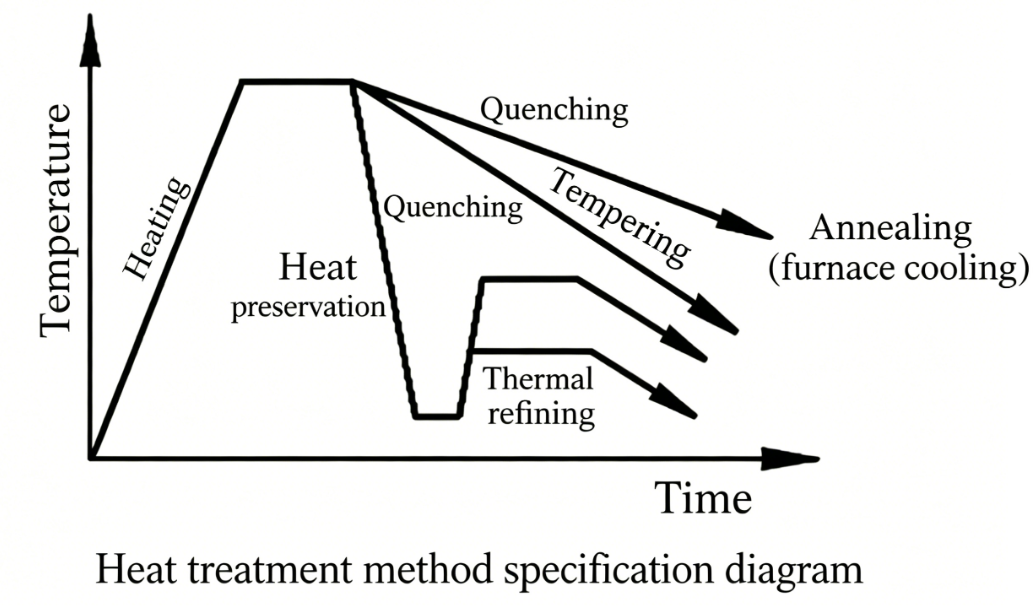
Several heat treatment methods are commonly applied to precision-turned components:
1. Annealing – Softens material for easier initial turning.
2. Quenching and Tempering – Produces high hardness and toughness.
3. Case Hardening (Carburizing/Nitriding) – Hardens only the surface while core remains ductile.
4. Stress Relieving – Removes residual stresses from heavy turning cuts.
Each process requires precise temperature control and post-treatment inspection.
When planning a production run of heat treatment parts on CNC lathes, follow these guidelines:
◆ Allow machining stock – Leave 0.2–0.5 mm on critical surfaces for post-heat treatment finishing.
◆ Use appropriate tooling – For hard turning (45–70 HRC), select CBN (cubic boron nitride) or ceramic inserts with negative rake angles.
◆ Control cutting parameters – Reduce speed and feed rates; use rigid setups to avoid chatter.
◆ Consider distortion – Design symmetrical shapes where possible; use fixtures that support parts evenly during heat treatment.
For deeper technical details, explore Precision CNC Turning Services. Industry standards are available at ASM Heat Treating Society.
Mastering CNC turning precision parts machining for heat treatment parts gives manufacturers a competitive edge. By understanding the interplay between turning operations and thermal processing, you can produce components that are both accurate and durable. Always evaluate the required hardness, distortion risks, and cost trade-offs when deciding your process sequence. With the right strategy, heat-treated precision parts will perform reliably in the most demanding applications.
1. Why is heat treatment necessary for CNC turned parts?
Heat treatment increases hardness, wear resistance, and strength, which raw materials lack. It also relieves internal stresses from machining, preventing deformation during use.
2. What is the difference between soft turning and hard turning?
Soft turning is performed on materials before heat treatment (low hardness), using standard carbide tools. Hard turning is done after heat treatment (high hardness, >45 HRC) using CBN or ceramic inserts.
3. Can all metals be heat treated after CNC turning?
No. Only ferrous metals (steels, cast iron) and some non-ferrous alloys (titanium, certain aluminum alloys) respond to heat treatment. Pure aluminum, copper, and brass typically do not harden via heat treatment.
4. How much distortion should I expect after heat treatment?
Distortion depends on part geometry, material, and heat treatment method. Typically, 0.02–0.1 mm per 100 mm length. Always add machining stock to compensate.
Add: Building 3No.277 Zhen'an Middle Road, Chang'an Town,Dongguan,Guangdong, China
Tel:+86-769-82855591
Copyright © 2019 All Rights Reserved Dongguan Start Precision Technology Co., Ltd. Tel: +86-769-82855591
Add: No. 277 Zhen'an Middle Road, Chang'an Town, Dongguan, Guangdong, China



 中文版
中文版 English